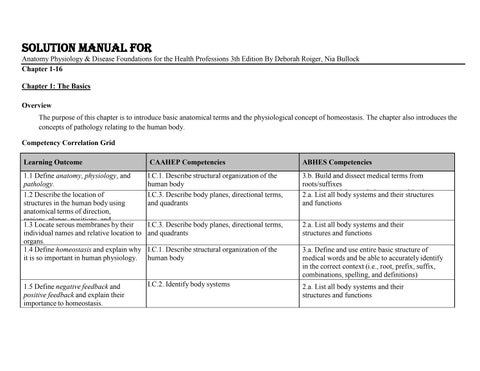
Solution Manual For Anatomy Physiology & Disease Foundations for the Health Professions 3th Edition By Deborah Roiger, Nia Bullock Chapter 1-16 Chapter 1: The Basics Overview The purpose of this chapter is to introduce basic anatomical terms and the physiological concept of homeostasis. The chapter also introduces the concepts of pathology relating to the human body. Competency Correlation Grid Learning Outcome
CAAHEP Competencies
ABHES Competencies
1.1 Define anatomy, physiology, and pathology. 1.2 Describe the location of structures in the human body using anatomical terms of direction, regions, planes, positions, and 1.3 Locate serous membranes by their cavities. individual names and relative location to organs. 1.4 Define homeostasis and explain why it is so important in human physiology.
I.C.1. Describe structural organization of the human body I.C.3. Describe body planes, directional terms, and quadrants
3.b. Build and dissect medical terms from roots/suffixes to the systems word element combinations 2.a.understand List all body and their structures and functions
I.C.3. Describe body planes, directional terms, and quadrants
2.a. List all body systems and their structures and functions
I.C.1. Describe structural organization of the human body
3.a. Define and use entire basic structure of medical words and be able to accurately identify in the correct context (i.e., root, prefix, suffix, combinations, spelling, and definitions)
1.5 Define negative feedback and positive feedback and explain their importance to homeostasis.
I.C.2. Identify body systems
2.a. List all body systems and their structures and functions
1.6 Define disease and describe the relationship between disease and homeostasis. 1.7 Define predisposing factors of disease and explain how specific predisposing factors affect disease.
I.C.9. Analyze pathology for each body system
2.b. Describe common diseases, symptoms, and etiologies as they apply to each system
I.C.9. Analyze pathology for each body system
2.b. Describe common diseases, symptoms, and etiologies as they apply to each system
Learning Outcome
CAAHEP Competencies
ABHES Competencies
1.8 Differentiate between signs and symptoms of disease and give an example of each. 1.9 Explain the function of pain and inflammation.
I.C.9. Analyze pathology for each body system
2.b. Describe common diseases, symptoms, and etiologies as they apply to each system
I.C.9. Analyze pathology for each body system
2.b. Describe common diseases, symptoms, and etiologies as they apply to each system
1.10 Explain the two classifications of disease and the subcategories of each.
I.C.9. Analyze pathology for each body system
2.b. Describe common diseases, symptoms, and etiologies as they apply to each system
1.11 Define diagnosis and list the steps involved in diagnosing diseases.
I.C.9. Analyze pathology for each body system
1.12 Define differential diagnosis and explain when it may be used.
I.C.8. Identify common pathology related to each body system
1.13 Summarize four types of treatment plans.
I.C.9.b. Analyze pathology for each body system, including treatment modalities
1.14 Define epidemiology and explain how epidemiology affects health care.
I.C.9. Analyze pathology for each body system
2.c. Identify diagnostic and treatment modalities as they relate to each body system 2.c. Identify diagnostic and treatment modalities as they relate to each body system 2.c. Identify diagnostic and treatment modalities as they relate to each body system 2.c. Identify diagnostic and treatment modalities as they relate to each body system
Summary Table 1 Learning Outcome
Lecture Outline
1.1 Define anatomy, physiology, and pathology.
1.1 Overview
1.2 Describe the location of structures in the human body using anatomical terms of direction, regions, planes, positions, and cavities.
1.2 Terms of Anatomy A. Anatomical Terms of Direction B. Anatomical Regions C. Anatomical Planes D. Anatomical Positions E. Anatomical Cavities
Activities—Talking Points
Workbook Concept Maps: Workbook Review Questions: (For answers, see below) Completion: Figure 1.12 Homeostasis concept 5 map Critical Thinking: Talking Point: Stress that all directional Spot Check: 1-2 2 terms are in reference to the patient—not to you. Stress that all terms mean the Workbook Review Questions: same thing regardless of the position the Multiple Select: 1-2 patient is in. Always think of the patient Matching: 1-5 as being in the anatomical position. Completion: 1-3 Discussion 1: IM page 10
Chapter Figures: Figure 1.1 Standard anatomical position Figure 1.2 Sagittal view of the head Figure 1.3 Chest and abdominal organs Figure 1.4 Layers of the skin Figure 1.5 Anatomical regions Figure 1.6 Abdominal quadrants and nine regions of the abdomen Figure 1.7 Anatomical planes Figure 1.8 Body cavities
Assessments
Group Activity 1: IM page 10 Workbook Coloring Book: Figure 1.1 Anatomical terms of direction Figure 1.2 Anatomical regions Figure 1.3 Anatomical planes Figure 1.4 Anatomical cavities
Learning Outcome 1.2 Continued
Lecture Outline Tables: Table 1.1 Anatomical Terms of Direction Table 1.2 Anatomical Regions Table 1.3 Anatomical Planes Table 1.4 Anatomical Positions Table 1.5 Anatomical Cavities
Activities—Talking Points Workbook Lab Exercises and Activities: Hand Figure 1.7 Hand with bones drawn on it Talking Point: Check for use of anatomical position Figure 1.8 Heart surgery Workbook Concept Maps: (For answers, see below) Figure 1.9 Anatomical terms concept map Figure 1.10 Anatomical regions concept map Figure 1.11 Anatomical cavities concept map
Assessments
Learning Outcome 1.3 Locate serous membranes by their individual names and relative location to organs.
Lecture Outline 1.2 Terms of Anatomy F. Serous Membranes Chapter Figures: Figure 1.9 Water balloon Figure 1.10 Pericardial and pleural membranes Figure 1.11 Peritoneal membrane Figure 1.12 Anterior view of the abdominopelvic organs Figure 1.13 Anterior view of omentums and mesenteries
Activities—Talking Points Assessments Talking Point: Serous membranes are Spot Check: 3-4 introduced in this chapter as they relate to cavities. They will be covered in later Suggested Activities: chapters as they relate to physiology. For Quiz 1.1, IM page 11 example, pleural membranes are explained more fully in Chapter 12 in Workbook Review Questions: relation to the mechanics of breathing. Critical Thinking: 1 Workbook Lab Exercises and Activities: Figure 1.8 Heart surgery Workbook Concept Maps: (For answers, see below) Figure 1.11 Anatomical cavities concept map