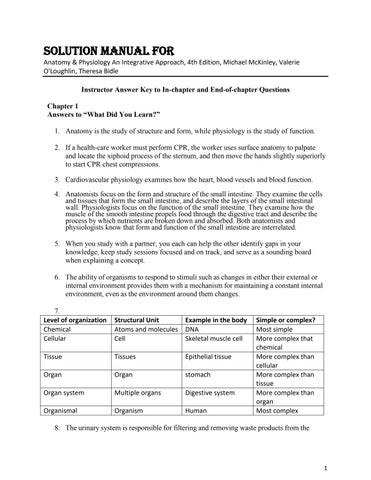
Solution Manual For Anatomy & Physiology An Integrative Approach, 4th Edition, Michael McKinley, Valerie O'Loughlin, Theresa Bidle Instructor Answer Key to In-chapter and End-of-chapter Questions Chapter 1 Answers to “What Did You Learn?” 1. Anatomy is the study of structure and form, while physiology is the study of function. 2. If a health-care worker must perform CPR, the worker uses surface anatomy to palpate and locate the xiphoid process of the sternum, and then move the hands slightly superiorly to start CPR chest compressions. 3. Cardiovascular physiology examines how the heart, blood vessels and blood function. 4. Anatomists focus on the form and structure of the small intestine. They examine the cells and tissues that form the small intestine, and describe the layers of the small intestinal wall. Physiologists focus on the function of the small intestine. They examine how the muscle of the smooth intestine propels food through the digestive tract and describe the process by which nutrients are broken down and absorbed. Both anatomists and physiologists know that form and function of the small intestine are interrelated. 5. When you study with a partner, you each can help the other identify gaps in your knowledge, keep study sessions focused and on track, and serve as a sounding board when explaining a concept. 6. The ability of organisms to respond to stimuli such as changes in either their external or internal environment provides them with a mechanism for maintaining a constant internal environment, even as the environment around them changes. 7. Level of organization Chemical Cellular
Structural Unit Atoms and molecules Cell
Example in the body DNA Skeletal muscle cell
Tissue
Tissues
Epithelial tissue
Organ
Organ
stomach
Organ system
Multiple organs
Digestive system
Organismal
Organism
Human
Simple or complex? Most simple More complex that chemical More complex than cellular More complex than tissue More complex than organ Most complex
8. The urinary system is responsible for filtering and removing waste products from the
1
blood. 9. A transverse plane, also called a horizontal or cross-sectional plane, would divide the mouth into superior and inferior sections. 10. Proximal. 11.A student‘s drawing and labeling should look similar to figure 1.7. 12.The lungs are located within the thoracic cavity. The serous membranes surrounding them consist of the parietal pleura, lining the inside of the body wall, and the visceral pleura, lining the individual lungs. 13. Epigastric 14. A homeostatic system consists of a receptor, such as a sensory neuron in the skin or a stretch receptor within a muscle, that detects either an internal or external stimulus; a control system that integrates the input from the receptor, such as the brain or an endocrine gland; and an effector, such as a muscle or a gland, that causes changes in response to the stimulus. 15. Receptors in the skin, and the hypothalamus, both act as receptors to detect changes in body temperature. (The skin receptors detect skin temperature changes, while the hypothalamus detects temperature changes in the blood). The hypothalamus also acts as the control center, as it signals the effectors to respond to bring the body temperature back to a set point. The effectors are blood vessels, skeletal muscle, and smooth muscle (when the body is trying to conserve heat), whereas the effectors are blood vessels and sweat glands (when the body is trying to release heat). 16. Negative feedback systems involve responses that are in opposition to the stimulus, thereby maintaining the environment near the set point or normal level. Conversely, positive feedback systems entail a series of responses, each increasing in intensity, until a climax event is reached, at which point the system will return to homeostasis. 17. Diabetes, an inability of the body to maintain blood sugar levels, may result in damage to anatomical structures throughout the body due to high levels of glucose. Answers to “Do You Know the Basics?” 1. B
Feedback: Surface anatomy correlates superficial markings on the surface of the body and skin to deeper anatomical features. 2. C
Feedback: Organs are often composed of several tissue types working in concert to perform a common function. 3. A
Feedback: An organism‘s metabolism is the sum of all of its biochemical reactions.
2
4. C
Feedback: A midsagittal or median plane separates the body into equal right and left halves as compared to simply a sagittal section, which separates the body into unequal right and left portions. There can be numerous sagittal planes but only one possible midsagittal section along the midline of the body. 5. D
Feedback: The term proximal is used to describe the position of a structure on an appendage closest to the point of attachment to the trunk. Although in standard anatomical position a structure that is proximal is often also superior, proximal is the correct term for describing the position along an appendage. The term superior may be used to describe positions along the axis of the body, closer to the head. 6. A
Feedback: The patellar region is the anterior portion of the knee. The popliteal region is the posterior portion of the knee. 7. A
Feedback: The diaphragm comprises the barrier between the superior thoracic cavity and the inferior abdominal cavity. The pelvic cavity is located inferior to the superior edges of the pelvic bones. 8. D
Feedback: The pleural cavity surrounding the lungs consists of the parietal pleura, lining the internal walls of the thoracic cavity, and the visceral pleura, lining the surface of the lungs. 9. B
Feedback: Homeostasis is an automated process for maintaining a constant internal environment. 10. D
Feedback: The effector increasing the stimulus is an example of positive feedback. In a negative feedback system, the response moves the system in opposition to the stimulus, back toward the set point. 11. Anatomy is the study of structure and form, whereas physiology is the study of how the
structures function. It is important to understand the anatomy of a structure in order to understand how it performs its function. Conversely, understanding the function of an anatomical feature helps to put into perspective the significance of its arrangement. 12. The simplest level of organization within an organism is found at the chemical level and is
composed of atoms and molecules. At the cellular level of organization, molecules are organized into cells and subcellular components, forming the basic units of life. Groupings of similar cells performing similar functions are referred to as tissues, and groups of tissues may be found working in concert, forming organs at the organ level of organization. Related groups of organs working together in order to coordinate activities within the organism are called organ systems. 13. A hierarchical organization, metabolism, growth and development, responsiveness,
regulation, and reproduction are characteristics common to all living organisms. All living things are arranged in a hierarchical manner with increasing levels of complexity from molecules to cells. They are capable of metabolism, growth and development, and
3
responsiveness to stimuli. They are also able to regulate their internal environment in order to maintain homeostasis, ultimately surviving long enough to reproduce. 14. The human body consists of eleven organ systems. They are the integumentary,
skeletal, muscular, nervous, endocrine, cardiovascular, lymphatic, respiratory, urinary, digestive, and reproductive systems. 15. A body in anatomical position is standing upright with the feet flat on the floor. The upper limbs are at the side of the body with palms facing anteriorly. The head is level and the eyes are looking forward. The anatomic position is the point of common reference used by anatomists and physiologists for accuracy and clarity. It provides an initial point of reference, from which all anatomic parts are described. 16. The forearm is the antebrachial region, the wrist is the carpal region, the chest is the
thoracic region, the armpit is the axillary region, the thigh is the femoral region, and the entire foot is the pes. 17. The cranial cavity and vertebral canal are located within the posterior aspect of the body.
The cranial cavity houses the brain and the vertebral canal contains the spinal cord. 18. The serous membranes are found lining the compartments of the ventral cavity of the body.
They consist of a parietal layer lining the inside of the body wall and a visceral layer covering internal organs. In between the two membranes is a potential space, the serous cavity, which contains serous fluid. 19. A homeostatic system consists of a receptor that detects an internal or external stimulus, a
control system that integrates the input from the receptor, and an effector, such as a muscle or a gland, that causes changes in response to the stimulus. 20. Negative feedback systems involve responses that are in opposition to the stimulus, thereby
maintaining the environment near the set point or normal level. Conversely, positive feedback systems entail a series of responses, each increasing in intensity until a climax event is reached, at which point the system will return to homeostasis. Answers to “Can You Apply What You’ve Learned?” 1. B
Feedback: The pain is coming from a region below the umbilicus, hence it is in the lower portion of the abdomen and it is located on the right side. It is therefore in the right lower quadrant. 2. D
Feedback: The right iliac region is located just medial to the pelvic bones. 3. B
Feedback: X-rays are not absorbed by soft tissue such as the appendix. They are usually used to visualize dense structures. 4. B
Feedback: Sweat glands release sweat at the surface of the skin.
4
5. B
Feedback: Serotonin is a neurotransmitter responsible for regulating both pathways associated with depression in the brain and gastric motility in the stomach. Drugs such as SSRIs are used to treat depression in individuals with low levels of serotonin in the brain by inhibiting its reuptake by neurons. Because the SSRI drugs cannot specifically target the brain, they also have an effect within the digestive system, causing nausea and diarrhea. Answers to “Can You Synthesize What You’ve Learned?” 1. Lynn has broken the bones within her forearm, the radius and ulna. She has an abrasion
on her chin as well as bruising on her buttocks and thigh. 2. The epinephrine counteracted the effect of the bee sting, acting in opposition to the
stimulus; it was therefore an example of negative feedback. 3. X-rays and CT scans are optimal for visualizing dense tissues, such as tumors. An MRI
or ultrasound would be better suited for examining soft tissues.
Chapter 2 Answers to “What Did You Learn?” 1. The mass of an atom is determined by the combined number of protons and neutrons within its
nucleus. The charge of an atom is determined by the number of positively charged protons and negatively charged electrons. 2. The nucleus of a chlorine atom consists of 17 protons and 18 neutrons. The electrons are
arranged into three separate shells; the first shell closest to the nucleus contains two electrons, the second shell contains eight electrons, and the third outer shell contains seven electrons, for a
5