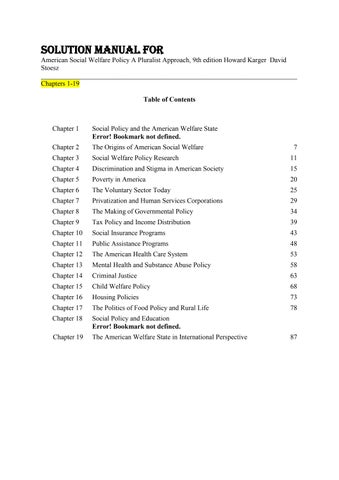
Solution Manual For American Social Welfare Policy A Pluralist Approach, 9th edition Howard Karger David Stoesz ___________________________________________________________________________ Chapters 1-19 Table of Contents
Chapter 1
Social Policy and the American Welfare State Error! Bookmark not defined.
Chapter 2
The Origins of American Social Welfare
7
Chapter 3
Social Welfare Policy Research
11
Chapter 4
Discrimination and Stigma in American Society
15
Chapter 5
Poverty in America
20
Chapter 6
The Voluntary Sector Today
25
Chapter 7
Privatization and Human Services Corporations
29
Chapter 8
The Making of Governmental Policy
34
Chapter 9
Tax Policy and Income Distribution
39
Chapter 10
Social Insurance Programs
43
Chapter 11
Public Assistance Programs
48
Chapter 12
The American Health Care System
53
Chapter 13
Mental Health and Substance Abuse Policy
58
Chapter 14
Criminal Justice
63
Chapter 15
Child Welfare Policy
68
Chapter 16
Housing Policies
73
Chapter 17
The Politics of Food Policy and Rural Life
78
Chapter 18
Social Policy and Education Error! Bookmark not defined.
Chapter 19
The American Welfare State in International Perspective
87
Chapter 1: Social Policy and the American Welfare State
CHAPTER SUMMARY Social welfare policy is arguably best viewed through the lens of political economy (i.e., the interaction of economic, political, and ideological forces). This chapter provides an overview of the American welfare state through that lens. In particular, it examines various definitions of social welfare policy, the relationship between social policy and social problems, and the values and ideologies that drive social welfare in the United States. In addition, the chapter examines the effects of ideology on the U.S. welfare state, including the import-ant roles played by conservatism and liberalism (and their variations) in shaping welfare policy. An understanding of social welfare policy requires the ability to grasp the economic justifications and consequences that underlie policy decisions. As such, this chapter contains a brief introduction to Keynesianism, free market economics, socialism, and communitarianism, among others. STUDENT LEARNING OBJECTIVES
Students will define social welfare policy, and identify how it drives social work practice. Students will understand how the redistributive role of social welfare policy may contribute to the maintenance and survival of our society. Students will understand the distinctive values and economic perspectives associated with Keynesianism, free market economics, and democratic socialism. Students will understand the political continuum from liberalism to libertarianism with an emphasis on the distinctive values and economic assertions of each. Students will understand some of the major systemic and personal implications for the current conservatism resurgence in America. Students will examine the growth of fringe groups in the United States.
TEACHING TIPS
It is important to create a comfortable, safe space for students to be able to discuss political perspectives. The instructor should lead the class in a discussion of how to participate in civil discourse in the classroom, and encourage students to develop a set of class expectations for mutual regard and respect. Begin by exploring the term ―policy.‖ Ask student about the policies they follow in their personal lives, at work, or in any agencies they encounter in their daily lives. Challenge students to provide support for their opinions shared in class, and to develop skills in providing convincing and compelling arguments that are substantiated. Identify the swinging pendulum of how the United States has moved from liberal to conservative approaches historically in addressing social issues. Bring up a number of controversial topics such as immigration, reproductive health care services, voting access, and other similar challenges. Ask your students to explore how a libertarian, a liberal, or a conservative may solve each one.
LECTURE GUIDE AND ASSET CORRELATION The below lecture guide and asset correlation indicates where discussion prompts, assignments, activities or online activities connect to a given topic. The full descriptions of these prompts and assignments follow the below guide.
Discussion Prompts Throughout this chapter, various discussion prompts have been provided for in-class use. These prompts are developed to assist you in starting open conversation with students about key topics of the chapter. Assignments and Activities These assignments and activities can be used in place of or in supplement of the online activities available for students. Key Terms Each chapter provides a list of key terms or concepts that students should know. Chapter Outline I.
Definitions of Social Welfare Policy (Discussion Prompt 1)
II.
Social Problems and Social Welfare Policy (Discussion Prompt 2 and Out-of-Class Assignment 1)
III.
Social Work and Social Policy (In-Class Activity 4)
IV.
Values, Ideology, and Social Welfare Policy (Discussion Prompt 3)
V.
The Political Economy of American Social Welfare (Out-of-Class Assignment 4)
VI.
The U.S. Economic Continuum (Discussion Prompt 4)
VII.
Keynesian Economics (In-Class Activity 3)
VIII.
Conservative or Free Market economics
IX.
Democratic Socialism
X.
The U.S. Political Continuum (In-Class Activities 1 and 2)
XI.
Liberalism and Left-of-Center Movements (Out-of-Class Assignment 2) a. Liberalism b. Neoliberalism c. Self-Reliance School
XII.
Classical Conservatives and the Far Right (Out-of-Class Assignment 3) a. Classic conservatism b. Neoconservatism c. Cultural and Social Conservatism d. Libertarianism
XIII.
The Growth of Fringe Groups (Discussion Prompt 5)
XIV.
The Welfare Philosophers and Neoconservative Think Tanks
XV.
Conclusion
KEY TERMS 1. Capitalism 2. Case management
3. Democratic capitalism 4. Democratic socialism 5. Governmental sector 6. Gross domestic product (G D P) 7. Human capital 8. Ideology 9. In-kind benefits 10. Keynesian economics 11. Mixed welfare economy 12. Neoliberalism 13. Political economy 14. Public choice school 15. Self-reliance school 16. Social services 17. Social justice 18. Social policy 19. Social welfare policy 20. Socialism 21. Supply-side economics 22. Temporary Assistance for Needy Families (T A N F) 23. Think tanks 24. Welfare state DISCUSSION PROMPTS 1. Since social welfare is a mechanism for redistributing resources from those in a society who have assets to those who do not, under what conditions do you think that social welfare is justifiable. Identify categories of people that you believe society should assist and categories of people that society should not assist. How do these groups of people differ? How are they alike? 2. What are the strengths and the weaknesses of the mixed welfare economy of the United States? Government agencies, for-profit corporations, and not-for-profit corporations all provide some social services. Identify the strengths and weaknesses of each with attention to the primary sources of revenue, potential for innovation, and capacity to respond to changing social problems. 3. What is the political ideology of one of your favorite family members? Describe how that person feels about a free market economy. Does your family member tend to believe that government is the solution or the problem? What does your family member think causes poverty? Would they prefer that people who are economically disadvantaged solve their own problems, or that our society give people a little more help? Where do you think your family member sit on the U. S. political continuum?
4. What are the advantages to a free market economy in comparison to an economy in which the government is more active? Unrestrained capitalism tends to increase economic disparities between rich and poor, but may offer more opportunity for some to succeed. Which is more important, opportunity or equality? Why? 5. As your text identifies, the United States has seen an increase in the presence of fringe groups both in social media and real, day-to-day experiences for people. Why do you think this has happened? Do you see these groups having an impact on your life and world? Why or why not? IN-CLASS ACTIVITIES 1. The Politics of the President. Divide students into teams of 3–4 students and have them recreate the U. S. Political Continuum (pp. 12–18) with seven columns from Liberalism to Libertarianism. Teams should brainstorm at least 10 different policy proposals advanced during the current President‘s administration and locate them within the appropriate column to identify the political orientation of the President. Share answers in class after teams are finished. 2. Examining the Political Spectrum. Chapter 1 introduces social welfare policy, and examines both economic and political continuums. Educations are able to create a group quiz by scrolling down the page at the Pew Research Center ―Political Typology Quiz.‖ Once created, students can compare their own place on the continuum with their peers in the class. Ask students to examine their results, and be prepared to participate in a class discussion about those results, and the sources of their political ideologies. Link: https://www.pewresearch.org/politics/quiz/political-typology/ 3. Liberal vs. Conservative Economic Views of Social Welfare. Watch the YouTube video for an entertaining contrast of Keynes‘ and Hayek‘s viewpoints titled ―Fear the Boom and Bust: Keynes vs. Hayek Rap Battle.‖ Use the video to illustrate and discuss these different perspectives. Link: https://youtu.be/d0nERTFo-Sk 4. Social Work and Policy. Take a look at the website of the National Association of Social Workers, and read through some of the advocacy and legislative issues links. Where would you place the N A S W along the U.S. political continuum? How do your own values and beliefs about policy issues put you in line with social work as a profession, and where do they deviate? Link: https://www.socialworkers.org/Advocacy OUT-OF-CLASS ASSIGNMENTS 1. Self-Reflection Exercise. Students write a one-page paper in class with the following prompt, ―I believe that social welfare programs in the United States should be expanded (or restricted) because . . . .‖ On the back of the page, students should identify at least five groups of people that will benefit from the implementation of this proposal and at least five groups who will be penalized from the implementation of this proposal. 2. The Politics of the Republican or Democratic Party. Students should access the website for the Republican Party or the Democratic Party. Have them review the materials available at the website. Compare the assigned party‘s positions on contemporary issues to the Liberal to Libertarian political continuum discussed in the text and write a 2–3-page paper identifying the political ideology or ideologies of the assigned party. 3. Media and Political Ideology. Watch at least one hour on one of the cable news channels that you do not regularly watch (e.g., Fox News Channel, M S N B C, C N B C,