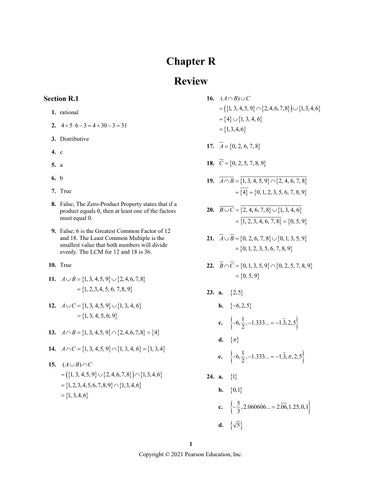
Chapter R Review Section R.1
16.
( A B) C 1, 3, 4,5, 9 2, 4, 6, 7,8 1,3, 4, 6
1. rational
4 1, 3, 4, 6
2. 4 5 6 3 4 30 3 31
1,3, 4, 6
3. Distributive
17. A 0, 2, 6, 7, 8
4. c 5. a
18. C 0, 2, 5, 7, 8, 9
6. b
19. A B 1, 3, 4, 5, 9 2, 4, 6, 7, 8 4 0, 1, 2, 3, 5, 6, 7, 8, 9
7. True 8. False; The Zero-Product Property states that if a product equals 0, then at least one of the factors must equal 0.
20. B C 2, 4, 6, 7, 8 1, 3, 4, 6 1, 2, 3, 4, 6, 7, 8 0, 5, 9
9. False; 6 is the Greatest Common Factor of 12 and 18. The Least Common Multiple is the smallest value that both numbers will divide evenly. The LCM for 12 and 18 is 36.
21. A B 0, 2, 6, 7, 8 0, 1, 3, 5, 9 0, 1, 2, 3, 5, 6, 7, 8, 9
22. B C 0, 1, 3, 5, 9 0, 2, 5, 7, 8, 9
10. True
0, 5, 9
11. A B 1, 3, 4,5, 9 2, 4, 6, 7,8
1, 2,3, 4, 5, 6, 7,8, 9
23. a.
12. A C 1, 3, 4,5, 9 1, 3, 4, 6 1, 3, 4, 5, 6, 9
13. A B 1, 3, 4,5, 9 2, 4, 6, 7,8 4
b.
6, 2,5
c.
d.
e.
14. A C 1, 3, 4,5, 9 1, 3, 4, 6 1, 3, 4 15.
( A B) C 1, 3, 4,5, 9 2, 4, 6, 7,8 1,3, 4, 6
24. a.
1, 2,3, 4,5, 6, 7,8,9 1,3, 4, 6 1, 3, 4, 6
2,5
1 6, , 1.333... 1.3, 2,5 2
1 6, , 1.333... 1.3, , 2,5 2
1
b.
0,1
c.
d.
5
5 , 2.060606... 2.06,1.25, 0,1 3
1 Copyright © 2021 Pearson Education, Inc.
Chapter R: Review
e. 25. a.
5 , 2.060606... 2.06,1.25, 0,1, 5 3
1
b.
0,1
c.
1 1 1 0,1, , , 2 3 4
d. None e.
1 1 1 0,1, , , 2 3 4
None
b.
1
c.
1.3, 1.2, 1.1, 1
d. e. 28. a.
c.
9.999
b.
9.998
36. a.
1.001
b.
1.000
37. a.
0.429
b.
0.428
38. a.
0.556
b.
0.555
39. a.
34.733
b.
34.733
40. a.
16.200
b.
16.200
45. 3 y 1 2 46. 2 x 4 6
None
47. x 2 6
None
48. 2 y 6
1 2, , 2 1, 2 2, , 2 1,
1 2
None
35. a.
44. 3 y 2 2
1.3, 1.2, 1.1, 1
b. None
0.053
43. x 2 3 4
b. None c.
b.
42. 5 2 10
d. None
27. a.
0.054
41. 3 2 5
26. a.
e.
34. a.
49.
x 6 2
50.
2 6 x
51. 9 4 2 5 2 7
52. 6 4 3 2 3 5
1 10.3 2
d.
2, 2
e.
53. 6 4 3 6 12 6 54. 8 4 2 8 8 0
1 2, 2, 10.3 2
55. 18 5 2 18 10 8
29. a.
18.953
b.
18.952
30. a.
25.861
b.
25.861
31. a.
28.653
b.
28.653
32. a.
99.052
b.
99.052
33. a.
0.063
b.
0.062
56. 100 10 2 100 20 80 57. 4
1 12 1 13 3 3 3
58. 2
1 4 1 3 2 2 2
2
Copyright © 2021 Pearson Education, Inc.
Section R.1: Real Numbers 59. 6 3 5 2 3 2 6 15 2 1 6 17 11 60. 2 8 3 4 2 3 2 8 3 6 3 2 8 18 3 2 10 3
70.
5 3 53 53 1 9 10 3 3 5 2 3 3 5 2 6
71.
6 10 2 3 5 2 2 3 5 2 4 25 27 5 5 3 9 5 5 3 9 45
72.
21 100 3 7 4 25 3 7 4 25 28 25 3 25 3 25 3
73.
3 2 15 8 23 4 5 20 20
74.
4 1 8 3 11 3 2 6 6
75.
7 4 49 32 81 8 7 56 56
76.
8 15 16 135 151 9 2 18 18
77.
5 1 10 3 13 18 12 36 36
78.
2 8 6 40 46 15 9 45 45
79.
5 8 25 64 39 13 24 15 120 120 40
80.
3 2 94 5 14 21 42 42
81.
3 2 98 1 20 15 60 60
82.
6 3 12 15 3 35 14 70 70
20 3 23
61. 4 9 5 6 7 3 4 14 42 3 56 42 3 14 3 17
62. 1 4 3 2 2 1 12 2 2 1 12 11
63. 10 6 2 2 8 3 2 10 6 4 5 2 10 2 5 2 10 7 2 10 14 4
64. 2 5 4 6 3 4 2 20 6 1 18 6 18 6 12
65.
1
1
5 3 2 2 2 1
66.
5 4 13 9 13 3
67.
4 8 12 6 53 2
68.
2 4 2 1 53 2
69.
3 10 3 2 5 3 2 5 2 5 21 5 3 7 5 3 7 7
5 18 5 27 5 9 3 5 9 3 15 83. 11 18 11 9 2 11 9 2 11 22 27 5 21 5 35 5 7 5 5 7 5 25 84. 2 21 2 7 3 2 7 3 2 6 35
3 Copyright © 2021 Pearson Education, Inc.
Chapter R: Review
85.
86.
1 4 17 4 17 21 1 3 7 21 21 21 21
98.
3x 1 x 5 3x 2 15 x x 5 3 x 2 14 x 5
2 4 1 2 22 2 2 2 2 2 3 5 6 3 5 3 2 3 5 3 2 3 15 2 5 2 10 2 10 2 12 3 5 15 15 15 15 15 43 4 3 4 53 5 3 5
99.
x 8 x 2 x 2 2 x 8 x 16 x 2 10 x 16
100.
x 4 x 2 x 2 2 x 4 x 8 x2 6 x 8
101. 3x( x 5k ) 3x 2 60 x
3 3 2 3 3 6 3 6 2 3 87. 2 4 8 1 4 8 4 8 4 2 8 12 3 12 3 15 8 8 8 8
3x 2 15 xk 3x 2 60 x 15 xk 60 x k 4
5 1 3 5 1 35 1 3 5 1 88. 3 6 2 1 6 2 3 2 2 3 2 2 5 1 5 1 4 2 2 2 2 2
102.
( x k )( x 3k ) x 2 4 x 12 x 2 3kx kx 3k 2 x 2 4 x 12 x 2 x(3k k ) 3k 2 x 2 4 x 12 x 2 x(3k k ) 3k 2 x 2 4 x 12
89. 6 x 4 6 x 24
x 2 x(2k ) 3k 2 x 2 4 x 12 2k 4
90. 4 2 x 1 8 x 4
k 2
91. x x 4 x 4 x 2
103. 2 x 3 x 2 x 3 x 2 3 x
92. 4 x x 3 4 x 2 12 x
5 x 5x
1 3 1 2 3x 2 3 93. 2 x 2 x 2 4 2 4 2 22 2 2 3x 2 3 x 1 2 2 2 2
104. 2 3 4 2 12 14 since multiplication comes before addition in the order of operations for real numbers.
2 3 4 5 4 20
1 2 1 3 2x 3 2 94. 3 x 3 x 3 3 6 3 6 3 3 2 3 2x 3 1 2x 3 3 2 2
95.
since operations inside parentheses come before multiplication in the order of operations for real numbers. 105. 2 3 4 2 12 24
x 2 x 4 x 2 4 x 2 x 8
2 3 2 4 6 8 48
2
x 6x 8
96.
106.
x 5 x 1 x 2 x 5 x 5 x2 6 x 5
97.
x 9 2 x 7 2 x 2 7 x 18 x 63
43 7 1 , but 25 7 4 3 4 5 3 2 20 6 26 13 2.6 2 5 10 10 10 5
107. Subtraction is not commutative; for example: 2 3 1 1 3 2 .
2 x 2 11x 63
4
Copyright © 2021 Pearson Education, Inc.
Section R.2: Algebra Essentials 108. Subtraction is not associative; for example: 5 2 1 2 4 5 2 1 . 109. Division is not commutative; for example: 2 3 . 3 2 110. Division is not associative; for example: 12 2 2 6 2 3 , but 12 2 2 12 1 12 .
111. The Symmetric Property implies that if 2 = x, then x = 2. 112. From the principle of substitution, if x 5 , then x x 5 5 x 2 25
Section R.2 1. variable 2. origin 3. strict 4. base; exponent (or power) 5. 1.2345678 103 6. d 7. a 8. b 9. True 10. False; the absolute value of a real number is nonnegative. 0 0 which is not a positive
x 2 x 25 5 2
x x 30
number.
113. There are no real numbers that are both rational and irrational, since an irrational number, by definition, is a number that cannot be expressed as the ratio of two integers; that is, not a rational number
Every real number is either a rational number or an irrational number, since the decimal form of a real number either involves an infinitely repeating pattern of digits or an infinite, nonrepeating string of digits. 114. The sum of an irrational number and a rational number must be irrational. Otherwise, the irrational number would then be the difference of two rational numbers, and therefore would have to be rational.
11. False; a number in scientific notation is expressed as the product of a number, x, 1 x 10 or 10 x 1 , and a power of 10. 12. True 13.
14.
116. Since 1 day = 24 hours, we compute 12997 541.5416 . 24 Now we only need to consider the decimal part of the answer in terms of a 24 hour day. That is,
0.5416 24 13 hours. So it must be 13 hours
later than 12 noon, which makes the time 1 AM CST.
15.
1 0 2
16. 5 6 17. 1 2 18. 3
5 2
19. 3.14
117. Answers will vary. 20.
3 4
1 3
115. Answers will vary.
2 1.41
5 Copyright © 2021 Pearson Education, Inc.
5 2
2 3 3 2