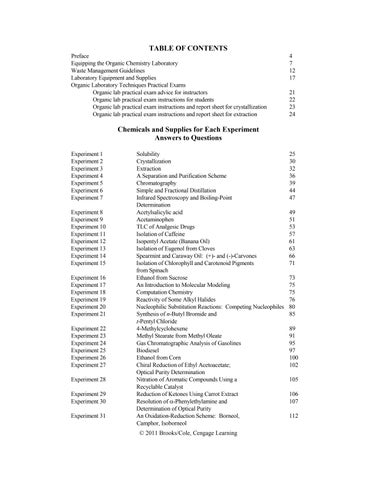
TABLE OF CONTENTS Preface Equipping the Organic Chemistry Laboratory Waste Management Guidelines Laboratory Equipment and Supplies Organic Laboratory Techniques Practical Exams Organic lab practical exam advice for instructors Organic lab practical exam instructions for students Organic lab practical exam instructions and report sheet for crystallization Organic lab practical exam instructions and report sheet for extraction
4 7 12 17 21 22 23 24
Chemicals and Supplies for Each Experiment Answers to Questions Experiment 1 Experiment 2 Experiment 3 Experiment 4 Experiment 5 Experiment 6 Experiment 7 Experiment 8 Experiment 9 Experiment 10 Experiment 11 Experiment 12 Experiment 13 Experiment 14 Experiment 15 Experiment 16 Experiment 17 Experiment 18 Experiment 19 Experiment 20 Experiment 21 Experiment 22 Experiment 23 Experiment 24 Experiment 25 Experiment 26 Experiment 27 Experiment 28 Experiment 29 Experiment 30 Experiment 31
Solubility Crystallization Extraction A Separation and Purification Scheme Chromatography Simple and Fractional Distillation Infrared Spectroscopy and Boiling-Point Determination Acetylsalicylic acid Acetaminophen TLC of Analgesic Drugs Isolation of Caffeine Isopentyl Acetate (Banana Oil) Isolation of Eugenol from Cloves Spearmint and Caraway Oil: (+)- and (-)-Carvones Isolation of Chlorophyll and Carotenoid Pigments from Spinach Ethanol from Sucrose An Introduction to Molecular Modeling Computation Chemistry Reactivity of Some Alkyl Halides Nucleophilic Substitution Reactions: Competing Nucleophiles Synthesis of n-Butyl Bromide and t-Pentyl Chloride 4-Methylcyclohexene Methyl Stearate from Methyl Oleate Gas Chromatographic Analysis of Gasolines Biodiesel Ethanol from Corn Chiral Reduction of Ethyl Acetoacetate; Optical Purity Determination Nitration of Aromatic Compounds Using a Recyclable Catalyst Reduction of Ketones Using Carrot Extract Resolution of α-Phenylethylamine and Determination of Optical Purity An Oxidation-Reduction Scheme: Borneol, Camphor, Isoborneol © 2011 Brooks/Cole, Cengage Learning
25 30 32 36 39 44 47 49 51 53 57 61 63 66 71 73 75 75 76 80 85 89 91 95 97 100 102 105 106 107 112
Experiment 32 Experiment 33 Experiment 34 Experiment 35 Experiment 36 Experiment 37 Experiment 38 139 Experiment 39 Experiment 40 Experiment 41 Experiment 42 Experiment 43 Experiment 44 Experiment 45 Experiment 46 Experiment 47 Experiment 48 Experiment 49 Experiment 50 Experiment 51 Experiment 52 Experiment 53 Experiment 54 Experiment 55 Experiment 56 Experiment 57 Experiment 58 Experiment 59 Experiment 60 Experiment 61 Experiment 62 Experiment 63 Experiment 64 Experiment 65 Experiment 66
Multistep ReactionSequence: The Conversion of Benzaldehyde to Benzilic Acid Triphenylmethanol and Benzoic Acid Aqueous-Based Organozinc Reactions Sonogashira coupling of Iodoaromatic Compounds with Alkynes Grubbs-Catalyzed Metathesis of Eugenol with cis1,4-Butenediol The Aldol Condensation: Preparation of Benzalacetophenones (Chalcones) A Green Enantioselective Aldol Condensation Reaction Preparation of an α,β-Unsaturated Ketone via Michael and Aldol Condensation Reactions Preparation of Triphenylpyridines 1,4-Diphenyl-1,3-Butadiene Relative Reactivities of Several Aromatic Compounds Nitration of Methyl Benzoate Benzocaine N,N-Diethyl-m-Toluamide: The Insect Repellent “OFF” Sulfa Drugs: Preparation of Sulfanilamide Preparation and Properties of Polymers: Polyester, Nylon,and Polystyrene Ring-opening Metathesis Polymerization using a Grubbs Catalyst The Diels-Alder Reaction of Cyclopentadiene with Maleic Anhydride Diels-Alder Reaction with Anthracene-9-methanol Photoreduction of Benzophenone and Rearangement of Benzpinacol to Benzopinacolone Luminol Carbohydrates Analysis of a Diet Soft Drink by HPLC Identification of Unknowns Preparation of a C-4 or C-5 Acetate Ester Isolation of Essential Oils from Allspice, Cloves Cumin, Caraway, Cinnamon, Fennel or Star Anise Competing Nucleophiles in S N 1 and S N 2 Reactions: Investigations Using 2-Pentanol and 3-Pentanol Friedel-Crafts Acylation The Analysis of Antihistamine Drugs by Gas Chromatography-Mass Spectrometry Carbonation of an Unknown Aromatic Halide The Aldehyde Enigma Synthesis of Substituted Chalcones: A GuidedInquiry Experience Green Epoxidation of Chalcones Cycloporopanatin of Chalcones Michael and Aldol Condensation Reactions
2 © 2011 Brooks/Cole, Cengage Learning
116 122 128 131 135 137
141 142 143 146 148 150 155 156 165 169 173 174 175 179 180 190 191 205 207 210 213 225 226 229 230 234 235 237
Experiment 67 Experiment 68
Esterification Reactions of Vanillin: The Use of NMR to Determine a Structure An Oxidation Puzzle
239 240
Answers to Problems in the Techniques Section Technique 1 Technique 2 Technique 3 Technique 4 Technique 5 243 Technique 6 Technique 7 Technique 8 247 Technique 9 Technique 10 Technique 11 Technique 12 Technique 13 Technique 14 Technique 15 Technique 16 Technique 17 Technique 18 Technique 19 Technique 20 Technique 21 Technique 22 Technique 23 Technique 24 Technique 25 Technique 26 Technique 27 Technique 28 Technique 29
Laboratory Safety The Laboratory Notebook, Calculations, and Laboratory Records Laboratory Glassware: Care and Cleaning How to Find Data for Compounds: Handbooks And catalogs Measurement of Volume and Weight
241 241 241 242
Heating and Cooling Methods Reaction Methods Filtration
244 245
Physical Constants of Solids: The Melting Point Solubility Crystallization: Purification of Solids Extractions, Separations, and Drying Agents Physical Constants of Liquids: The Boiling Point and Density Simple Distillation Fractional Distillation, Azeotropes Vacuum Distillation, Manometers Sublimation Steam Distillation Column Chromatography Thin-Layer Chromatography High-Performance Liquid Chromatography (HPLC) Gas Chromatography Polarimetry Refractometry Infrared Spectroscopy Nuclear Magnetic Resonance Spectroscopy Carbon-13 Nuclear Magnetic Resonance Spectroscopy Mass Spectrometry Guide to the Chemical Literature
248 248 249 252 255
Correlation of Experiments with Lecture Topics
256 257 260 260 261 262 264 265 266 267 268 269 270 271 271 271 273
3 © 2011 Brooks/Cole, Cengage Learning
PREFACE Introduction to Organic Laboratory Techniques: A Small Scale Approach (Third Edition) continues our dedication to the teaching of the organic chemistry laboratory. As we have gathered experience with microscale techniques in the organic laboratory through the development of experiments and methods for the microscale versions of our textbook, we have discovered that students can learn to do careful work in the organic laboratory on a small scale. They do not have to consume large quantities of chemicals, and they do not have to work with very large flasks to learn the standard laboratory techniques. Furthermore, we recognize that many instructors do not wish to abandon the traditional-scale approach to their courses, and many colleges and universities cannot afford to convert all of their glassware to microscale. In the traditional approach to teaching this subject, the quantities of chemicals used were on the order of 5-100 grams. The approach used in this textbook differs from the traditional laboratory in that nearly all of the experiments use smaller amounts of chemicals (1-10 grams). However, the glassware and methods used in this approach are identical to the glassware and methods used in traditional-scale experiments. The advantages of the small-scale approach include improved safety in the laboratory, reduced risk of fire and explosion, and reduced exposure to hazardous vapors. This approach decreases the need for hazardous waste disposal, leading to reduced contamination of the environment. In this edition we have devoted considerable effort toward improving the safety of all of the experiments. Technique Chapter 1, “Laboratory Safety,” places strong emphasis on the safe use and disposal of hazardous chemicals. We have included information on Material Safety Data Sheets (MSDS) and Right-to-Know laws. We have continued to update and improve instructions for the handling of waste products that are produced in the experiments. We recommend that virtually all waste, including aqueous solutions, be placed into appropriate waste containers. The new experiments are listed in the Preface of the Textbook. These include several “green” chemistry experiments and some project-based experiments. In the latter experiments, students must either solve a significant problem or they must generate all of part of the experimental procedure. A Green Chemistry essay has been added and some of the experiments have been modified to make them more “green.” We have significantly increased the number of unknowns listed in Appendix 1. We also offer an alternative way of solving unknowns using mainly spectroscopy.
4 © 2011 Brooks/Cole, Cengage Learning
We hope that this instructor's manual will assist you in preparing solutions, chemical reagents, supplies, and equipment necessary for each experiment that you choose to do. The lists of chemicals and equipment required for each experiment are based on the amount required for ten students. For chemicals, the amounts indicated include at least a 25% excess. At the end of the manual we have included a section that correlates the experiments with topics presented in standard organic lecture courses. The time required for each experiment is given in laboratory periods. It is assumed that a laboratory period is about three hours in length. For laboratory periods that are either shorter or longer, appropriate adjustments must be made. The technique chapters of the textbook are designed to stand independently from the experiments. You may have a favorite experiment that you like to do in your course. If this is the case, you can freely add your experiment and still take advantage of the technique chapters in the textbook. Since both standard-scale and microscale techniques are described in the technique chapters, you may even add some microscale experiments and still be able to refer your students to the appropriate sections in these chapters for information on each technique. The publishers have made available videos to accompany the Textbook. These videos can be studied by students in advance of the laboratory session. They show the various steps for assembling an apparatus and carrying out a technique. See the Preface to the Textbook for more information. Students may purchase access to the website: www.cengagebrain.com A new feature of the Instructor’s Manual is the inclusion of some laboratory practical exams that test students on two basic organic laboratory techniques: crystallization and extraction. You may find these exams to be a useful way of evaluating student technique. The idea is to have students perform techniques without the textbook and without looking over another student’s shoulder for help! If you encounter problems with any of the experiments in the Textbook or if you need help in setting up your laboratory, please contact us. We would also like to hear from you if you have any suggestions for improvements in techniques or in any of the experiments. Donald L. Pavia
E-Mail: pavia@chem.wwu.edu
Gary M. Lampman
E-Mail: lampman@chem.wwu.edu
George S. Kriz
E-Mail: George.Kriz@chem.wwu.edu 5 © 2011 Brooks/Cole, Cengage Learning