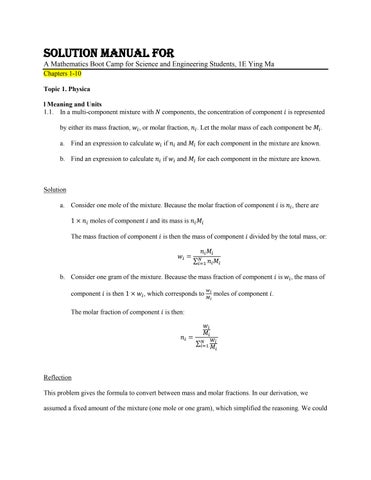
Solution Manual For A Mathematics Boot Camp for Science and Engineering Students, 1E Ying Ma Chapters 1-10 Topic 1. Physica l Meaning and Units 1.1. In a multi-component mixture with by either its mass fraction,
components, the concentration of component is represented
, or molar fraction,
. Let the molar mass of each component be
.
a. Find an expression to calculate
if
and
for each component in the mixture are known.
b. Find an expression to calculate
if
and
for each component in the mixture are known.
Solution a. Consider one mole of the mixture. Because the molar fraction of component is
, there are
moles of component and its mass is The mass fraction of component is then the mass of component divided by the total mass, or:
∑ b. Consider one gram of the mixture. Because the mass fraction of component is component is then
, which corresponds to
, the mass of
moles of component .
The molar fraction of component is then:
∑
Reflection This problem gives the formula to convert between mass and molar fractions. In our derivation, we assumed a fixed amount of the mixture (one mole or one gram), which simplified the reasoning. We could
have assumed a different amount, and we would arrive at the same result. Note that in
, while both
and
is typically given
are dimensionless.
1.2. The experimentally measured bonding energy of a metallic material is bonding energy in the unit of
. What is the
?
Solution We can use the factor-label method for the conversion.
1.3. In SI units, the gas constant of
.
Solution Using the factor-label method, we have:
Reflection
. Using the factor-label method, express R in the unit
While less common,
is a valid unit for energy. In fact,
gives energy. Thus, a
unit of volume times a unit of pressure results in a unit of energy. Similarly, energy and
. Note that
is also a unit of
is the abbreviation for cubic centimeter.
1.4. The units of force, energy, pressure, and viscosity1 are dyne (dyn), erg (erg), barye (Ba), and poise (P), respectively, in the CGS system. Note that symbols for these units are given in the parenthesis. Show that: a. b. c. d.
Analysis In the CGS system, the base unit for length is
and the base unit for mass is . To convert the SI unit to
CGS, we need to write the SI unit in base units including
and
, and then convert them to
respectively.
Solution a. Because
, we have:
b. Because
, thus:
c. Because
1
, thus:
Viscosity is a measure of a fluid’s resistance to deformation. The SI unit of viscosity is
.
and ,
d. Because
, thus:
1.5. Answer the following questions. a. Convert 1
to
b. Express elementary charge, c. Compare units and
in
and
and
.
. Which one is a bigger unit? If the same charge is expressed in
, which one has a bigger numerical value (refer to b)?
Solution: is the unit of charge in e.m.u., where the Coulomb’s law is given by:
a.
Consider two point charges of 1
that are 1 .
apart, then: /
(
)
So,
Now, we need to find the amount of charge in e.s.u. that gives rise to such a force. In e.s.u.,
So, √
√
Thus:
Here c is the speed of light measured in CGS.
(
)
b. It is shown in Example 1.5 that
Because
, and
c. Because
, and
. Consequently,
, so
, we can see that
is a much bigger unit
of charge. For the same amount of charge, the numerical value expressed in bigger than that in
is c times
. For example, we have shown in b that the numerical value of the
elementary charge is
in
numerical value in
. In general, if unit A is
of a quantity expressed in A is
, which is times bigger than
, the
times bigger than unit B, the numerical value
of the numerical value of the same quantity expressed in B.
1.6. In the English Engineering system of units, Newton’s second law is written as is measured in pound-force (
),
in pound ( ), and
in
It is known that the standard gravitational acceleration is given by
, where
. Show that
. .
Solution Because one pound-force is defined as the gravitational force experienced by a mass of one pound, we have: