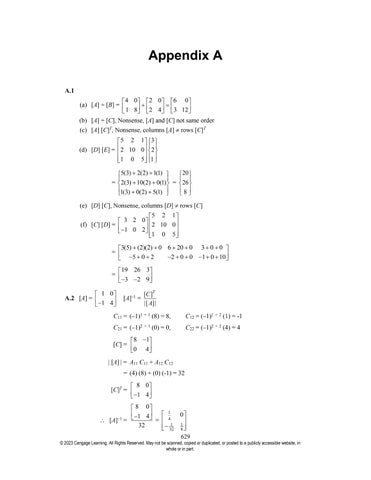
Appendix A A.1 4 0 2 0 6 0 (a) [A] + [B] = 1 8 2 4 3 12 (b) [A] + [C], Nonsense, [A] and [C] not same order
(c) [A] [C]T, Nonsense, columns [A] rows [C]T 5 2 1 3 (d) [D] [E] = 2 10 0 2 1 0 5 1 5(3) 2(2) 1(1) 20 = 2(3) 10(2) 0(1) = 26 1(3) 0(2) 5(1) 8
(e) [D] [C], Nonsense, columns [D] rows [C] 5 2 1 3 2 0 (f) [C] [D] = 2 10 0 1 0 2 1 0 5 3(5) (2)(2) 0 6 20 0 3 0 0 = 2 0 0 1 0 10 5 0 2
19 26 3 = 3 2 9
A.2 [A] =
1 0 1 4
[A]–1 =
[C ]T |[ A] |
C11 = (–1)1 + 1 (8) = 8,
C12 = (–1)1 + 2 (1) = -1
C21 = (–1)2 + 1 (0) = 0,
C22 = (–1)2 + 2 (4) = 4
8 1 [C] = 0 4
| [A] | = A11 C11 + A12 C12 = (4) (8) + (0) (-1) = 32 8 0 [C]T = 1 4
8 0 1 4 1 –1 [A] = = 4 32 1
32
0 1 8 629
© 2023 Cengage Learning. All Rights Reserved. May not be scanned, copied or duplicated, or posted to a publicly accessible website, in whole or in part.
Verify by multiplying [A] [A]–1 = [I] A.3 [D]–1 =
[C ]T |[ D ]|
5 2 1 [D] = 2 10 0 1 0 5 50 10 10 Cofactor matrix, [C] = 10 24 2 2 46 10
| [D] | = 5(50) + (2)(-10) + (1)(-10) = 220 5 50 10 10 22 1 [D]–1 = 10 24 2 1 22 220 2 46 1 10 22
1 1 22 22 6 1 55 110 1 23 110 110
A.4 Nonsense 2 0 A.5 [B] = 2 4
2 0 1 0 st (1) divide 1 row by 2 2 4 0 1 1 0 12 0 (2) 2 4 0 1
st row by -2 and add to row 2
1 0 12 0 nd (3) divide 2 row by 4 0 4 1 1 1 0 1 0 12 0 2 –1 = (4) [B] 1 1 1 1 0 1 4 4 4 4 –1 A.6 [D] by row reduction 5 2 1 5 2 1 1 0 0 [D] 2 10 0 2 10 0 0 1 0 1 0 5 1 0 5 0 0 1
a. Divide R1 by 5 1 2 1 1 0 0 5 5 5 2 10 0 0 1 0 1 0 5 0 0 1 b. Multiply R1 by -2 + Add to R2
630
© 2023 Cengage Learning. All Rights Reserved. May not be scanned, copied or duplicated, or posted to a publicly accessible website, in whole or in part.
1 52 1 0 9 5 1 0
1 5 2 5
5
1 5 2 5
0 0 1 0 0 0 1
c. Multiply R1 by -1 + Add to R3 2 1 5 1 0 9 5 0 2 5
1 5 52 4 54
1 5 52 15
0 0 1 0 0 1
d. Multiply R2 by 1/23 + Add to R3 1 1 0 0 1 52 5 5 1 2 2 0 9 5 5 5 1 0 5 1 0 0 110 23 1 23 23 e. Multiply R3 by 23/275 + Add to R2 1 1 0 0 1 52 5 5 23 276 23 1 0 55 275 275 0 9 5 110 5 1 0 0 23 23 1 23 f. Multiply R3 by -23/550 + Add to R1
23 23 1 0 110 550 550 1 52 23 276 23 1 0 55 275 275 0 9 5 110 5 1 0 0 23 23 1 23 g. Multiply R2 by -1/23 + Add to R1 5 1 1 0 22 22 1 0 22 46 23 276 23 0 55 275 275 0 5 110 5 1 0 0 23 1 23 23 h. Divide R2 by 46/5 + R3 by 110/23 5 1 0 0 22 1 0 1 0 22 0 0 1 1 22
5 22 1 [D]–1 = 22 1 22
1 22
6 55 1 110
1 22
6 55 1 110
1 22 1 110 23 110
1 22 1 110 23 110
A.7 Show that ([A] [B])T = [B]T [A]T by using [A] =
a11 a21
a12 a22
[B] =
631
b11 b12 b21 b22
b13 b23
© 2023 Cengage Learning. All Rights Reserved. May not be scanned, copied or duplicated, or posted to a publicly accessible website, in whole or in part.
([A] [B]) =
a11 (b11 ) a12 (b21 ) a11 (b12 ) a12 (b22 ) a11 (b13 ) a12 (b23 ) a21 (b11 ) a22 (b21 ) a21 (b12 ) a22 (b22 ) a21 (b13 ) a22 (b23 )
a11 (b11 ) a12 (b21 ) a21 (b11 ) a22 (b21 ) ([A] [B]) = a11 (b12 ) a12 (b22 ) a21 (b12 ) a22 (b22 ) a11 (b13 ) a12 (b23 ) a21 (b13 ) a22 (b23 ) T
b11 b21 [B] = b12 b22 b13 b23 T
[A]T =
b11 (a11 ) b21 (a12 ) T
a11 a12
a21 a22
b11 (a21 ) b21 (a22 )
T
[B] [A] = b12 (a11 ) b22 (a12 ) b12 (a21 ) b22 (a22 ) b13 (a11 ) b23 (a12 ) b13 (a21 ) b23 (a22 ) a11 (b11 ) a12 (b21 )
a21 (b11 ) a22 (b21 )
= a11 (b12 ) a12 (b22 ) a21 (b12 ) a22 (b22 ) a11 (b13 ) a12 (b23 ) a21 (b13 ) a22 (b23 ) Answer: ([A] [B])T = [B]T [A]T A.8 [T] =
C S S C
[C] =
C S S C
[C]T =
C S
S C
| [T] | = C2 + S2 = 1 [T]–1 =
C [C ]T = S |[T ] |
[T]T =
C S
S C
and
S C
[T]T = [T]–1 and T is an orthogonal matrix
A.9 Show {X}T [A] {X} is symmetric. Given {X} = {X}T = {X}T [A] {X} = =
x
y
1
x
, [A] =
a b b c
x 1 y x x 1 a b x y x b c 1
y x
ax b bx c x ay bx by cx 1 632
y x
© 2023 Cengage Learning. All Rights Reserved. May not be scanned, copied or duplicated, or posted to a publicly accessible website, in whole or in part.
=
ax 2
axy by bx 2
bx bx c
axy bx
2
by cx ay
2
cx
bxy bxy cx 2
as the 1–2 term = 2–1 term {X}T [A] {X} is symmetric. A.10 Evaluate [K] =
L 0
1 L
[ B ]T E [B] dx, [B] =
[K] =
[K] =
1 L 1 L
L 0 1 L2 1 L2
1 L2
1 L –1 L
1 L
L 0
[K] = E
1 L
E
1 dx L
E dx
1 L2
1 L
1 L
=
1 1
E L
1 1
(Should multiply by A to get actual [K] for a bar) A.11 The following integral represents the strain energy in a bar U=
where
{d} =
A L T {d } [B]T [D] [B] {d} dx 2 0 d1
[B] =
d2
1 L
1 L
[D] = E
Show that ddU yields [k] {d}, where [k] is the bar stiffness matrix given by {d } [k] =
AE L
1 1
1 1
{d}T = [d1 d2]
[B]T =
1 L 1 L
U=
A L T {d } [B]T [D] [B] {d} dx 2 0
U=
AL AL {d}T [B]T [D]T [B] {d} = [d1 2 2
U=
AL d 2 d1 1 [E ] 2 L L
U=
AEL d 2 d1 2 L
1 L
633
1 L 1 L
E
1 L
1 L
d2
d1
d1 d2
d1
1 L 1 L
d2]
d2 d1 d2
=
AEL d1 d 2 2 L2
d1 2
L
d2
© 2023 Cengage Learning. All Rights Reserved. May not be scanned, copied or duplicated, or posted to a publicly accessible website, in whole or in part.