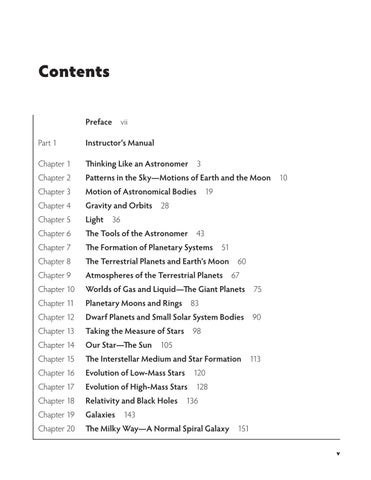
Contents Preface
vii
Part 1
Instructor’s Manual
Chapter 1
Thinking Like an Astronomer
3
Chapter 2 Patterns in the Sky—Motions of Earth and the Moon 10 Chapter 3 Motion of Astronomical Bodies Chapter 4 Gravity and Orbits Chapter 5 Light
19
28
36
Chapter 6 The Tools of the Astronomer
43
Chapter 7 The Formation of Planetary Systems 51 Chapter 8 The Terrestrial Planets and Earth’s Moon 60 Chapter 9 Atmospheres of the Terrestrial Planets 67 Chapter 10
Worlds of Gas and Liquid—The G iant Planets 75
Chapter 11
Planetary Moons and Rings 83
Chapter 12
D warf Planets and Small Solar System Bodies 90
Chapter 13
Taking the Measure of Stars
Chapter 14
O ur Star—The Sun
Chapter 15
The Interstellar Medium and Star Formation 113
Chapter 16
E volution of Low-Mass Stars 120
Chapter 17
Evolution of High-Mass Stars 128
Chapter 18
R elativity and Black Holes 136
Chapter 19
G alaxies 143
Chapter 20
The Milky Way—A Normal Spiral Galaxy 151
98
105
v
vi ◆ Contents
Chapter 21
The Expanding Universe 158
Chapter 22
Cosmology
Chapter 23
L arge-Scale Structure in the Universe
Chapter 24
Life 178
Part 2
Answers to Starry Night Workbook Exercises
Exercise 1
The Celestial Sphere
Exercise 2
Earth’s Rotation Period 188
Exercise 3
Motion of the Sun along the Ecliptic
Exercise 4
Motion of the Moon
Exercise 5
Earth and Moon Phases
Exercise 6
Sunrise on Mars 192
Exercise 7
Precession 194
Exercise 8
Kepler’s Laws 194
Exercise 9
Flying to Mars
Exercise 10
The Moons of Jupiter 195
Exercise 11
The Rings of Saturn 196
Exercise 12
Pluto and Kuiper Belt Objects
Exercise 13
Asteroids
Exercise 14
The Magnitude Scale and Distances
Exercise 15
Stars and the H-R Diagram 199
Exercise 16
Nebulae: The Birth and Death of Stars 200
Exercise 17
Pulsars and Supernova Remnants
Exercise 18
Galaxy Classification 201
Exercise 19
Quasars and Active Galaxies 201
Exercise 20
Views of the Milky
202
Exercise 21
Globular Clusters
203
Exercise 22
The Neighborhood of the Sun
Exercise 23
Beyond the Milky Way
165 171
188 189
189 190
195
197
197
Credits 205
204
197
200
203
Preface For each chapter of the textbook, you w ill find a corresponding chapter in the Instructor’s Manual that contains all or most of the following sections:
INSTRUCTOR NOTES • This section provides a brief overview of the chapter and a list of major topics discussed. It often includes common misconceptions to address and recommendations for additional resources.
INTERACTIVE SIMULATIONS • Textbook author Stacy Palen has created seven Interactive Simulations that pair with selected Exploration activities. This section briefly describes each Interactive Simulation associated with the chapter and notes the corresponding section of the textbook.
TEACHING READING ASTRONOMY NEWS
DISCUSSION POINTS
• This section contains the worked solutions and discussion of the Reading Astronomy News questions.
• This section suggests important discussion topics and activities. The chapter Learning Goal associated with each item is noted.
CHECK YOUR UNDERSTANDING SOLUTIONS
PROCESS OF SCIENCE
• This section provides answers and supporting information for all of the in-chapter Check Your Understanding questions.
• This section provides a brief overview of the chapter’s Process of Science figure. We also have questions in Smartwork5 that relate to the figure.
ASTROTOUR ANIMATIONS • The AstroTour animations are narrated, conceptual overviews with a consistent structure of Introduction— E xplanation—Conclusion. This section of the Instructor’s Manual briefly describes each AstroTour animation associated with the chapter and notes the corresponding section of the textbook.
ASTRONOMY IN ACTION VIDEOS • The Astronomy in Action Videos are a series of mini- lectures and demos done by textbook author Stacy Palen. This section of the Instructor’s Manual briefly describes each Astronomy in Action Video associated with the chapter and notes the corresponding section of the textbook as well as the length of the video.
END-OF-CHAPTER SOLUTIONS • This section provides worked solutions to all of the end-of-chapter questions and problems (Test Your Understanding, Thinking about the Concepts, and Applying the Concepts).
EXPLORATION • This section briefly describes the Exploration activity and provides worked solutions to each question.
LEARNING ASTRONOMY BY DOING ASTRONOMY: COLLABORATIVE LECTURE ACTIVITIES • This section introduces activities from the Learning Astronomy by Doing Astronomy workbook that are relevant to the chapter. The textbook reference of the associated topic is noted. vii
viii ◆ Preface For adopters of The Norton Starry Night Workbook, the answers to the exercises are included at the end of the manual. ill find the information in this manual We hope that you w useful. We welcome your comments, questions, and suggestions (contact your local Norton representative: http://books.w wnorton.com/books/fi nd-your-rep/). Finally, we would like to thank Ricardo Covarrubias of Milikin University and Jay Dunn of Georgia State University, Perimeter College, whose careful review improved the accuracy and usefulness of this manual. Additional resources: Norton Interactive Instructor’s Guide (IIG) iig.w wnorton.com/astro6 This new and searchable online resource is designed to help instructors prepare for lecture in real time. All of the content in this Instructor’s Manual, and more, is located on the IIG. In addition to this manual’s content, you w ill find: the Test Bank, AstroTour animations, Astronomy in
Action videos, Interactive Simulations, Lecture Power- Point slides, all of the textbook’s art, photos, and t ables, and Learning Management System Coursepacks (available in Blackboard, Canvas, Desire2Learn, and Moodle formats). Smartwork5 Online Activities and Assessment digital.w wnorton.com/astro6 More than 2,00 questions support 21st Century Astronomy, Sixth Edition—a ll with answer-specific feedback, hints, and ebook links. Norton offers pre-made assignments for each chapter of the text to make it easy to get started, but Smartwork5 is also fully customizable. Questions include ranking, labeling, and sorting exercises based on book and NASA art, selected end-of-chapter questions, versions of the Explorations (based on AstroTours and new Simulations), and questions that accompany the Reading Astronomy News feature in each textbook chapter. Astronomy in Action video questions focus on overcoming common misconceptions, while Process of Science guided inquiry assignments take students through the steps of a discovery and ask them to participate in the decision-making process that led to the discovery.
PA RT I :
Instructor’s Manual