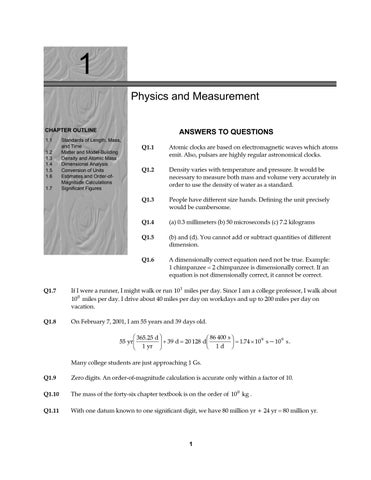
1 Physics and Measurement CHAPTER OUTLINE 1.1 1.2 1.3 1.4 1.5 1.6 1.7
ANSWERS TO QUESTIONS
Standards of Length, Mass, and Time Matter and Model-Building Density and Atomic Mass Dimensional Analysis Conversion of Units Estimates and Order-ofMagnitude Calculations Significant Figures
Q1.1
Atomic clocks are based on electromagnetic waves which atoms emit. Also, pulsars are highly regular astronomical clocks.
Q1.2
Density varies with temperature and pressure. It would be necessary to measure both mass and volume very accurately in order to use the density of water as a standard.
Q1.3
People have different size hands. Defining the unit precisely would be cumbersome.
Q1.4
(a) 0.3 millimeters (b) 50 microseconds (c) 7.2 kilograms
Q1.5
(b) and (d). You cannot add or subtract quantities of different dimension.
Q1.6
A dimensionally correct equation need not be true. Example: 1 chimpanzee = 2 chimpanzee is dimensionally correct. If an equation is not dimensionally correct, it cannot be correct.
Q1.7
If I were a runner, I might walk or run 10 1 miles per day. Since I am a college professor, I walk about 10 0 miles per day. I drive about 40 miles per day on workdays and up to 200 miles per day on vacation.
Q1.8
On February 7, 2001, I am 55 years and 39 days old. 55 yr
F 365.25 d I + 39 d = 20 128 dFG 86 400 s IJ = 1.74 × 10 s ~ 10 s . GH 1 yr JK H 1d K 9
9
Many college students are just approaching 1 Gs. Q1.9
Zero digits. An order-of-magnitude calculation is accurate only within a factor of 10.
Q1.10
The mass of the forty-six chapter textbook is on the order of 10 0 kg .
Q1.11
With one datum known to one significant digit, we have 80 million yr + 24 yr = 80 million yr.
1
2
Physics and Measurement
SOLUTIONS TO PROBLEMS Section 1.1
Standards of Length, Mass, and Time
No problems in this section
Section 1.2 P1.1
Matter and Model-Building
From the figure, we may see that the spacing between diagonal planes is half the distance between diagonally adjacent atoms on a flat plane. This diagonal distance may be obtained from the Pythagorean theorem, Ldiag = L2 + L2 . Thus, since the atoms are separated by a distance
L = 0.200 nm , the diagonal planes are separated by
Section 1.3 *P1.2
1 2 L + L2 = 0.141 nm . 2
Density and Atomic Mass
Modeling the Earth as a sphere, we find its volume as 24
3 4 3 4 π r = π 6.37 × 10 6 m = 1.08 × 10 21 m 3 . Its 3 3
e
j
m 5.98 × 10 kg = = 5.52 × 10 3 kg m3 . This value is intermediate between the V 1.08 × 10 21 m 3 tabulated densities of aluminum and iron. Typical rocks have densities around 2 000 to 3 000 kg m3 . The average density of the Earth is significantly higher, so higher-density material must be down below the surface. density is then ρ =
P1.3
a
fb
g
e j
With V = base area height V = π r 2 h and ρ =
ρ=
F 10 mm I f GH 1 m JK
1 kg m = 2 π r h π 19.5 mm 2 39.0 mm
a
fa
4
ρ = 2.15 × 10 kg m *P1.4
m , we have V
3
3
.
m for both. Then ρ iron = 9.35 kg V and V ρ gold m gold m gold 19.3 × 10 3 kg / m3 = ρ gold = = 23.0 kg . and m gold = 9.35 kg . Next, ρ iron 9.35 kg V 7.86 × 10 3 kg / m3
Let V represent the volume of the model, the same in ρ =
F GH
P1.5
3
9
V = Vo − Vi =
ρ=
4 π r23 − r13 3
e
j
FG IJ e H K
e
4π ρ r23 − r13 m 4 , so m = ρV = ρ π r23 − r13 = V 3 3
j
j.
I JK
Chapter 1
P1.6
3
4 4 3 π r and the mass is m = ρV = ρ π r 3 . We divide this equation 3 3 for the larger sphere by the same equation for the smaller:
For either sphere the volume is V =
m A ρ 4π rA3 3 rA3 = = = 5. m s ρ 4π rs3 3 rs3
a f
Then rA = rs 3 5 = 4.50 cm 1.71 = 7.69 cm . P1.7
Use 1 u = 1.66 × 10 −24 g . For He, m 0 = 4.00 u
(b)
0
(c) *P1.8
F 1.66 × 10 g I = 6.64 × 10 g . GH 1 u JK F 1.66 × 10 g I = 9.29 × 10 g . For Fe, m = 55.9 uG H 1 u JK F 1.66 × 10 g I = 3.44 × 10 g . For Pb, m = 207 uG H 1 u JK
(a)
(a)
-24
−24
-24
−23
−24
−22
0
The mass of any sample is the number of atoms in the sample times the mass m 0 of one atom: m = Nm 0 . The first assertion is that the mass of one aluminum atom is m 0 = 27.0 u = 27.0 u × 1.66 × 10 −27 kg 1 u = 4.48 × 10 −26 kg . Then the mass of 6.02 × 10 23 atoms is m = Nm 0 = 6.02 × 10 23 × 4.48 × 10 −26 kg = 0.027 0 kg = 27.0 g . Thus the first assertion implies the second. Reasoning in reverse, the second assertion can be written m = Nm 0 . 0.027 0 kg = 6.02 × 10 23 m 0 , so m 0 =
0.027 kg 6.02 × 10 23
= 4.48 × 10 −26 kg ,
in agreement with the first assertion. (b)
The general equation m = Nm 0 applied to one mole of any substance gives M g = NM u , where M is the numerical value of the atomic mass. It divides out exactly for all substances, giving 1.000 000 0 × 10 −3 kg = N 1.660 540 2 × 10 −27 kg . With eight-digit data, we can be quite sure of the result to seven digits. For one mole the number of atoms is N=
F 1 I 10 GH 1.660 540 2 JK
−3 + 27
= 6.022 137 × 10 23 .
(c)
The atomic mass of hydrogen is 1.008 0 u and that of oxygen is 15.999 u. The mass of one molecule of H 2 O is 2 1.008 0 + 15.999 u = 18.0 u. Then the molar mass is 18.0 g .
(d)
For CO 2 we have 12.011 g + 2 15.999 g = 44.0 g as the mass of one mole.
b
g
b
g
4
Physics and Measurement
P1.9
b gFGH 101 kgg IJK = 4.5 × 10 kg . F 1.66 × 10 kg I = 3.27 × 10 kg . Each atom has mass m = 197 u = 197 uG H 1 u JK Mass of gold abraded: ∆m = 3.80 g − 3.35 g = 0.45 g = 0.45 g
−4
3
−27
−25
0
Now, ∆m = ∆N m 0 , and the number of atoms missing is ∆N =
∆m
=
m0
4.5 × 10 −4 kg 3.27 × 10 −25 kg
= 1.38 × 10 21 atoms .
The rate of loss is ∆N ∆t ∆N ∆t P1.10
P1.11
=
FG H
1 yr 1.38 × 10 21 atoms 365.25 d 50 yr
IJ FG 1 d IJ FG 1 h IJ FG 1 min IJ K H 24 h K H 60 min K H 60 s K
= 8.72 × 10 11 atoms s .
e
je
j = 9.83 × 10
(a)
m = ρ L3 = 7.86 g cm 3 5.00 × 10 −6 cm
(b)
N=
(a)
The cross-sectional area is
3
−16
g = 9.83 × 10 −19 kg
9.83 × 10 −19 kg m = = 1.06 × 10 7 atoms m 0 55.9 u 1.66 × 10 −27 kg 1 u
e
j
a
f a
fa
fa
A = 2 0.150 m 0.010 m + 0.340 m 0.010 m = 6.40 × 10
−3
2
m .
f.
The volume of the beam is
ja
e
f
V = AL = 6.40 × 10 −3 m 2 1.50 m = 9.60 × 10 −3 m3 . Thus, its mass is
e
FIG. P1.11
je9.60 × 10 m j = 72.6 kg . F 1.66 × 10 kg I = 9.28 × 10 The mass of one typical atom is m = a55.9 ufG H 1 u JK 3
m = ρV = 7.56 × 10 kg / m
(b)
−3
3
3
−27
0
m = Nm 0 and the number of atoms is N =
−26
kg . Now
72.6 kg m = = 7.82 × 10 26 atoms . −26 m 0 9.28 × 10 kg
Chapter 1
P1.12
(a)
F 1.66 × 10 kg I = 2.99 × 10 GH 1 u JK −27
The mass of one molecule is m 0 = 18.0 u
−26
5
kg . The number of
molecules in the pail is N pail = (b)
1.20 kg m = = 4.02 × 10 25 molecules . m 0 2.99 × 10 −26 kg
Suppose that enough time has elapsed for thorough mixing of the hydrosphere. N both = N pail
F m I = (4.02 × 10 molecules)F 1.20 kg I , GH M JK GH 1.32 × 10 kg JK pail
25
21
total
or
N both = 3.65 × 10 4 molecules .
Section 1.4 P1.13
Dimensional Analysis
The term x has dimensions of L, a has dimensions of LT −2 , and t has dimensions of T. Therefore, the equation x = ka m t n has dimensions of
e
L = LT −2
j aTf or L T = L T m
n
1 0
m
n − 2m
.
The powers of L and T must be the same on each side of the equation. Therefore, L1 = Lm and m = 1 . Likewise, equating terms in T, we see that n − 2m must equal 0. Thus, n = 2 . The value of k, a dimensionless constant, cannot be obtained by dimensional analysis . *P1.14
(a)
Circumference has dimensions of L.
(b)
Volume has dimensions of L3 .
(c)
Area has dimensions of L2 .
e j
Expression (i) has dimension L L2
1/2
= L2 , so this must be area (c).
Expression (ii) has dimension L, so it is (a). Expression (iii) has dimension L L2 = L3 , so it is (b). Thus, (a) = ii; (b) = iii, (c) = i .
e j