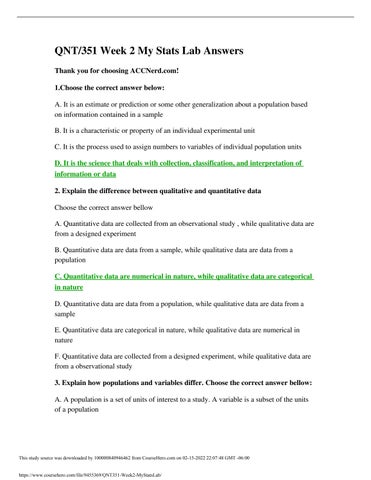
QNT/351 Week 2 My Stats Lab Answers Thank you for choosing ACCNerd.com! 1.Choose the correct answer below: A. It is an estimate or prediction or some other generalization about a population based on information contained in a sample B. It is a characteristic or property of an individual experimental unit C. It is the process used to assign numbers to variables of individual population units D. It is the science that deals with collection, classification, and interpretation of information or data 2. Explain the difference between qualitative and quantitative data Choose the correct answer bellow A. Quantitative data are collected from an observational study , while qualitative data are from a designed experiment B. Quantitative data are data from a sample, while qualitative data are data from a population C. Quantitative data are numerical in nature, while qualitative data are categorical in nature D. Quantitative data are data from a population, while qualitative data are data from a sample E. Quantitative data are categorical in nature, while qualitative data are numerical in nature F. Quantitative data are collected from a designed experiment, while qualitative data are from a observational study 3. Explain how populations and variables differ. Choose the correct answer bellow: A. A population is a set of units of interest to a study. A variable is a subset of the units of a population
This study source was downloaded by 100000840946462 from CourseHero.com on 02-15-2022 22:07:48 GMT -06:00
https://www.coursehero.com/file/9455369/QNT351-Week2-MyStatsLab/
B. A variable is a set of units of interest to a study. A population is a characteristic or property of the units being studied. C. A population is a set of units of interest to a study. A variable is an object upon which data is collected D. A population is a set of units of interest to a study. A variable is a characteristic or property of the units being studied 4. Define statistical thinking. Choose the correct answer bellow: A. Statistical thinking involves applying rational thought and the science of statistics to critically assess data and interferences B. Statistical thinking is a statement about the degree of uncertainty associated with a statistical inference C. Statistical thinking utilizes sample data to make estimates, decisions, predictions, or other generalization about a larger set of data D. Statistical thinking is a series of actions or operations that transforms inputs to outputs 5. Suppose you’re given a data set that classifies each sample unit into one of four categories: A,B,C or D. You plan to create a computer database consisting of these data, and you decide to code the data as A=, B=, C=3, and D=4. Are the data consisting of the classifications A, B, C, and D qualitative or quantitative? After the data are input as 1, 2, 3, or 4, are they qualitative or quantitative? Are the data consisting of the classifications A, B, C, and D qualitative or quantitative? A. Quantitative, because they are measured on a naturally occurring numerical sale B. Quantitative, because they can only be classified into categories C. Qualitative, because they can only be classified into categories D. Qualitative, because they are measured on a naturally occurring numerical sale After the data are input as 1, 2, 3, or 4, are they qualitative or quantitative? A. Qualitative, because they are measured on a naturally occurring numerical sale B. Quantitative, because they are measured on a naturally occurring numerical sale
This study source was downloaded by 100000840946462 from CourseHero.com on 02-15-2022 22:07:48 GMT -06:00
https://www.coursehero.com/file/9455369/QNT351-Week2-MyStatsLab/
C. Qualitative, because they cannot be meaningfully added, subtracted, multiplied, or divided D. Quantitative, because they cannot be meaningfully added, subtracted, multiplied, or divided 6. A company tracked all credit card purchases during the year 2005 and measured two variables: (1) the cardholder’s town of residence, and (2) the amount (in dollars) of each monthly payment a. identify the type (qualitative or quantitative) of each variable measured b. does the data set collected represent a population or a sample? a. Is the variable (1) qualitative or quantitative?
Qualitative
Quantitative
Is the variable (2) qualitative or quantitative?
Quantitative
Qualitative
b. Does the data set collected represent a population or a sample?
Sample
Population
7. Identify each of the following variables as qualitative or quantitative a. college major b. distance of commute to work c. number of pets in a family d. natural hair color a. Is a college major qualitative or quantitative?
Qualitative
This study source was downloaded by 100000840946462 from CourseHero.com on 02-15-2022 22:07:48 GMT -06:00
https://www.coursehero.com/file/9455369/QNT351-Week2-MyStatsLab/
Quantitative
b. Is distance of commute to work qualitative or quantitative?
Qualitative
Quantitative
c. Is number of pets in a family qualitative or quantitative
Qualitative
Quantitative
d. Is natural hair color qualitative or quantitative?
Qualitative
Quantitative
8. Identify each of the following variables as qualitative or quantitative a. Eye color b. Number of brothers and sisters c. Size of home d. Political party preference a. Is the variable qualitative or quantitative? Why?
Eye color is a quantitative variable. Its values are not numerical
Eye color is a qualitative variable. Its values are not numerical
Eye color is a qualitative variable. Its values are numerical
Eye color is a quantitative variable. Its values are numerical
b. Is the variable qualitative or quantitative? Why?
Numbers of brothers and sisters is a quantitative variable. Its values are not numerical
This study source was downloaded by 100000840946462 from CourseHero.com on 02-15-2022 22:07:48 GMT -06:00
https://www.coursehero.com/file/9455369/QNT351-Week2-MyStatsLab/
Numbers of brothers and sisters is a quantitative variable. Its values are numerical
Numbers of brothers and sisters is a qualitative variable. Its values not numerical
Numbers of brothers and sisters is a qualitative variable. Its values are not numerical
c. Is the variable qualitative or quantitative? Why?
Size of home is a quantitative variable. Its values are not numerical
Size of home is a qualitative variable. Its values are not numerical
Size of home is a qualitative variable. Its values are numerical
Size of home is a quantitative variable. Its values are numerical
d. Is the variable qualitative or quantitative? Why?
Political party preference is quantitative variable. Its values are not numerical
Political party preference is quantitative variable. Its values are numerical
Political party preference is qualitative variable. Its values not numerical
Political party preference is qualitative variable. Its values are not numerical
9. A company surveyed a random sample of 10,000 employees in the region. One question the asked was, “ If your employer provides you with mentoring opportunities are you likely to remain in your job for the next five years?” The found that 730 members of the sample said yes. a. Identify the population of interest in the company
The 10,000 employees surveyed
All people in the region
The 730 employees who answered yes
All employees in the region
b. Based on the question posed by the company what is the variable of interest?
If they answered yes to the survey question
This study source was downloaded by 100000840946462 from CourseHero.com on 02-15-2022 22:07:48 GMT -06:00
https://www.coursehero.com/file/9455369/QNT351-Week2-MyStatsLab/