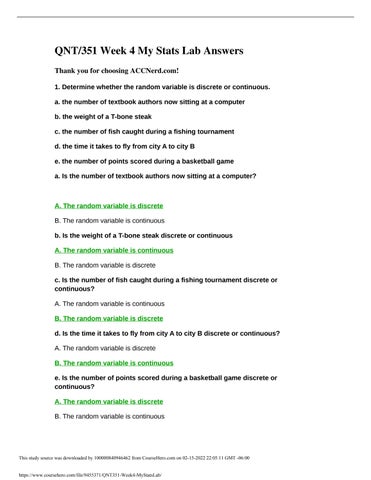
QNT/351 Week 4 My Stats Lab Answers Thank you for choosing ACCNerd.com! 1. Determine whether the random variable is discrete or continuous. a. the number of textbook authors now sitting at a computer b. the weight of a T-bone steak c. the number of fish caught during a fishing tournament d. the time it takes to fly from city A to city B e. the number of points scored during a basketball game a. Is the number of textbook authors now sitting at a computer?
A. The random variable is discrete B. The random variable is continuous b. Is the weight of a T-bone steak discrete or continuous A. The random variable is continuous B. The random variable is discrete c. Is the number of fish caught during a fishing tournament discrete or continuous? A. The random variable is continuous B. The random variable is discrete d. Is the time it takes to fly from city A to city B discrete or continuous? A. The random variable is discrete B. The random variable is continuous e. Is the number of points scored during a basketball game discrete or continuous? A. The random variable is discrete B. The random variable is continuous
This study source was downloaded by 100000840946462 from CourseHero.com on 02-15-2022 22:05:11 GMT -06:00
https://www.coursehero.com/file/9455371/QNT351-Week4-MyStatsLab/
2. Determine whether the random variable is discrete or continuous. In each case, state the possible values of the random variable. (a) the number of light bulbs that burn out in the next week in room with 17 bulbs (b) the amount of rain in City B during April (a) Is the number of light bulbs that burn out in the next week in room with 17 bulbs discrete or continuous?
A. The random variable is continuous. The possible values are 0≤x≤17 B. The random variable is discrete. The possible values are 0, 1, 2, …, 17 C. The random variable is continuous. The possible values are 0, 1, 2, …, 17 D. The random variable is discrete. The possible values are 0≤x≤17 (b) Is the amount of rain in City B during April discrete or continuous? A. The random variable is discrete. The possible values are r=1, 2, 3, … B. The random variable is discrete. The possible values are r≥0 C. The random variable is continuous. The possible values are r≥0 D. The random variable is continuous. The possible values are r=1, 2, 3, …
3. The random variable x has the following discrete probability distribution. Complete parts a trough f.
a. List the values x may assume. 1, 4, 5, 8, 9 b. What value of x is most probable? 9 c. Display the probability distribution as a graph. Choose the correct graph bellow.
This study source was downloaded by 100000840946462 from CourseHero.com on 02-15-2022 22:05:11 GMT -06:00
https://www.coursehero.com/file/9455371/QNT351-Week4-MyStatsLab/
A.
C.
B.
D.
Answer = D d. Find P(x=8) P(x=8)=.1 e. Find P(x≥5) P(x≥5)=.7 f. Find P(x>2) P(x>2)=.9 4. A discrete random variable x can assume five possible values 2, 3, 5, 7, and 9. Its probability distribution is shown here. Complete parts a trough c.
This study source was downloaded by 100000840946462 from CourseHero.com on 02-15-2022 22:05:11 GMT -06:00
https://www.coursehero.com/file/9455371/QNT351-Week4-MyStatsLab/
a. What is p(5)? p(5) = .26 b. What is the probability that x equals 2 or 9? p(x=2 or x=9) = .41 c. What is p (x≤7)? p (x≤7) = .74
5. Toss three fair coins and let x equal the number of tails observed. a. Identify the sample points associated with this experiment and assign a value of x to each sample point b. Calculate p(x) for the values x=1 and x=2 c. Construct a graph for p(x) d. What is P(x=2 or x=3)?
a. Choose the correct answer bellow A. x=0, 1, 2, 3 B. x=1, 2, 3 C. x=0, 1, 2 D. x=1, 2 b. Calculate p(x) for x=1 p(1) = .375 Calculate p(x) for x=2 p(2) = .375 c. Choose the correct graph bellow
This study source was downloaded by 100000840946462 from CourseHero.com on 02-15-2022 22:05:11 GMT -06:00
https://www.coursehero.com/file/9455371/QNT351-Week4-MyStatsLab/
A.
C.
B.
D.
Correct Answer = C d. P(x=2 or x=3) .5
6. Find the following probabilities for the standard normal random variable z. a. P(z>1.79) b. P(z< -1.46) c. P(0.54 ≤ z ≤ 2.67) d. P(- 2.34 < z > 1.77) a. P(z>1.79) = .0367 b. P(z< -1.46) = .0721
This study source was downloaded by 100000840946462 from CourseHero.com on 02-15-2022 22:05:11 GMT -06:00
https://www.coursehero.com/file/9455371/QNT351-Week4-MyStatsLab/