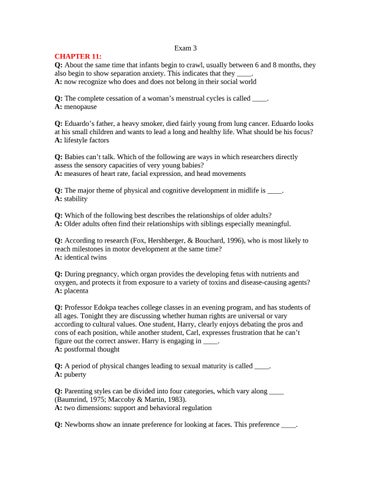
Exam 3 CHAPTER 11: Q: About the same time that infants begin to crawl, usually between 6 and 8 months, they also begin to show separation anxiety. This indicates that they ____. A: now recognize who does and does not belong in their social world Q: The complete cessation of a woman’s menstrual cycles is called ____. A: menopause Q: Eduardo’s father, a heavy smoker, died fairly young from lung cancer. Eduardo looks at his small children and wants to lead a long and healthy life. What should be his focus? A: lifestyle factors Q: Babies can’t talk. Which of the following are ways in which researchers directly assess the sensory capacities of very young babies? A: measures of heart rate, facial expression, and head movements Q: The major theme of physical and cognitive development in midlife is ____. A: stability Q: Which of the following best describes the relationships of older adults? A: Older adults often find their relationships with siblings especially meaningful. Q: According to research (Fox, Hershberger, & Bouchard, 1996), who is most likely to reach milestones in motor development at the same time? A: identical twins Q: During pregnancy, which organ provides the developing fetus with nutrients and oxygen, and protects it from exposure to a variety of toxins and disease-causing agents? A: placenta Q: Professor Edokpa teaches college classes in an evening program, and has students of all ages. Tonight they are discussing whether human rights are universal or vary according to cultural values. One student, Harry, clearly enjoys debating the pros and cons of each position, while another student, Carl, expresses frustration that he can’t figure out the correct answer. Harry is engaging in ____. A: postformal thought Q: A period of physical changes leading to sexual maturity is called ____. A: puberty Q: Parenting styles can be divided into four categories, which vary along ____ (Baumrind, 1975; Maccoby & Martin, 1983). A: two dimensions: support and behavioral regulation Q: Newborns show an innate preference for looking at faces. This preference ____.
A: provides advantages in social behavior and language learning Q: Which of the following is in the category of the most common and preventable sources of adverse effects in the developing fetus? A: Allison and her husband drink a bottle or two of wine every night with dinner. Q: Children grow up and move out, leaving their parents at midlife with an “empty nest.” Michael’s parents, Americans, are quite cheerful about it. Rumi’s parents, from India and now living in Canada, are quite disappointed. This difference in reaction most likely reflects ____. A: cultural variation Q: Teens begin to form an identity by asking “Who am I?” and “What kind of person do I want to be?” According to Erikson, failure to achieve a stable identity leads to ____. A: role confusion and problems with subsequent stages Q: Gabriel is 25 years old, 6 foot 3 inches, and 185 pounds. He is an accomplished lacrosse player and continues to play in a competitive league. Gabriel ____. A: is most likely at the peak of his physical fitness Q: Jack was a very timid child, both physically and socially. His parents gently encouraged him to participate in activities with other children. Over time he became quite adept at playing team sports. This is an example of ____. A: goodness of fit Q: Which of the following types of intelligence is most likely to change due to aging? A: fluid intelligence Q: Which of the following is a finding from Harry Harlow’s study (1958) of rhesus monkeys and attachment? A: The mother’s ability to provide contact comfort was critical in forming a strong attachment on the part of her infant. Q: The study of human development considers changes in behavior ____. A: that correlate with growth or maturation Q: Long-term marriage partners show more similarities with each other due to a lifetime spent in each other’s company, along with a(n) ____. A: lack of attention to past negative events and personality traits Q: The emotional bonding between an infant and a parent or caregiver is called ____. A: attachment Q: How can adolescence best be described? A: A period of development beginning at puberty and ending at young adulthood
Q: We produce many more synapses than we need, and then retain only those that are used in a “use it or lose it” fashion. What does this demonstrate? A: The important role of experience in wiring the brain Q: The starting point of late adulthood is best described as ____. A: vague Q: Marjorie is in her seventh month of pregnancy with her first child. Which of the following is true regarding her fetus’s development? A: The fetus can hear and recognize Marjorie’s voice. Q: Myelination of the frontal lobes is much greater in adults aged 23 to 30 than in youth between the ages of 12 and 16. Unfortunately, the adolescent’s white matter is more susceptible than an adult’s to damage from ____. A: binge drinking Q: Which scenario exemplifies a key factor in predicting the timing of attachment? A: Jayce is starting to crawl. Q: Midlife is most often a time of ____. A: many challenges Q: Why does a 40-year-old woman have a greater probability of giving birth to a child with Down syndrome than a 25-year-old woman? A: A 40-year-old woman has been exposed to more years of environmental influence, possibly including harmful factors, that can lead to faulty cell division. Q: Sofia was six pounds at birth. She is a healthy baby. How much does she likely weigh now that she is one year old? A: 18 pounds (tripled) Q: Ryan grew up in a family of four boys. He and his brothers have never engaged in “acting out” behaviors, such as excessive drinking or drug use. However, now in their teens, they tend to be depressed and withdrawn from their peers. Their parents are most likely ____. A: authoritarian Q: Which scenario best exemplifies an ecological approach to development? A: Liam was toilet trained at 18 months, a standard approach for his community. Q: Kohlberg’s postconventional reasoning has been criticized as not representing a universal stage of moral development, but rather being ____ (Murphy, Gilligan, & Puka, 1994). A: a characteristic of males in Europe and the United States Q: Individual differences in temperament may emerge early in life (Thomas & Chess,
1977, 1989). These traits ____. A: most likely represent genetic differences Q: Alexa is 15 years old. She is very involved in environmental issues, including issues such as the finding alternatives to fossil fuels and the protection of biodiversity on the planet. According to Piaget, Alexa is in the ____ of cognitive development. A: formal operational stage Q: With regard to developmental outcomes, your text emphasizes ____. A: the interactions between nature and nurture Q: What is the definition of accommodation? A: The incorporation of new learning into an existing schema that requires revision of the schema Q: Ava is almost one month old. What does she spend most of her day doing? A: sleeping Q: In Erikson’s work (Erikson, 1968), a consistent, unified sense of self is called ____. A: identity Q: Marcus is about 1-1/2 years old. His mother left him at a friend’s house to play for the first time while she took the family car in for maintenance. Marcus did not show distress when his mother left nor did he immediately approach her when she returned. What pattern of attachment is this? A: avoidant Q: The ectoderm develops into ____. A: the nervous system Q: Joshua is three years old. He often whines, and constantly demands attention from his parents, not venturing far from them at the park. Which of the following would most likely describe the parenting style of Joshua’s parents? A: unresponsive or inconsistent Q: The obvious evolutionary purpose of puberty is to prepare an individual for ____. A: sex Q: During which stage do cells begin to differentiate into three types: the ectoderm, mesoderm, and endoderm? A: zygote Q: Which of the following is true regarding young adulthood? A: It emerges gradually in industrialized countries. Q: In whose life have epigenetic processes likely played the most dominant role?
A: Sixty-five old Oliver, who has worked hard as a truck driver since he was 19 years old Q: What role does habituation play in evaluating a baby’s sensory capacities? A: When the baby spends equal time looking at two stimuli, he likely cannot tell the difference between them. Q: At the onset of puberty, ____. A: there is substantial gray matter growth Q: A pattern of infant-caregiver bonding in which children explore confidently and return to the parent or caregiver for reassurance is called ____. A: secure attachment Q: A failure to develop a typical theory of mind has been linked to the development of ____ (Gopnik, Capps, & Meltzoff, 2000). A: autism Q: Jenna is a very rebellious teenager. Just about everything she says and does worries her parents. Her values are most likely ____. A: not too different from her parents Q: Ethan is just two weeks old. His mother strokes his cheek and he turns toward the touch and opens his mouth. This is called the ____. A: rooting reflex Q: What is egocentrism in Piaget’s view? A: The limited ability to understand the point of view of other people Q: Which of the following is a criticism of Piaget’s theories? A: Piaget viewed the developing child in relative isolation from his or her family, community, and culture. Q: Amy loves to eat swordfish in any preparation but decides to avoid it during her pregnancy. Why? A: It contains mercury, which is harmful to brain development. Q: The vast majority of genetic abnormalities in an embryo will result in ____. A: spontaneous abortion or miscarriage Q: The parenting style that combines high behavioral regulation with low support is ____. A: authoritarian Q: What is a teratogen? A: A chemical agent that can harm the zygote, embryo, or fetus