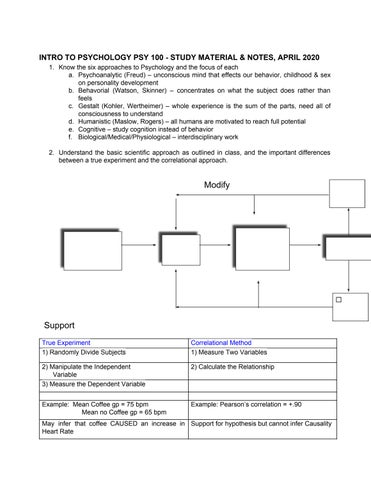
INTRO TO PSYCHOLOGY PSY 100 - STUDY MATERIAL & NOTES, APRIL 2020 1. Know the six approaches to Psychology and the focus of each a. Psychoanalytic (Freud) – unconscious mind that effects our behavior, childhood & sex on personality development b. Behavorial (Watson, Skinner) – concentrates on what the subject does rather than feels c. Gestalt (Kohler, Wertheimer) – whole experience is the sum of the parts, need all of consciousness to understand d. Humanistic (Maslow, Rogers) – all humans are motivated to reach full potential e. Cognitive – study cognition instead of behavior f. Biological/Medical/Physiological – interdisciplinary work 2. Understand the basic scientific approach as outlined in class, and the important differences between a true experiment and the correlational approach. Modify
Support True Experiment 1) Randomly Divide Subjects
Correlational Method 1) Measure Two Variables
2) Manipulate the Independent Variable 3) Measure the Dependent Variable
2) Calculate the Relationship
Example: Mean Coffee gp = 75 bpm Mean no Coffee gp = 65 bpm
Example: Pearson’s correlation = +.90
May infer that coffee CAUSED an increase in Support for hypothesis but cannot infer Causality Heart Rate
3. William James, Whilhelm Wundt, Charles Darwin, Sir Francis Galton, James Watson, Titchener a. William James – functionalism focusing on consciousness not the structure (disagreed with structuralism), Stream of Consciousness where you may focus on something and then find yourself thinking of something else b. Whilhelm Wundt – introspection c. Charles Darwin – evolution, natural selection, no matter what there is normal distribution d. Sir Francis Galton – Darwin’s cousin, Hereditary Genius (book) saying certain things such as intelligence ran in families, anthrometric (measuring everything they could about humans) e. James Watson – Little Albert study (scared orphan by putting rat in front of child and then loud noise behind head to prove that phobias were learned) f. Tichener – student of Wundt, came to US and brought introspection, Structuralism: attempting to study consciousness by breaking it into basic structures and elements 4. What is introspection? a. To look within, examine your own thoughts 5. A testable hypothesis must be disconfirmable or falsifiable so that an experiment can either support it or not. Some people might instead explain one outcome with one explanation and a second outcome with a second explanation and a third with a third and so on. They make attempts to disprove anything. They just find alternate explanations. It is always easy to offer an explanation of any finding after the fact. The trick in science is to make a prediction and ONLY THEN collect the data to see if it comes out as predicted. . 6. We begin a true experiment by randomly dividing subjects into 2 or more groups in order to get groups that are equal on uncontrollable variables such as age, Intelligence, gender and so on. By doing this we have equaled the effect of all such extraneous variables. We have not actually controlled those variables, just evened out any effect they might have on the Dependent variable. If we don’t do this, any of those extraneous (third) variables might explain any effect we observe on the dependent variable and we could not infer causality. 7. We randomly select subjects in some research in order to get a sample that represents a population of interest. This allows us to generalize any findings from the sample to the larger population 8. understand the important difference between True Experiments and Correlational Studies and how that relates to causation True Experiment 1) Randomly Divide Subjects
Correlational Method 1) Measure Two Variables
2) Manipulate the Independent Variable 3) Measure the Dependent Variable
2) Calculate the Relationship
Example: Mean Coffee gp = 75 bpm Mean no Coffee gp = 65 bpm
Example: Pearson’s correlation = +.90
2
May infer that coffee CAUSED an increase in Support for hypothesis but cannot infer Causality Heart Rate
9. Study the fields of specialization in the text book, 10. Charles Darwin’s brilliant book On the Origin of Species pointed out that natural selection acts on individual differences in the population and that natural selection could not occur if there were no natural variation in a population to begin with. This led to investigations of individual differences in people, which led to psychology.
Statistics and Methods 11. Area under the normal curve (about 34%, 14%, 2%, .13%) 12. the dependent variable and the independent variable. a. independent variable: condition that the experiment manipulates b. dependent variable: resulting behavior that is measured/recorded 13. descriptive and inferential branches of statistics a. Descriptive: summarizing large amounts of data into a form that is easily interpreted. Graphs, measures of central tendency, measures of variation. b. Inferential: using statistical procedures to draw conclusions about the meaning of data 14. There are s measures of central tendency (mean, median and mode) and 3 measures of spread or variability range, standard deviation and variance) a. Central Tendency i. mean – arithmetic average ii. median/50th percentile – number in the middle iii. mode – number that occurs the most often b. Spread/Variability i. Range – subtract highest from lowest ii. Standard deviation – how far groups lie from average iii. Variance - the standard deviation squared 15. What does it mean to manipulate a variable? 16. Verbally explain the standard deviation. 17. Correlations have two independent qualities, Magnitude and Direction. -.95 is still a very strong correlation. It just happens to be negative. The weakest correlation would be 0, which is actually no correlation at all. 18. Know what a z-score is. It is also called a standardized score. Such conversions allow us to compare scores that are on different scales with different means and standard deviations or even different units of measure. For example we might say that since your z score for height is.67 while your z score for weight is .80, you are heavier than you are tall. a. z-score is specific score – mean of specific score divided by the standard deviation (+1 to -1) 19. Understand the third variable problem and the directionality problem as they relate to correlational studies. a. Third Variable problem: a factor, related to each of the other two, might account for a relationship between the two factors that does not exist b. Directionality problem: question of which variable is causing the other to change 3