Solution Manualth for
Fundamentals of Electric Circuits 7 Edition by Charles Alexander and Matthew Sadiku Chapter 1-19
Saturday, October 27, 2018
CHAPTER 1 P.P.1.1
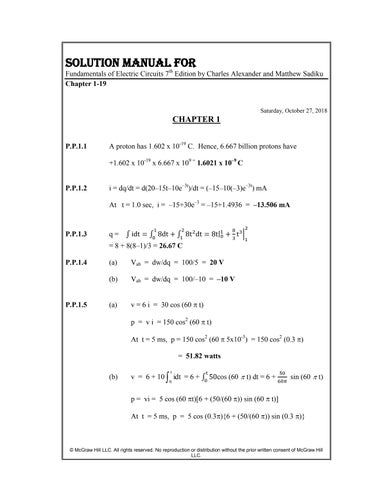
A proton has 1.602 x 10⁻¹⁹ C. Hence, 6.667 billion protons have +1.602 x 10-19 x 6.667 x 109 = 1.6021 x 10⁻⁹ C
P.P.1.2
i = dq/dt = d(20–15t–10e–3t)/dt = (–15–10(–3)e–3t) mA At t = 1.0 sec, i = –15+30e–3 = –15+1.4936 = –13.506 mA
P.P.1.3
q= ∫
∫
∫
|
|
= 8 + 8(8–1)/3 = 26.67 C P.P.1.4
P.P.1.5
(a)
Vab = dw/dq = 100/5 = 20 V
(b)
Vab = dw/dq = 100/–10 = –10 V
(a)
v = 6 i = 30 cos (60 t) p = v i = 150 cos2 (60 t) At t = 5 ms, p = 150 cos2 (60 5x10⁻³) = 150 cos2 (0.3 ) = 51.82 watts
(b)
v = 6 + 10 idt = 6 + ∫ t
0
cos (60 t) dt = 6 +
sin (60 t)
p = vi = 5 cos (60 t)[6 + (50/(60 )) sin (60 t)] At t = 5 ms, p = 5 cos (0.3){6 + (50/(60 )) sin (0.3 )}
© McGraw Hill LLC. All rights reserved. No reproduction or distribution without the prior written consent of McGraw Hill LLC.
=5(0.58779)(6+(0.26526)(0.80902)) = 18.264 watts
P.P.1.6
p = v i = 115 x 12 = 1380 watts; w = p x t W = 1380x24 = 33.12 k watt-hours p1 = 5(–45) = –225 w
P.P.1.7
p2 = 2(45) = 90 w p3 = 0.12xI(20) = 0.6(25)(20) = 60 w p4 = 3(25) = 75 w Note that all the absorbed power adds up to zero as expected.
dn = –1.6 x 10-19 x 1013 = –1.6 x 10⁻⁶ A dt p = v0 i = 25 x 103 x (1.6 x 10-6) = 40 mW
P.P.1.8
i = dq/dt = e
P.P.1.9
Minimum monthly charge
= $12.00
First 100 kWh @ $0.16/kWh
= $16.00
Next 160 kWh @ $0.10/kWh
= $16.00
Remaining 0 kWh @ $0.06/kWh
= $0.00
Total Charge = $44.00 Average cost = $44/[100+160+0] = 16.923 cents/kWh P.P.1.10
This assigned practice problem is to apply the detailed problem solving technique to some of the more difficult problems of Chapter 1.
Tuesday, November 13, 2018 © McGraw Hill LLC. All rights reserved. No reproduction or distribution without the prior written consent of McGraw Hill LLC.
CHAPTER 2
P.P.2.1
i = V/R = 110/15 = 7.333 A
P.P.2.2
(a)
v = iR = 3 mA[10 kohms] = 30 V
(b)
G = 1/R = 1/10 kohms = 100 µS
(c)
p = vi = 30 volts[3 mA] = 90 mW
P.P.2.3
p = vi which leads to i = p/v = [30 cos2 (t) mW]/[15cos(t) mA]
or i = 2cos(t) mA R = v/i = 15cos(t)V/2cos(t)mA = 7.5 k
P.P.2.4
5 branches and 3 nodes. The 1 ohm and 2 ohm resistors are in parallel. The 4 ohm resistor and the 10 volt source are also in parallel.
P.P.2.5
Applying KVL to the loop we get: –32 + 4i – (–8) + 2i = 0 which leads to i = 24/6 = 4A v1 = 4i = 16 V and
P.P.2.6
v2 = –2i = –8 V
Applying KVL to the loop we get: –70 + 10i + 2vx + 5i = 0 But, vx = 10i and v0 = –5i. Hence, –70 + 10i + 20i + 5i = 0 which leads to i = 2 A.
© McGraw Hill LLC. All rights reserved. No reproduction or distribution without the prior written consent of McGraw Hill LLC.
Thus, vx = 20V and v0 = –10 V
Applying KCL, 0 = –9 + i0 + [i0 /4] + [v0 /8], but i0 = v0/2
P.P.2.7
Which leads to: 9 = (v0/2) + (v0/8) + (v0/8) thus, v0 = 12 V and i0 = 6 A P.P.2.8
2 + –
10V
i1
+ V1 – Loop 1
i3
4
+ V3 –
i2 + V2 –
– +
Loop 2
8
6V
At the top node,
0 = –i1 + i2 + i3 or i1 = i2 + i3
(1)
For loop 1 or
–10 + V1 + V2 = 0 V1 = 10 – V2
(2)
For loop 2 or
– V2 + V3 – 6 = 0 V3 = V2 + 6
(3)
Using (1) and Ohm’s law, we get (V1/2) = (V2/8) + (V3/4) and now using (2) and (3) in the above yields [(10 – V2)/2] = (V2/8) + (V2 + 6)/4 or
[7/8]V2 = 14/4 or V2 = 4 V
V1 = 10 – V2 = 6 V, V3 = 4+6 = 10 V, i1 = (10–4)/2 = 3 A, i2 = 4/8 = 500 mA, i3 = 2.5 A
P.P.2.9
Req
4
3
6
4
4
5
© McGraw Hill LLC. All rights reserved. No reproduction or distribution without the prior written consent of McGraw Hill LLC.
3
3
Combining the 4 ohm, 5 ohm, and 3ohm resistors in series gives 4+3+5 = 12. But, 4 in parallel with 12 produces [4x12]/[4+12] = 48/16 = 3ohm. So that the equivalent circuit is shown below.
4
Req
3
3
6
3 Thus, Req = 4 + 3 + [6x6]/[6+6] = 10
20
P.P.2.10 16
Req
5 20
18
1
9
2
Combining the 9 ohm resistor and the 18 ohm resistor yields [9x18]/[9+18] = 6 ohms.
© McGraw Hill LLC. All rights reserved. No reproduction or distribution without the prior written consent of McGraw Hill LLC.