lOMoARcPSD|11700591
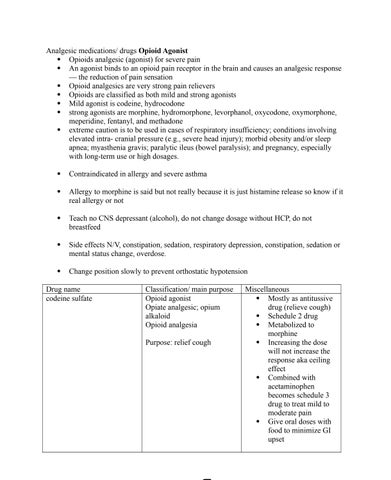
Analgesic medications/ drugs Opioid Agonist Opioids analgesic (agonist) for severe pain An agonist binds to an opioid pain receptor in the brain and causes an analgesic response — the reduction of pain sensation Opioid analgesics are very strong pain relievers Opioids are classified as both mild and strong agonists Mild agonist is codeine, hydrocodone strong agonists are morphine, hydromorphone, levorphanol, oxycodone, oxymorphone, meperidine, fentanyl, and methadone extreme caution is to be used in cases of respiratory insufficiency; conditions involving elevated intra- cranial pressure (e.g., severe head injury); morbid obesity and/or sleep apnea; myasthenia gravis; paralytic ileus (bowel paralysis); and pregnancy, especially with long-term use or high dosages.
Contraindicated in allergy and severe asthma
Allergy to morphine is said but not really because it is just histamine release so know if it real allergy or not
Teach no CNS depressant (alcohol), do not change dosage without HCP, do not breastfeed
Side effects N/V, constipation, sedation, respiratory depression, constipation, sedation or mental status change, overdose.
Change position slowly to prevent orthostatic hypotension
Drug name codeine sulfate
Classification/ main purpose Opioid agonist Opiate analgesic; opium alkaloid Opioid analgesia Purpose: relief cough
Miscellaneous Mostly as antitussive drug (relieve cough) Schedule 2 drug Metabolized to morphine Increasing the dose will not increase the response aka ceiling effect Combined with acetaminophen becomes schedule 3 drug to treat mild to moderate pain Give oral doses with food to minimize GI upset
lOMoARcPSD|11700591
meperidine HCl trade name: Demerol)
Opioid agonist Opioid analgesic Synthetic opioid analgesic (schedule II) Purpose: treat acute pain
Meperidine use not recommended because of the unpredictable effects of neuro metabolites at analgesic doses and risk for seizures
used with caution - in elderly - in patients who require long-term pain medication - who have kidney dysfunction. Oral and injectable forms NOT FOR LONG TERM PAIN TREATMENT Used for acute pain post op and in emergency room methadone HCl trade name: Dolophine
Opioid agonist Opioid analgesic Synthetic opioid analgesic (schedule II)
Purpose: detoxification treatment of opioids addicts
morphine sulfate
Opioid agonist Prototype all opioid drugs Schedule II controlled substance
Purpose: treat severe pain
Eliminated through liver so can be used in renal impairment patient. May cause cardiac dysrhythmia Drug accumulates in tissues and slowly released Allowing 24 hours dosing Half life longer than duration of activity High abuse potential Oral, injectable, rectal, epidural form Toxic metabolite morphine 6 glucuronide will accumulate in renal patient so do not give to renal impaired patients Do not give CNS
lOMoARcPSD|11700591
propoxyphene HCl trade name: Darcocet
Opioid analgesic Mild agonist
oxycodone hydrochloride
Opioid agonist Similar to morphine
Fentanyl
Opioid agonist Synthetic opioid Schedule II Purpose: treat moderate to severe pain/ manage break through and procedural pain
depressant with this drug because CNS depression can occur In 2010 removed from market due to adverse effects Combined with acetaminophen to make Percocet Only available orally High abuse potential Transdermal patches, parenteral injection , buccal forms, oral Injectable uses: in ICU for sedation and pre-op Transdermal and oral uses: long term control of malignant pain and nonmalignant chronic pain Transdermal/ patch information Treats cancer induced pain for those who cannot swallow and best or non-escalating pain Do not give patch to opioid naïve, acute pain patient and post op patient Patches take 6-12 hours for pain control gives pain control for 72 hours Change patch every 72 hours remove old patch Do not give heating pad or put in hot area with patch
lOMoARcPSD|11700591
Partial agonist also called agonist- antagonist Agonists-antagonists Substances that bind to a receptor and cause a partial response that is not as strong as that caused by an agonist (also known as a partial agonist) Partial agonist has limited action Lower risk of misuse and addiction Contraindicated in allergy Used for short term pain control such as obstetric procedures Do not give with full opioid agonist it can cause withdrawal symptoms Maybe used in patient with opioid addiction Do not give for chronic or cancer pain pentazocine and nalbuphine have ceiling effect Drug name butorphanol
Classification Partial agonist
Miscellaneous When giving IV infuse for over 3-5 minutes Not available to be combined with naloxone Trans nasal form available
nalbuphine
Partial agonist
pentazocine
Partial agonist
IV doses of 10 mg give for over 5 minutes Subcu, IV and IM forms Give IV form of 5 mg for over 5 minutes
Opioid antagonist Name
They are competitive antagonists with a strong affinity for these binding sites. Through such binding they can reverse the adverse effects induced by the opioid drug, such as respiratory depression. These drugs are used in the management of both opioid overdose and opioid addiction Careful titration of dose until patient breathe independently Works as blocking drug for opioid agonist Adverse effect opioid withdrawal symptoms Contraindicated: allergy May need repeated doses every 2-3 minutes Classification
Miscellaneous
lOMoARcPSD|11700591
Naxolone
Opioid antagonist
Short lived last about an hour
Trade name: Narcan
Purpose: severe respiratory depression and treatment of opioid overdose
Injectable form only available
Opioid analgesics combination drugs Do not give to patient with allergy oral only Name Classification Percocet Combination of oxycodone and acetaminophen Vicodin non–Schedule II opioids hydrocodone and acetaminophen combination Vicodin ES 7.75 mg of hydromorphone and 750 mg of acetaminophen Vicodin HP 10 mg of hydromorphone and 660 mg of acetaminophen Tylenol w codeine
Miscellaneous
Used mostly for pediatrics
Non opioid analgesic drugs Do not take if liver dysfunction and allergy Mild-moderate pain usually treated with non-opioids: Acetaminophen or NSAID’s Name Classification Miscellaneous Acetaminophen Analgesic and antipyretic Contraindicated: Purpose: treat mild to allergy, severe liver moderate pain and fever disease, and the genetic disease known as glucose-6phosphate dehydrogenase (G6PD) deficiency. Maximum daily dose