lOMoARcPSD|11700591
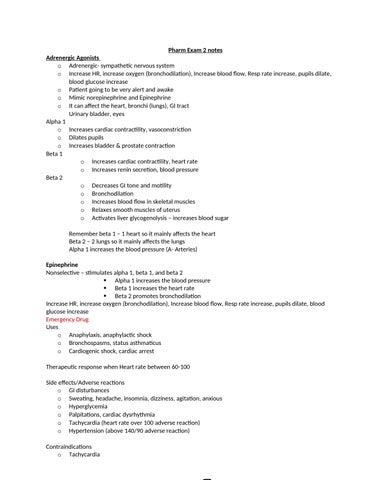
Pharm Exam 2 notes Adrenergic Agonists o Adrenergic- sympathetic nervous system o Increase HR, increase oxygen (bronchodilation), Increase blood flow, Resp rate increase, pupils dilate, blood glucose increase o Patient going to be very alert and awake o Mimic norepinephrine and Epinephrine o It can affect the heart, bronchi (lungs), GI tract Urinary bladder, eyes Alpha 1 o Increases cardiac contractility, vasoconstriction o Dilates pupils o Increases bladder & prostate contraction Beta 1 o Increases cardiac contractility, heart rate o Increases renin secretion, blood pressure Beta 2 o Decreases GI tone and motility o Bronchodilation o Increases blood flow in skeletal muscles o Relaxes smooth muscles of uterus o Activates liver glycogenolysis – increases blood sugar Remember beta 1 – 1 heart so it mainly affects the heart Beta 2 – 2 lungs so it mainly affects the lungs Alpha 1 increases the blood pressure (A- Arteries) Epinephrine Nonselective – stimulates alpha 1, beta 1, and beta 2 Alpha 1 increases the blood pressure Beta 1 increases the heart rate Beta 2 promotes bronchodilation Increase HR, increase oxygen (bronchodilation), Increase blood flow, Resp rate increase, pupils dilate, blood glucose increase Emergency Drug Uses o Anaphylaxis, anaphylactic shock o Bronchospasms, status asthmaticus o Cardiogenic shock, cardiac arrest Therapeutic response when Heart rate between 60-100 Side effects/Adverse reactions o GI disturbances o Sweating, headache, insomnia, dizziness, agitation, anxious o Hyperglycemia o Palpitations, cardiac dysrhythmia o Tachycardia (heart rate over 100 adverse reaction) o Hypertension (above 140/90 adverse reaction) Contraindications o Tachycardia
lOMoARcPSD|11700591
o Glaucoma (due to dilation of the pupils is going to increase pressure in the eye) o Labor (vasoconstricting of the vessels occur and will stop blood flow to the baby) Caution o Hypertension o Prostatic hypertrophy o Diabetes mellitus Interactions o MAOI’s tricyclic antidepressants – intensify and prolong effect o Beta blockers – block effect o Digoxin – can increase risk of dysrhythmia o Lab – increases blood sugar Assessment o Vital signs (pt will be placed on a monitor) o Medication/medical history (what if they were on morphine and overdose on it then we can just give naloxone and we can use epinephrine) o Current symptoms o Baseline glucose level Nursing interventions o Monitor blood pressure, heart rate and urine output o Monitor IV site for infiltration. Give IV push slowly (1 mg/minute) unless in cardiac arrest we will give it faster o Patient on cardiac monitor when giving IV o Monitor for side effects/adverse reactions – report hypertension, irregular heart rate, tachycardia o Monitor blood glucose in diabetic patients with long term use (albuterol) Teaching o The side effects/adverse reactions to report (palpitations) o Avoid drugs that increase the blood pressure such as cold medication and diet pills o Avoid adrenergic when breastfeeding o Nasal sprays should only be used 3-5 days o Take medication as prescribed o How to use inhaled drugs or drops – return demonstration Epi-Pen Teaching o If pt uses it they need to call 911 o Inform provider if EpiPen is used more than twice a week o Have EpiPen with you at all times o Do not refrigerate EpiPen but store in cool, dark place o Use EpiPen at first sign of reaction o Inspect the contents for particles and do not use if particles are pink or brown o Inject subcutaneously in the outer thigh and hold in place for 5-10 seconds o After administration massage the injection site o Report side effects/adverse reactions
lOMoARcPSD|11700591
Adrenergic blockers Action o Block the alpha1 receptor sites (A- Arteries) o Results in vasodilation, decreased blood pressure, pupil constriction, reduces contraction of the smooth muscle in the bladder neck and prostate o THEY DO NOTHING TO THE HEART RATE Use o Antihypertensive o Benign prostatic hypertrophy (BPH) o Reynaud’s disease All drugs in this class end in ‘sin’- these drugs work mainly on the vessels Beta Blockers -LOL Action Beta 1 Blocker o Blocks beta adrenergic receptor sites o Decreases movement of epinephrine o Suppresses renin-angiotensin-aldosterone system Beta2 o Bronchoconstriction o Contracts uterus o inhibits glycogenolysis o Leads to hypoglycemia Uses o Antihypertensive o Angina o Heart failure o Dysrhythmias
Drugs in this class end in ‘olol’ – these drugs work on the heart and vessels Selective versus non-selective Drug starts with A-M more selective to beta 1 have less of a chance of causing bronchoconstriction Drug starts with N-Z non-selective and blocks beta 1 and beta 2
Side effects/Adverse reactions: Opposite of adrenergic drugs o Drowsy, dizzy, headaches o Depression, decreased libido o Orthostatic hypotension o Bradycardia, hypotension o Masking of hypoglycemia Contraindications o Heart block, bradycardia o Asthma (unless selective beta 1 – these begin with letters A-M as a rule – atenolol. These are safer than non-selective) o Pregnancy Caution o Renal dysfunction