BTEC Business Level 3
Narges Ahmadi
Unit 1: Exploring Business
Learning Aim C: To examine the environment in which businesses operate. Task 1 (P4) – Discuss the internal, external and competitive environment of a given business Task 2 (M3) - Assess the effects of the business environment on a given business
The Environment (P4) In this section to examine the environment which businesses operate, I will be discussing External, internal and competitive environment.
External Environment
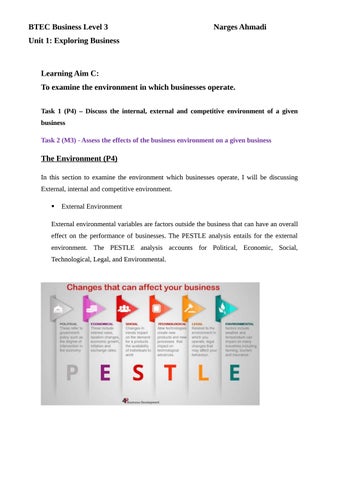
External environmental variables are factors outside the business that can have an overall effect on the performance of businesses. The PESTLE analysis entails for the external environment. The PESTLE analysis accounts for Political, Economic, Social, Technological, Legal, and Environmental.
Internal Environment
The internal environment is a part of the business that influences the performance of companies. This could include staff, executives and more. Corporate culture, CSR and ethics are often considered in the internal setting. Corporate culture refers to the attitudes and practices that decide how the personnel and management of an organization communicate and perform external business transactions. Corporate culture is always inferred, not explicitly specified, and evolves from the collective characteristics of the people the organization hires organically over time. The culture of an organization will be expressed in its dress code, working hours, workplace configuration, employee compensation, turnover, hiring decisions, customer service, and customer loyalty. Corporate social responsibility (CSR) is a business strategy of self-regulation that allows an organization to be socially responsible for itself, its stakeholders and the public. Companies should be mindful of the type of effect they have on all facets of society, including economic, social and environmental aspects, by exercising corporate social responsibility, also called corporate citizenship. In relation to arguably contentious issues such as corporate governance, insider trading, bribery, sexism, corporate social responsibility and fiduciary obligations, business ethics relates to the enforcement of effective business policies and practices. Business ethics is always guided by the law, but business ethics at other times offer a clear guideline that corporations may choose to obey to achieve public acceptance.
Competitive Environment
The competitive environment applies to any company selling within a market the same or similar goods. John Lewis & Partners and Tesco, for instance, are Marks and Spencer's rivals.
External Environment (M&S) The external environment of M&S can be addressed by using PESTLE, I will be using all 6 factors to assess Marks and Spencer.
1) Political factors (P4) The two political factors affect Marks and Spencer are Corporation tax and the National wage. 1.1 Corporation Tax. (P4) A corporate tax is a levy on a company's income. Taxes are charged on the net income of a company, which is income minus the cost of products sold, expenditures of general and administration, sales and marketing, research and growth, depreciation, and other operating costs.
The UK's income tax remains at 19 percent. Corporate tax was strong in 2010, sitting at 28 percent. This meant corporations were losing more money, and because of the corporate tax rates, others were unable to keep their profits steady. Investors were motivated by the corporate tax to invest in firms. After 2010, the income tax was dropped to help corporations recover after the recession of 2008/9 and to get their revenues back up. There have been a lot of results since the fall in the corporate tax rate. Company is making money again, policy reforms have been made that raise sales, and loss limits have been implemented.
The Labour Party reveals how it aims to raise corporate tax to 26 percent in 2019. In their platform, one of their proposals is to raise income tax to 26pc. For companies that produce an annual turnover of under £ 300,000, their price would be 21pc.
Assessment on the effect on M&S (M3) Today, the reform in corporate tax could have a much more positive effect on M&S than on the Labour Party. The corporate rate currently stands at 19%, which is relatively low, meaning that now Marks and Spencer's will make more profit than they were when the corporation tax was higher. However, they will boost the corporate tax rate if the Labour Party wins, and M&S can make less profit since they will be taxed higher. Company typically measures its performance through sales and profit. Corporation tax rates shifting overtime M&S may be affected either positively or negatively. If tax taxes raise the total income of companies, which means that businesses will need to increase their revenue, they can do so by providing more discounts or encouraging more. Businesses would also have to consider cutting expenses by firing workers. By attracting more customers by providing more sales deals, they would need to boost their sales. Both of these can affect the overall benefit of Marks and Spencer. As a consequence of the global pandemic, the Government has expended an additional GBP 200 billion on the economy and the latest lockdown would add another £40 billion. The government is paying for this by using the money they have earned from taxation. These taxes shall include income tax and corporate tax. They can however, earn more tax from corporate tax. Therefore, income tax could be high to ensure that the government has enough money to cover unforeseen costs.
1.2 National Wage (P4) All UK workers are entitled to a National Minimum Wage (NMW). This is the national wage per hour where all work is supposed to be completed. The national minimum wage was introduced in the United Kingdom on 1 April 1999. The National Minimum Wage was introduced by the Labour Government in 1998 but only came into effect in 1999. The National Minimum Wage Act was passed to ensure that all workers earned a decent amount of money that would help to sustain their livelihoods. The National Living Wage is the statutory minimum wage payable to staff in the United Kingdom aged 25 years and over, which entered into practise on 1 April 2016. As of April 2020, it is £8.72 per hour for those aged 25 and over, £8.20 for those aged 21–24, £6.45 for those aged 18–20. Currently, the minimum wage for 16-17 is £4.55.
The Living Wage is set up by the Living Wage Foundation. There is a rate for the United Kingdom and a rate for London. The UK Living Wage is £9.30 per hour and the London Living Wage is £10.75 per hour for 2020-21. The living wage Salaries are based on the cost of living. The Resolution Foundation (a think tank aimed at raising the living conditions of low-and middle-income families) measures the prices and is overseen by the Living Wage Foundation.