Narges Ahmadi
Unit 1: Exploring Business Learning Aim A To achieve learning Aim A, I will be exploring the features of different businesses and analyse what makes them successful.
P1 Introduction The two contrasting businesses I will be discussing are Marks and Spencer (M&S) and the National society for Prevention of Cruelty to Children (NSPCC.)
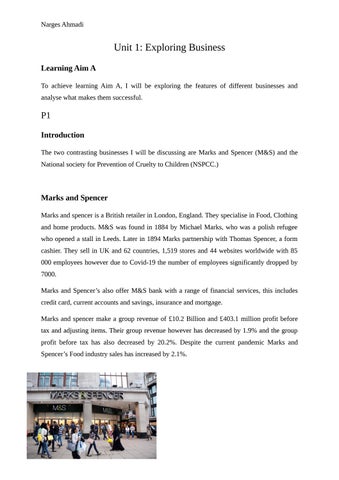
Marks and Spencer Marks and spencer is a British retailer in London, England. They specialise in Food, Clothing and home products. M&S was found in 1884 by Michael Marks, who was a polish refugee who opened a stall in Leeds. Later in 1894 Marks partnership with Thomas Spencer, a form cashier. They sell in UK and 62 countries, 1,519 stores and 44 websites worldwide with 85 000 employees however due to Covid-19 the number of employees significantly dropped by 7000. Marks and Spencer’s also offer M&S bank with a range of financial services, this includes credit card, current accounts and savings, insurance and mortgage. Marks and spencer make a group revenue of £10.2 Billion and £403.1 million profit before tax and adjusting items. Their group revenue however has decreased by 1.9% and the group profit before tax has also decreased by 20.2%. Despite the current pandemic Marks and Spencer’s Food industry sales has increased by 2.1%.
Narges Ahmadi
Types of Organisations There are 3 type of organisations the private, public and non-profit organisation.
o Private sector- includes man different types of businesses. There is sole trader, Partnerships, Franchise, Co-Operative, Private limited company (PLC) and Public limited company (LTD) -
Sole trader: a sole trader is any business that is owned and controlled by one individual Although they may have employ workers they are still the sole owner of the business. Examples of sole traders are such as plumbers, hairdressers or convenience stores
- Partnership: is when two or more people are owners of a business. They have shared control over the business and share profit together. examples of partnerships doctors, dentists and solicitors.
- Franchise: when a business gets an authorisation from a company or group to use their name and logo. This enables the business to sell the franchisor’s goods/service. The franchisee has to pay a portion of their revenue to the franchisor. An example of franchise is KFC.
- Co-Operative: is a member owned business that is owned by at least 5 people. All of the members are allowed to equal vote nevertheless of their involvement or amount of investment however all members are expected to contribute in helping the business run and flourish. An example of a Co-Operative is thehive.
Narges Ahmadi
- Public limited company (PLC): is a company that offers their shares to the public on the stock exchange market. They allow the public to invest into their business. An example of a public limited company is Tesco. -
Private limited company LTD): is a company that offers shares to only family and friends also they have a limited amount of shareholder of up to 50.
A private sector is run and owned by individuals aimed to make as much as profit as possible, this profit benefits the owners, shareholders and investors. o Public sector-
the public sector are organisations that are operated and run by the
government to provide services to the public. These organisations do not pursue to make profit like the private sector does. Examples are state schools, social care, National health service. o Not-for-Profit/ voluntary sector- is an independent sector that help create impact in society rather than generate profit. This is any charity work. Their main aim is to raise awareness to current issues and to help people by raising funds. Examples of this sector are Environmental Protection UK, World vision, social welfare organisation: Human Rights.
The Not-for profit/voluntary sector are run by trustees. These organisations aim to help specific issues. Marks and Spencer- is a public limited company and a part of the private sector as its main objective is to generate profit.
Marks and Spencer’s liability There are two types of liability: 1. Limited liability- when a business has limited liability it means that the owners personal assets are not at risk as the company is separate from the owners, meaning the owners would not have to deal with debts but the company will. The owners and
Narges Ahmadi investors contribution to the business will not be at risk. An example of limited liability company is amazon.
2. Unlimited liability- when a business has unlimited liability It means the owner will be responsible for any loss within the business. The owner’s personal assets are at risk such as car or house. Sole traders tend to have unlimited liability. An example of unlimited liability company is Equitable Life Assurance Society. 3. Private sectors consist of limited and unlimited liability, the Public sector has unlimited liability, and the Not-for-Profit/ Voluntary Sector has limited liability. Marks and Spencer’s have limited liability so if there any losses in the business, the business will be responsible not the owners and investors.
Purpose of Marks and Spencer What is the purpose of a business? The purpose of a business is to produce goods and services for customers. The purpose of a business depends on the sector, for private sectors lower costs to generate as much a profit as possible unless it’s a non-profit organisation. Marks and Spencer only purpose is not just to make profit and grow but also to produce goods and services to maintain customer satisfactions on the want sand needs, this way they build customer loyalty Moreover, they contribute to charities to help society. The difference between goods and services o Goods- are tangible items that consumers purchase. Examples of goods are supermarket, o Services- are intangible, it an activity or support offered by a business. Examples of services are car wash., doctors, law firms.
Narges Ahmadi
Example of Goods
Example of a Service
The purpose of Non-profit sector is unlike compared to the private and public sector. The factor being private sectors focuses on lower costs to generate profit in contrast to a Nonprofit organisation’s focus is to raise awareness to current issues in society and raise funds to help these issues. They do not make profit.
Sector o The four sectors businesses operate are in: primary, secondary, tertiary and quaternary. -
Primary: this comprises obtaining raw materials. For example, coal and metals that have to be mined. This sector is also known as extractive production.
-
Secondary: this is the manufacturing and assembly process. This stage involves transforming raw material into components., for example making plastic out of oil. It also involves assembling the product, for example building and bridge and road
-
Tertiary: this is the commercial services that support the production and delivery process, for example insurance, transport, advertising and other services such as teaching and health care
-
Quaternary: the industry that provide information services such as computing and information communication technology.