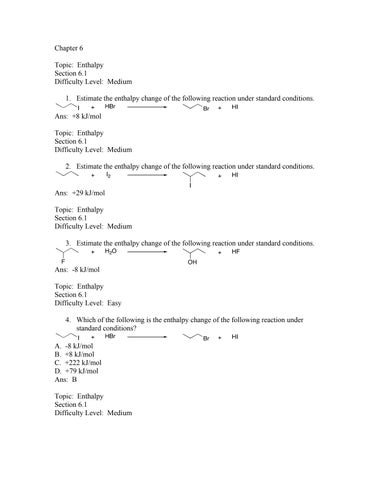
Chapter 6 Topic: Enthalpy Section 6.1 Difficulty Level: Medium 1. Estimate the enthalpy change of the following reaction under standard conditions. Ans: +8 kJ/mol Topic: Enthalpy Section 6.1 Difficulty Level: Medium 2. Estimate the enthalpy change of the following reaction under standard conditions.
Ans: +29 kJ/mol Topic: Enthalpy Section 6.1 Difficulty Level: Medium 3. Estimate the enthalpy change of the following reaction under standard conditions.
Ans: -8 kJ/mol Topic: Enthalpy Section 6.1 Difficulty Level: Easy 4. Which of the following is the enthalpy change of the following reaction under standard conditions? A. -8 kJ/mol B. +8 kJ/mol C. +222 kJ/mol D. +79 kJ/mol Ans: B Topic: Enthalpy Section 6.1 Difficulty Level: Medium
5. Which of the following is the enthalpy change of the following reaction under standard conditions?
A. -8 kJ/mol B. +8 kJ/mol C. -506 kJ/mol D. +63 kJ/mol Ans: A Topic: Enthalpy Section 6.1 Difficulty Level: Medium 6. Later in the course, we will compare the halogenation of differently substituted carbons, comparing reactions like the ones below. Which of the following statements is true about reactions A and B?
A. Both reactions have a positive heat of reaction (Ho) B. Neither reaction has a positive heat of reaction (Ho) C. Only reaction A has a positive heat of reaction (Ho) D. Only reaction B has a positive heat of reaction (Ho) Ans: B Topic: Enthalpy Section 6.1 Difficulty Level: Medium 7. Later in the course, we will compare the halogenation of differently substituted carbons, comparing reactions like the ones below. Which of the following reactions has a more exothermic heat of reaction (Ho)?
A. Reaction A has a more exothermic heat of reaction (Ho) B. Reaction B has a more exothermic heat of reaction (Ho) C. Both reactions have the same heat of reaction (Ho) Ans: B
Topic: Enthalpy Section 6.1 Difficulty Level: Hard 8. You are working in a research laboratory and have developed a new reagent that cleaves C-H bonds homolytically. Unfortunately, this reagent can achieve only one of the transformations shown below. In light of bond dissociation energies, which transformation is most likely to be achieved?
Ans: A Topic: Enthalpy Section 6.1 Difficulty Level: Easy 9. What type of bond cleavage does the following reaction involve? A. homolytic B. heterolytic Ans: A Topic: Enthalpy Section 6.1 Difficulty Level: Easy 10. What type of bond cleavage does the following reaction involve?
Ans: heterolytic Topic: Entropy Section 6.2 Difficulty Level: Easy 11. Predict the sign of S of the following reaction.
A. positive B. negative C. no change Ans: B Topic: Entropy Section 6.2 Difficulty Level: Easy 12. Predict the sign of S of the following reaction.
A. positive B. negative C. no change Ans: A Topic: Entropy Section 6.2 Difficulty Level: Easy 13. Predict the sign of S of the following reaction.
A. positive B. negative C. no change Ans: B Topic: Entropy Section 6.2 Difficulty Level: Medium 14. Predict the sign of S of the following reaction.
Ans: positive Topic: Entropy Section 6.2 Difficulty Level: Medium
15. Predict the sign of S of the following reaction.
Ans: negative
Topic: Entropy Section 6.2 Difficulty Level: Hard 16. Why is the entropy change negative for ring closures? A. Closing a ring results in fewer molecules. B. Closing a ring results in more molecules. C. Closing a ring releases energy. D. Closing a ring restricts the rotation around individual carbon-carbon bonds. Ans: D Topic: Entropy Section 6.2 Difficulty Level: Hard 17. Which of the following would you expect to have the most negative S?
Ans: D Topic: Entropy Section 6.2 Difficulty Level: Hard 18. Of following reactions, which one(s) would you expect to have a negative S?