lOMoARcPSD|11448692
1
The mountain gorilla is an endangered species with as few as 880 individuals surviving in the wild. Many of the animals have been ‘habituated’ to human contact. The health of these animals is monitored and medical assistance is given when necessary. Animals that are not habituated are rarely visited.
i. Suggest one advantage and one disadvantage of keeping some gorilla families that have not been habituated.
advantage: less likely to catch disease from humans - exhibit natural behaviour disadvantage: could be wiped out by disease - if they do need medical assistance
[2]
- more difficult to count
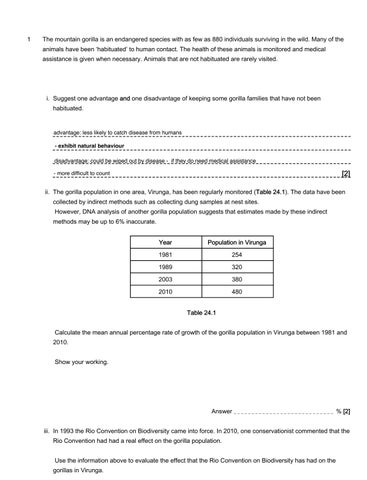
ii. The gorilla population in one area, Virunga, has been regularly monitored (Table 24.1). The data have been collected by indirect methods such as collecting dung samples at nest sites. However, DNA analysis of another gorilla population suggests that estimates made by these indirect methods may be up to 6% inaccurate. Year
Population in Virunga
1981
254
1989
320
2003
380
2010
480 Table 24.1
Calculate the mean annual percentage rate of growth of the gorilla population in Virunga between 1981 and 2010. Show your working.
Answer _ _ _ _ _ _ _ _ _ _ _ _ _ _ _ _ _ _ _ _ _ _ _ _ _ _ _ _ % [2] iii. In 1993 the Rio Convention on Biodiversity came into force. In 2010, one conservationist commented that the Rio Convention had had a real effect on the gorilla population. Use the information above to evaluate the effect that the Rio Convention on Biodiversity has had on the gorillas in Virunga.
© OCR 2025. You may photocopy this page.
1 of 25
Downloaded by arshad hussain (aashi.arshad575@gmail.com)
Created in ExamBuilder
lOMoARcPSD|11448692
[3] 2
Liver cells have a high metabolic rate. Hydrogen peroxide is a metabolic product produced in significant quantities in liver cells. It needs to be removed in order to prevent serious damage to the liver cells. Hydrogen peroxide is detoxified by the enzyme catalase:
2H2O2 ⟶ 2H2O + O2
Catalase has a very high turnover number. A single catalase molecule can catalyse the breakdown of approximately 6 million hydrogen peroxide molecules every minute. Catalase is found in peroxisomes inside the liver cells. Peroxisomes are organelles surrounded by a single membrane. The activity of catalase was investigated in a laboratory, using chopped liver tissue and dilute hydrogen peroxide. When the chopped liver was added to the hydrogen peroxide large quantities of froth as bubbles of oxygen were produced in the liquid. Fig. 17.3 shows the effect of increasing enzyme concentration on the rate of the reaction.
i. Identify two variables that would need to be controlled in this laboratory investigation. 1
© OCR 2025. You may photocopy this page.
2 of 25
Downloaded by arshad hussain (aashi.arshad575@gmail.com)
Created in ExamBuilder
lOMoARcPSD|11448692
2 [1] ii. How could you control one of the variables that you identified in (i) in the laboratory investigation?
[1] iii. * Using the information, deduce why and how catalase activity is regulated inside the liver cells.
[6]
© OCR 2025. You may photocopy this page.
3 of 25
Downloaded by arshad hussain (aashi.arshad575@gmail.com)
Created in ExamBuilder