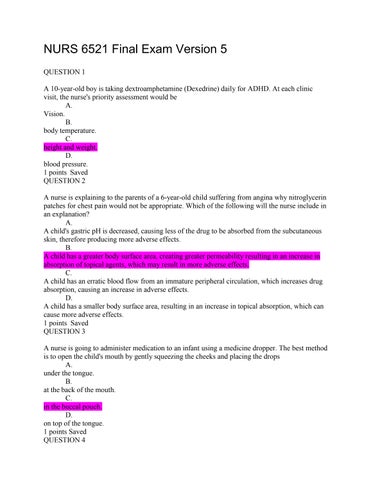
NURS 6521 Final Exam Version 5 QUESTION 1 A 10-year-old boy is taking dextroamphetamine (Dexedrine) daily for ADHD. At each clinic visit, the nurse's priority assessment would be A. Vision. B. body temperature. C. height and weight. D. blood pressure. 1 points Saved QUESTION 2 A nurse is explaining to the parents of a 6-year-old child suffering from angina why nitroglycerin patches for chest pain would not be appropriate. Which of the following will the nurse include in an explanation? A. A child's gastric pH is decreased, causing less of the drug to be absorbed from the subcutaneous skin, therefore producing more adverse effects. B. A child has a greater body surface area, creating greater permeability resulting in an increase in absorption of topical agents, which may result in more adverse effects. C. A child has an erratic blood flow from an immature peripheral circulation, which increases drug absorption, causing an increase in adverse effects. D. A child has a smaller body surface area, resulting in an increase in topical absorption, which can cause more adverse effects. 1 points Saved QUESTION 3 A nurse is going to administer medication to an infant using a medicine dropper. The best method is to open the child's mouth by gently squeezing the cheeks and placing the drops A. under the tongue. B. at the back of the mouth. C. in the buccal pouch. D. on top of the tongue. 1 points Saved QUESTION 4
A 15-year-old boy has been diagnosed with bone cancer after several months of fatigue and pain. What question should the nurse include in an assessment when trying to minimize the potential for adverse drug reactions? A. “Did Tylenol or other over-the-counter pain remedies ever relieve your pain?” B. “How much do you weigh?” C. “Do you ever use alcohol or drugs?” D. “On a scale of zero to ten, what level of pain is acceptable to you?” 1 points Saved QUESTION 5 A patient reports to a clinic with complaints of breast tenderness, a right lumpy breast, and no breast discharge. The breast tenderness occurs primarily during her menstrual cycle. The nurse practitioner probably suspects A. breast cancer. B. PMS. C. pain in the heart. D. cancerous breast tenderness. 1 points Saved QUESTION 6 A 19-year-old patient reports to a clinic with vaginal discharge with a foul odor. A microscopic exam reveals trichomonas vaginalis. The nurse practitioner is aware that A. trichomoniasis is an incurable disease. B. trichomoniasis discharge is typically thin and clear. C. asymptomatic women are diagnosed with trichomoniasis by a routine pap smear. D. it is unusual to have an odor with trichomoniasis. 1 points Saved QUESTION 7 A 6-month-old child has developed skin irritation due to an allergic reaction. He has been prescribed a topical skin ointment. The nurse will consider which of the following before administering the drug? A. That there is decreased absorption rates of topical drugs in infants
B. That there is a lower concentration of water in an infant's body compared with an adult C. That there is less body surface area to be concerned about D. That the infant's skin has greater permeability than that of an adult 1 points Saved QUESTION 8 A nurse who provides care on a pediatric medicine unit has conducted a medication reconciliation of a recently-admitted patient. In light of the fact that the child takes methylphenidate (Ritalin), the nurse is justified in considering a history of what health problem? A. Respiratory depression B. Obesity C. ADHD D. Anxiety 1 points Saved QUESTION 9 A nurse is administering drugs to a 10-year-old child who has multiple health problems. The child is underweight and is on a special diet. Which of the following will the nurse consider when planning for the best absorption of the prescribed drugs? (Select all that apply.) A. Disease process B. Weight C. Diet D. Route of administration E. Age 1 points Saved QUESTION 10 A nurse works at a weight management clinic. To which of the following overweight patients could the nurse safely administer dextroamphetamine? A. A 28-year-old African-American woman with hyperthyroidism B. A 48-year-old Caucasian man who has adult-onset diabetes C.
A 38-year-old Caucasian woman with glaucoma D. A 60-year-old African-American man who experiences angina 1 points Saved QUESTION 11 The recommended treatment for trichomoniasis is A. Flagyl. B. Meclizine. C. Amoxicillan. D. Diflucan. 1 points Saved QUESTION 12 A 30-year-old man with a BMI of 59 has recently been diagnosed with type 2 diabetes mellitus. In light of the man's lack of success with weight loss programs in the past, his care provider has prescribed sibutramine (Meridia). What instructions should the nurse consequently provide to this patient? A. “This drug will help you to lose weight without having to exercise or change your normal diet.” B. “Take this drug once each day on an empty stomach.” C. “Take a dose when you feel like you are tempted to binge on food.” D. “It's best to take a dose of sibutramine after each meal.” 1 points Saved QUESTION 13 A child is admitted to the burn unit with second and third degree burns on both arms and part of his or her face. When administering topical medications to the burned areas, the nurse should A. allow the child to apply the medication if possible. B. cool the medication prior to administration. C. use sterile technique when applying the medication. D. use clean technique only when applying the medication. 1 points Saved QUESTION 14
A patient is being seen in the emergency department for a sprained ankle and is given a drug to relieve pain. When a second dose of the pain medication is given, the patient develops redness of the skin, itching, and swelling at the site of injection of the drug. The most likely cause of this response is A. an allergic response. B. a paradoxical response. C. a hepatotoxic response. D. an idiosyncratic response. 1 points Saved QUESTION 15 A 29-year-old woman who is morbidly obese has recently begun a comprehensive, medicallysupervised program of weight reduction. Prior to adding dextroamphetamine (Dexedrine) to her regimen, the patient should be questioned about her intake of A. alcohol. B. grapefruit juice. C. caffeine. D. trans fat. 1 points Saved QUESTION 16 A nurse practitioner orders 150 mg of oral fluconazole for a patient with vulvovaginal candidiasis. The patient should expect to take medication A. once a day. B. every day until the infection is gone. C. for 30 days. D. for 20 days. 1 points Saved QUESTION 17 An immunocompromised 7-year-old child was recently discharged home with a peripherallyinserted central line (PIC line) for home antibiotic therapy. He has now been brought to the emergency department by his mother and father with signs and symptoms of line sepsis. Upon