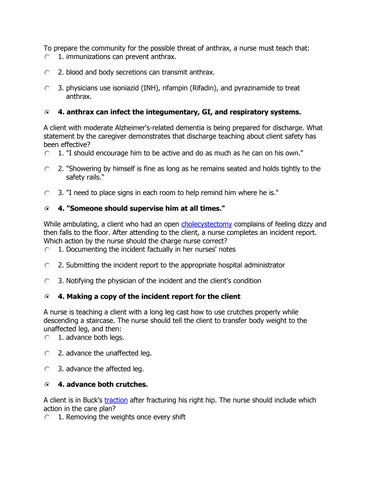
To prepare the community for the possible threat of anthrax, a nurse must teach that: 1. immunizations can prevent anthrax. 2. blood and body secretions can transmit anthrax. 3. physicians use isoniazid (INH), rifampin (Rifadin), and pyrazinamide to treat anthrax. 4. anthrax can infect the integumentary, GI, and respiratory systems. A client with moderate Alzheimer's-related dementia is being prepared for discharge. What statement by the caregiver demonstrates that discharge teaching about client safety has been effective? 1. "I should encourage him to be active and do as much as he can on his own." 2. "Showering by himself is fine as long as he remains seated and holds tightly to the safety rails." 3. "I need to place signs in each room to help remind him where he is." 4. "Someone should supervise him at all times." While ambulating, a client who had an open cholecystectomy complains of feeling dizzy and then falls to the floor. After attending to the client, a nurse completes an incident report. Which action by the nurse should the charge nurse correct? 1. Documenting the incident factually in her nurses' notes 2. Submitting the incident report to the appropriate hospital administrator 3. Notifying the physician of the incident and the client's condition 4. Making a copy of the incident report for the client A nurse is teaching a client with a long leg cast how to use crutches properly while descending a staircase. The nurse should tell the client to transfer body weight to the unaffected leg, and then: 1. advance both legs. 2. advance the unaffected leg. 3. advance the affected leg. 4. advance both crutches. A client is in Buck's traction after fracturing his right hip. The nurse should include which action in the care plan? 1. Removing the weights once every shift
2. Maintaining the bed in the knee-Gatch position 3. Keeping the client in semi-Fowler's position 4. Maintaining correct body alignment The nurse-manager of a 20-bed coronary care unit is off duty when a staff nurse makes a serious medication error. The client, who received an overdose of medication, nearly dies. Which statement accurately reflects the nurse-manager's accountability? 1. The nursing supervisor will notify the nurse-manager at home. 2. The nurse-manager is off duty; therefore, she need not be notified. 3. The nurse-manager should be informed when she returns to duty. 4. The nursing supervisor decides to call the off-duty nurse-manager if time permits A client with myasthenia gravis is receiving continuous mechanical ventilation. When the high-pressure alarm on the ventilator sounds, what should the nurse do? 1. Check for an apical pulse. 2. Suction the client's artificial airway. 3. Increase the oxygen percentage. 4. Ventilate the client with a handheld mechanical ventilator. A nurse places a client in full leather restraints. How often must the nurse check the client's circulation? 1. Once per hour 2. Once per shift 3. Every 10 to 15 minutes 4. Every 2 hours A nurse uses Nitrazine paper to determine whether a pregnant client's membranes have ruptured. If the membranes have ruptured, the paper will turn which color? 1. Pink 2. Blue 3. Yellow 4. Green A client in the manic phase of bipolar disorder arrives at the outpatient psychiatric clinic. To help the client manage a manic episode, the nurse should suggest that she:
1. go shopping with a friend. 2. read a book in a quiet room. 3. reorganize a kitchen cabinet. 4. play a game with a few friends. A nurse realizes she is 1 hour late in administering a dose of medication for a 4-year-old child. She gives the medication immediately, and assesses the child. The child isn't harmed by the delay. Which action should the nurse take next? 1. No further action is necessary. 2. The nurse should notify the physician of the error. 3. The nurse should follow facility procedures for reporting an error. 4. The nurse should document a medication error in the client's chart. A client who is disoriented and restless after sustaining a concussion during a car accident is admitted to the hospital. Which nursing diagnosis takes the highest priority in this client's care plan? 1. Disturbed sensory perception (visual) 2. Dressing or grooming self-care deficit 3. Impaired verbal communication 4. Risk for injury A nurse prepares to measure a client's blood pressure. What is the correct procedure for measuring blood pressure? 1. Wrapping the cuff around the limb, with the uninflated bladder covering about onefourth of the limb circumference 2. Measuring the arm about 2″ (5 cm) above the antecubital space 3. Wrapping the cuff around the limb, with the uninflated bladder covering about three-quarters of the limb circumference 4. Using a bladder that is 6″ (15 cm) long. An assessment of a client's orientation is best obtained by: 1. asking the client's name, where he lives, and what time it is. 2. asking the client to repeat a series of three digits spoken slowly. 3. pointing to common objects and asking the client to name them.
4. using the Glasgow Coma Scale and computing the score. When preparing a client for surgery to treat appendicitis, the nurse formulates a nursing diagnosis of Risk for infection related to inflammation, perforation, and surgery. What is the rationale for choosing this nursing diagnosis? 1. Obstruction of the appendix may increase venous drainage and cause the appendix to rupture. 2. Obstruction of the appendix reduces arterial flow, leading to ischemia, inflammation, and rupture of the appendix. 3. The appendix may develop gangrene and rupture, especially in a middle-aged client. 4. Infection of the appendix diminishes necrotic arterial blood flow and increases venous drainage. When caring for a client with severe impetigo, the nurse should include which intervention in the care plan? 1. Placing mitts on the client's hands 2. Administering systemic antibiotics as ordered 3. Applying topical antibiotics as ordered 4. Continuing to administer antibiotics for 21 days as ordered A physician orders meperidine (Demerol), 1.1 mg/kg I.M., for a 16-month-old child who has just had abdominal surgery. When administering this drug, the nurse should use a needle of which size? 1. 18G 2. 20G 3. 23G 4. 27G A nurse is to collect a sputum specimen from a client. The best time to collect this specimen is: 1. early in the evening. 2. any time during the day. 3. in the morning, as soon as the client awakens. 4. before bedtime.
An infant requires cardiorespiratory monitoring. A nurse must locate and clean the necessary equipment, move it into the infant's room, and secure it to the bedside wallmounting device. Which principles should a nurse use to complete this task safely? 1. Principles of geometry and mathematics 2. Principles of ergonomics and geometry 3. Principles of sterile technique and mathematics 4. Principles of infection control and ergonomics performing a postoperative assessment on a client who has undergone surgery to manage increased intracranial pressure (ICP), a nurse notes an ICP reading of 0 mm Hg. Which action should the nurse perform first? 1. Check the equipment. 2. Contact the physician to review the care plan. 3. Continue the assessment because no actions are indicated at this time. 4. Document the reading because it reflects that the treatment has been effective. A client received chemotherapy 24 hours ago. Which precautions are necessary when When caring for the client? 1. Wear sterile gloves. 2. Place incontinence pads in the regular trash container. 3. Wear personal protective equipment when handling blood, body fluids, and feces. 4. Provide a urinal or bedpan to decrease the likelihood of soiling linens. An 11-year-old child contracted severe acute respiratory syndrome (SARS) when traveling abroad with her parents. The nurse knows she must put on personal protective equipment to protect herself while providing care. Based on the mode of SARS transmission, which personal protective equipment should the nurse wear? 1. Gloves 2. Gown and gloves 3. Gown, gloves, and mask 4. Gown, gloves, mask, and eye goggles or eye shield