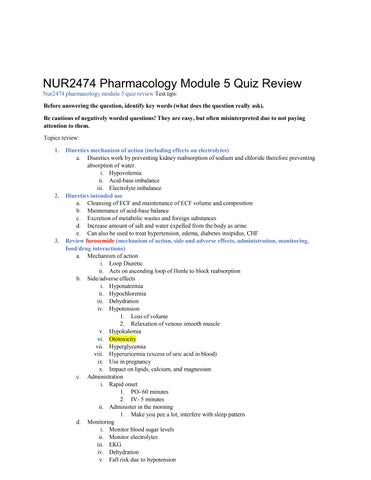
NUR2474 Pharmacology Module 5 Quiz Review Nur2474 pharmacology module 5 quiz review Test tips: Before answering the question, identify key words (what does the question really ask). Be cautious of negatively worded questions! They are easy, but often misinterpreted due to not paying attention to them. Topics review: 1.
2.
3.
Diuretics mechanism of action (including effects on electrolytes) a. Diuretics work by preventing kidney reabsorption of sodium and chloride therefore preventing absorption of water. i. Hypovolemia ii. Acid-base imbalance iii. Electrolyte imbalance Diuretics intended use a. Cleansing of ECF and maintenance of ECF volume and composition b. Maintenance of acid-base balance c. Excretion of metabolic wastes and foreign substances d. Increase amount of salt and water expelled from the body as urine e. Can also be used to treat hypertension, edema, diabetes insipidus, CHF Review furosemide (mechanism of action, side and adverse effects, administration, monitoring, food/drug interactions) a. Mechanism of action i. Loop Diuretic ii. Acts on ascending loop of Henle to block reabsorption b. Side/adverse effects i. Hyponatremia ii. Hypochloremia iii. Dehydration iv. Hypotension 1. Loss of volume 2. Relaxation of venous smooth muscle v. Hypokalemia vi. Ototoxicity vii. Hyperglycemia viii. Hyperuricemia (excess of uric acid in blood) ix. Use in pregnancy x. Impact on lipids, calcium, and magnesium c. Administration i. Rapid onset 1. PO- 60 minutes 2. IV- 5 minutes ii. Administer in the morning 1. Make you pee a lot, interfere with sleep pattern d. Monitoring i. Monitor blood sugar levels ii. Monitor electrolytes iii. EKG iv. Dehydration v. Fall risk due to hypotension
4.
vi. Furosemide and gentamicin (antibiotic) should not be mixed due to acoustic damage —tinnitus vii. Kidney function 1. Creatinine a. 0.84 to 1.21 mg/dl 2. Creatinine clearance: a. Men—110 to 150 ml/min b. Women—100 to 130 ml/min 3. Bun a. 10-20 mg/dl e. Food/drug interactions i. Digoxin ii. Ototoxic drugs iii. Potassium-sparing diuretics iv. Lithium v. Antihypertensive agents vi. NSAIDs vii. Gentamicin Types of Diuretics a. Loop Diuretics i. Furosemide (Lasix): potassium wasting. will help you get ride of fluid in the lungs. Used to treat pulmonary, edematous states (swollen from fluid), hypertension. Interacts with potassium sparring diuretics because loop diuretics make you lose potassium and potassium-sparring diuretics make you save potassium. ii. Must give potassium with this type of diuretic. iii. (Pink frothy sputum is a side effect if patient has pulmonary edema) b.
Thiazide Diuretics i. Benzothiazide diuretics are not as potent as loop diuretics but produce similar effects and have similar side effects. Not as effective if patient has poor urine flow such as a patient with damaged kidneys. ii. Side effects: hyponatremia, hypochloremia, dehydration, hypokalemia, use cautiously in pregnancy and lactation, hyperglycemia, hyperuricemia. Ototoxicity. (not mix with other ototoxic drugs) iii. Hydrochlorothiazide: Most widely used. Peaks in 4 to 6 hours. Used for HTN, edema, and Diabetes insipidus. Same side effects as above. Also impacts lipids, calcium, and magnesium.
c.
Osmotic Diuretics: promotes diuresis by creating osmotic force within lumen of the nephron. Given parenterally (IV). Treats renal failure, reduces intracranial and intraocular pressure. i. Mannitol: 1.
Side effects: edema, headache, nausea, vomiting, fluid, and electrolyte imbalance.
d.
Potassium-sparing Diuretics: increase in urine production. Substantial decrease in potassium excretion. Do not increase potassium with this medication. Stay away from potassium rich foods.
i. Spironolactone (Aldactone): Blocks aldosterone (Aldosterone Antagonist) in the distal nephron. Causes retention of potassium. Increases sodium excretion. Treats hypertension, heart failure, acne in young women, edematous states, premenstrual syndrome, polycystic ovary syndrome. 1.
Side effects: hyperkalemia, benign and malignant tumors, endocrine effects, gynecomastia (enlargement of breast tissue in males)
ii. Triamterene e.
Side effects of Loop Diuretics: dehydration, hyponatremia, hypokalemia, hypotension, ototoxicity (toxic to the ear. Ototoxic drugs should not be mixed with other ototoxic drugs.)
5.
6.
Ace inhibitors mechanism of action (angiotensin 1 to 2 conversion, effects on aldosterone, and potassium) a. Prevents angiotensin conversion from 1 to 2 b. Reduce levels of angiotensin ii c. Increase levels of bradykinin d. Dilation of arterioles and veins e. Effects on potassium and aldosterone i. Predisposes to potassium retention 1. Hyperkalemia ii. Due to the effect on angiotensin ii which inhibits aldosterone release iii. If you do not have aldosterone doing its job on the kidneys, you end up with hyperkalemia. iv. Aldosterone regulates blood volume and blood pressure. f. Prevents i. Mi, stroke, death in patients with high cardiovascular risk g. Therapeutic uses i. HTN ii. HF iii. MIS iv. Diabetic/nondiabetic nephropathy h. Drug interactions i. Diuretics ii. Antihypertensive agents iii. Potassium sparing diuretics iv. Lithium v. NSAIDs i. Examples of ACE inhibitors i. Captopril and moexipril—ending in “pril” or Ace inhibitors side and adverse effects (A-avoid pregnancy, A-angioedema, C-cough, E-elevated potassium) a. First-dose hypotension i. Change position slowly ii. Ask for assistance b. Fetal injury—do not give to pregnant women c. Dry cough i. Patients that can no tolerate ACE inhibitors due to the DRY COUGH may need to switch to ARBs (Angiotensin 2 Receptor Blockers). ARBs do not have the coughing symptom. d. Angioedema i. Potentially life-threatening—become an ICU patient