lOMoARcPSD|11700591
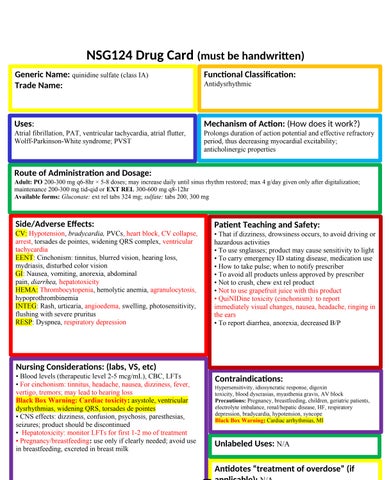
NSG124 Drug Card (must be handwritten) Generic Name: quinidine sulfate (class IA) Trade Name:
Functional Classification:
Uses:
Mechanism of Action: (How does it work?)
Atrial fibrillation, PAT, ventricular tachycardia, atrial flutter, Wolff-Parkinson-White syndrome; PVST
Antidysrhythmic
Prolongs duration of action potential and effective refractory period, thus decreasing myocardial excitability; anticholinergic properties
Route of Administration and Dosage:
Adult: PO 200-300 mg q6-8hr × 5-8 doses; may increase daily until sinus rhythm restored; max 4 g/day given only after digitalization; maintenance 200-300 mg tid-qid or EXT REL 300-600 mg q8-12hr Available forms: Gluconate: ext rel tabs 324 mg; sulfate: tabs 200, 300 mg
Side/Adverse Effects:
CV: Hypotension, bradycardia, PVCs, heart block, CV collapse, arrest, torsades de pointes, widening QRS complex, ventricular tachycardia EENT: Cinchonism: tinnitus, blurred vision, hearing loss, mydriasis, disturbed color vision GI: Nausea, vomiting, anorexia, abdominal pain, diarrhea, hepatotoxicity HEMA: Thrombocytopenia, hemolytic anemia, agranulocytosis, hypoprothrombinemia INTEG: Rash, urticaria, angioedema, swelling, photosensitivity, flushing with severe pruritus RESP: Dyspnea, respiratory depression
Patient Teaching and Safety:
• That if dizziness, drowsiness occurs, to avoid driving or hazardous activities • To use snglasses; product may cause sensitivity to light • To carry emergency ID stating disease, medication use • How to take pulse; when to notify prescriber • To avoid all products unless approved by prescriber • Not to crush, chew ext rel product • Not to use grapefruit juice with this product • QuiNIDine toxicity (cinchonism): to report immediately visual changes, nausea, headache, ringing in the ears • To report diarrhea, anorexia, decreased B/P
Nursing Considerations: (labs, VS, etc)
• Blood levels (therapeutic level 2-5 mcg/mL), CBC, LFTs • For cinchonism: tinnitus, headache, nausea, dizziness, fever, vertigo, tremors; may lead to hearing loss Black Box Warning: Cardiac toxicity: asystole, ventricular dysrhythmias, widening QRS, torsades de pointes • CNS effects: dizziness, confusion, psychosis, paresthesias, seizures; product should be discontinued • Hepatotoxicity: monitor LFTs for first 1-2 mo of treatment • Pregnancy/breastfeeding: use only if clearly needed; avoid use in breastfeeding, excreted in breast milk
Contraindications:
Hypersensitivity, idiosyncratic response, digoxin
toxicity, blood dyscrasias, myasthenia gravis, AV block Precautions: Pregnancy, breastfeeding, children, geriatric patients, electrolyte imbalance, renal/hepatic disease, HF, respiratory depression, bradycardia, hypotension, syncope Black Box Warning: Cardiac arrhythmias, MI
Unlabeled Uses: N/A Antidotes “treatment of overdose” (if
lOMoARcPSD|11700591
NSG124 Drug Card (must be handwritten) Generic Name: lidocaine (class IB) Trade Name: lidopen auto injector
Functional Classification:
Uses:
Mechanism of Action: (How does it work?)
Ventricular tachycardia, ventricular dysrhythmias during cardiac surgery, digoxin toxicity, cardiac catheterization
Antidysrhythmic
Increases electrical stimulation threshold of ventricle, HisPurkinje system, which stabilizes cardiac membrane, decreases automaticity
Route of Administration and Dosage:
Ventricular arrhythmias caused by MI, cardiac manipulation/glycosides • Adult: IV BOL 50-100 mg (1-1.5 mg/kg) 25-50 mg/min, repeat q5min until arrhythmias are controlled, max 300 mg in 1 hr; begin IV INFUSION; IV INFUSION 1-4 mg/min (20-50 mcg/kg/min) • Child: IV/INTRAOSSEUS BOL 1 mg/kg; start infusion at 30 mcg/kg/min Renal/hepatic dose with heart failure • Adult <50 kg: IV reduce dose Available forms: IV INFUSION 0.2% (2 mg/mL), 0.4% (4 mg/mL), 0.8% (8 mg/mL); IV 4% (40 mg/mL), 10% (100 mg/mL), 20% (200 mg/mL); IV dir 1% (10 mg/mL), 2% (20 mg/mL); Inj (to IV admix) 20% (200 mg/mL)
Side/Adverse Effects:
CNS: Headache, dizziness, involuntary movement, confusion, tremor, drowsiness, euphoria, seizures, shivering CV: Hypotension, bradycardia, heart block, CV collapse, arrest EENT: Tinnitus, blurred vision GI: Nausea, vomiting, anorexia HEMA: Methemoglobinemia INTEG: Rash, urticaria, edema, swelling, petechiae, pruritus MISC: Febrile response, phlebitis at inj site RESP: Dyspnea, respiratory depression
Nursing Considerations: (labs, VS, etc)
• ECG continuously to determine increased PR or QRS segments; if these develop, discontinue or reduce rate; watch for increased ventricular ectopic beats, may have to rebolus; B/P • Drug levels: therapeutic level 1.5-5 mcg/mL • I&O ratio, electrolytes (potassium, sodium, chlorine) • Toxicity: monitor for seizures, confusion, tremors; if these occur, discontinue immediately, notify prescriber; keep emergency equipment nearby • Malignant hyperthermia: tachypnea, tachycardia, changes in B/P, increased temperature • Respiratory status: rate, rhythm, lung fields for crackles, watch for respiratory depression; lung fields, bilateral crackles may occur with HF; increased respiration, pulse; product should be discontinued • CNS effects: dizziness, confusion, psychosis, paresthesias, convulsions; product should be discontinued • Pregnancy/breastfeeding: use only if clearly needed; use caution in breastfeeding, excreted in breast milk
Patient Teaching and Safety:
• About the use of automatic lidocaine injection device if ordered for personal use • To report signs of toxicity immediately
Contraindications:
Hypersensitivity to amides, severe heart block, supraventricular dysrhythmias, Adams-Stokes syndrome, Wolff-Parkinson-White syndrome Precautions: Pregnancy, breastfeeding, children, geriatric patients, renal/hepatic disease, HF, respiratory depression, malignant hyperthermia, myasthenia gravis, weight <50 kg
Unlabeled Uses: Attenuation of intracranial
pressure increased during intubation/endotracheal tube suctioning
Antidotes “treatment of overdose” (if applicable):
O2, artificial ventilation, ECG; administer DOPamine for circulatory depression, diazepam or thiopental for seizures; decrease product if needed
lOMoARcPSD|11700591
NSG124 Drug Card (must be handwritten) Generic Name: amiodarone Trade Name: cordarone
Functional Classification:
Uses:
Mechanism of Action: (How does it work?)
Hemodynamically unstable ventricular tachycardia, supraventricular tachycardia, ventricular fibrillation not controlled by 1st-line agents
Antidysrhythmic (class III)
Prolongs duration of action potential and effective refractory period, noncompetitive α- and β-adrenergic inhibition; increases PR and QT intervals, decreases sinus rate, decreases peripheral vascular resistance
Route of Administration and Dosage:
Ventricular dysrhythmias Adult: PO Loading dose 800-1600 mg/day for 1-3 wk, then 600-800 mg/day for 1 mo, maintenance 400 mg/day; IV loading dose (1st rapid) 150 mg over the first 10 min, then slow 360 mg over the next 6 hr, maintenance 540 mg given over the remaining 18 hr, decrease rate of the slow infusion to 0.5 mg/min Supraventricular tachycardia • Adult: PO 600-800 mg/day × 1 wk until desired response, then decrease to 400 mg/day × 3 wk, then 200-400 mg/day (maintenance) • Child: PO 10 mg/kg/day × 10 days or until desired response, then decrease to 5 mg/kg/day for several wk, then decrease to 2.5 mg/kg/day or lower (maintenance) Conversion of atrial fibrillation to sinus rhythm (unlabeled) • Adult: IV 5-7 mg/kg over 30-60 min, then 1.2-1.8 mg/kg CONT IV INFUSION or PO divided doses Available forms: Tabs 100, 200, 400 mg; inj 50 mg/mL
Side/Adverse Effects:
CNS: Headache, dizziness, involuntary movement, tremors, peripheral neuropathy, malaise, fatigue, ataxia, paresthesias, insomnia, confusion, hallucinations CV: Hypotension, bradycardia, HF, dysrhythmias EENT: Corneal microdeposits, dry eyes ENDO: Hypo/hyperthyroidism GI: Nausea, vomiting, diarrhea, abdominal pain, anorexia, constipation, hepatotoxicity, pancreatitis GU: Epididymitis, ED INTEG: Rash, photosensitivity, bluegray skin discoloration, alopecia, spontaneous ecchymosis, toxic epidermal necrolysis, urticaria, pancreatitis, phlebitis (IV) MISC: Flushing, abnormal taste or smell, edema, abnormal salivation RESP: Pulmonary fibrosis/toxicity, ARDS
Nursing Considerations: (labs, VS, etc)
Black Box Warning: Cardiac dysrhythmias: ECG continuously to determine effectiveness; measure PR, QRS, QT intervals; check for PVCs, other dysrhythmias, B/P continuously for hypo/hypertension; report dysrhythmias, slowing heart rate; monitor amiodarone level: therapeutic 1-2.5 mcg/mL; toxic >2.5 mcg/mL Black Box Warning: Pulmonary toxicity: dyspnea, fatigue, cough, fever, chest pain; product should be discontinued; for ARDS, pulmonary fibrosis, crackles, tachypnea, increased at higher doses (>400 mg/day), toxicity is common, monitor chest x-ray, pulmonary function tests with diffusion capacity • Stevens-Johnson syndrome: monitor for rash, blistering; discontinue immediately, notify prescriber Black Box Warning: Hepatotoxicity: monitor hepatic enzymes; rarely fatal hepatotoxicity has occurred • Electrolytes (sodium, potassium, chloride); hepatic studies: AST, ALT, bilirubin, alk phos; for dehydration, hypovolemia; monitor PT, INR if using warfarin • CNS symptoms: confusion, psychosis, numbness, depression, involuntary movements; product should be discontinued • Hypothyroidism: lethargy; dizziness; constipation; enlarged thyroid gland; edema of extremities; cool, pale skin • Hyperthyroidism: restlessness; tachycardia; eyelid puffiness; weight loss; frequent urination; menstrual irregularities; dyspnea; warm, moist skin; may cause fatal thyrotoxicosis, cardiac dysrhythmias; may need to discontinue product • Ophthalmic exams at baseline and periodically (PO); to prevent corneal deposits, use methylcellulose • Cardiac rate, respirations: rate, rhythm, character, chest pain; start with patient
Patient Teaching and Safety:
• To take this product as directed; to avoid missed doses; not to use with grapefruit juice; not to discontinue abruptly, not to use other drugs, herbs without prescriber approval, many interactions • To use sunscreen or stay out of sun to prevent burns; that dark glasses may be needed for photophobia • To report side effects immediately; more common at high dose and longer duration • That skin discoloration is usually reversible • To report vision changes, weight change, rash, blistering, numbness, temperature intolerance • Pregnancy/breastfeeding: Identify if pregnancy is planned or suspected or if breastfeeding; not to be used in pregnancy, breastfeeding
Contraindications:
Pregnancy, breastfeeding, neonates, infants, severe sinus node dysfunction, hypersensitivity to this product/iodine/benzyl alcohol, cardiogenic shock, 2nd- to 3rd-degree AV block, bradycardia Precautions: Children, goiter, Hashimoto’s thyroiditis, electrolyte imbalances, HF, respiratory disease, torsades de pointes Black Box Warning: Hepatotoxicity, cardiac arrhythmias, pneumonitis, pulmonary fibrosis; requires an experienced clinician
Unlabeled Uses: Atrial fibrillation
treatment/prophylaxis, atrial flutter, cardiac arrest, cardiac surgery, CPR, heart failure, PSVT, Wolff-Parkinson-White (WPW) syndrome, supraventricular tachycardia
Antidotes “treatment of overdose” (if applicable): O2, artificial ventilation, ECG, administer