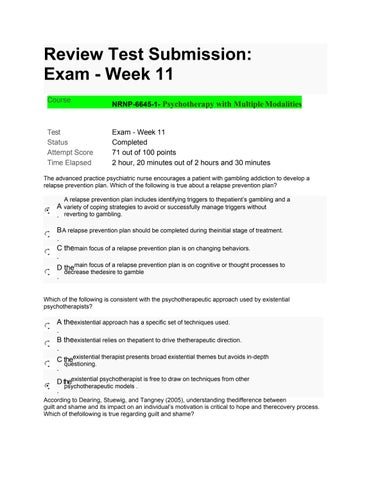
Review Test Submission: Exam - Week 11 Course
Test Status Attempt Score Time Elapsed
NRNP-6645-1- Psychotherapy with Multiple Modalities
Exam - Week 11 Completed 71 out of 100 points 2 hour, 20 minutes out of 2 hours and 30 minutes
The advanced practice psychiatric nurse encourages a patient with gambling addiction to develop a relapse prevention plan. Which of the following is true about a relapse prevention plan? A relapse prevention plan includes identifying triggers to thepatient’s gambling and a
A variety of coping strategies to avoid or successfully manage triggers without . reverting to gambling. B A relapse prevention plan should be completed during theinitial stage of treatment. . C themain focus of a relapse prevention plan is on changing behaviors. . D themain focus of a relapse prevention plan is on cognitive or thought processes to decrease thedesire to gamble . Which of the following is consistent with the psychotherapeutic approach used by existential psychotherapists?
A theexistential approach has a specific set of techniques used. . B theexistential relies on thepatient to drive thetherapeutic direction. . C theexistential therapist presents broad existential themes but avoids in-depth questioning. . D theexistential psychotherapist is free to draw on techniques from other psychotherapeutic models . . According to Dearing, Stuewig, and Tangney (2005), understanding thedifference between guilt and shame and its impact on an individual’s motivation is critical to hope and therecovery process. Which of thefollowing is true regarding guilt and shame?
A Shame drives a person to engage in treatment while guilt drives a person to avoid treatment. . B Shame causes a person to perceive self as a failure and guilt causes avoidance of treatment. . C Guilt causes a person to perceive himself as a loser and shame drives a person to avoid treatment. . D Shame drives avoidance from treatment, Guilt often motivates a person to seek treatment. . Which of thefollowing is not consistent with what is known about relapse?
A Relapse indicates treatment failure. . B Relapse is a persistent risk in addiction. . C Relapse is a characteristic of all chronic medical diseases. . D Relapse is thereturn to substance use or addictive behaviors after periods of abstinence. . The advanced practice psychiatric nurse proficient in Interpersonal Psychotherapy (IPT) is working with an older adult who does not realize she has depression. Which of thefollowing is true?
A IPT is not an appropriate model for treating depression in older adults. . B This is a common IPT issue with older adults during theinitial sessions. . C theadvanced practice psychiatric nurse should consider using a standardized scale to quantify thedepression and use this to educate thepatient and thefamily. . D B and C . The patient in Dialectical Behavior Therapy (DBT) complains theskills being taught in DBT don’t work, struggles with keeping diary cards, and doing assigned homework. This is consistent with which stage of treatment within theDBT model? A Stage 1
.
B Stage 2 . C Stage 3 . D Stage 4 . The existential concept of an openness, readiness, and flexibility to grow and change, which necessitates a capacity to choose alternatives, and shape one’s own destiny as authors of creating their own world is which of thefollowing?
A Freedom . B Responsibili ty . C Authenticity . D Meaning . Which of thefollowing is not consistent with a family-centered approach in child therapy?
A In family-centered treatment, thefamily is thefocus of treatment. . B Family- centered treatment is appropriate to improve family interactions. . C Family-centered treatment is appropriate to keep families engaged in services . D Family-centered treatment is appropriate to increase family knowledge about mental health. . The Gestalt therapist notices thepatient is fidgeting with fingers, legs are shaking and asks the patient “What are you experiencing right now in your body?” This is a type of creative experimentation known as which of thefollowing?
A Focusing . B Body awareness . C Language of responsibility .
D Empty-chair dialogue . The advanced practice psychiatric nurse is working with a group of patients in an outpatient substance abuse treatment program. One patient comes to theadvanced practice psychiatric nurse after thegroup session and asks if theadvanced practice psychiatric nurse would meet at a nearby Starbucks to clarify a couple of questions that came up at theend of thesession and fears relapse. Which of thefollowing would be consistent with thetraditional therapeutic frame?
A Given concerns about relapse it would be important to meet with thepatient just this . one time and just for 10 minutes but meet in your office. B Remind thepatient that one of therules is not having contact outside of therapy sessions. . C Agree to meet with patient alone in thegroup room to resolve any outstanding concerns from thegroup. . D Agree to meet with thepatient at Starbucks briefly to discuss theunresolved issues, but only this once and only for 10 minutes. . Which of thefollowing statements would not be consistent with thehumanistic-existential concept of “holism” ?
A People are unique. . B thewhole is greater than thesum of its parts. . C Mind, body, spirit work in a unified synergistic fashion. . D Dysfunctions such as a chemical imbalance must be .
Which of thefollowing statements would not be consistent with thehumanistic-existential concept of “holism” ?
A People are unique. . B thewhole is greater than thesum of its parts. . C Mind, body, spirit work in a unified synergistic fashion. .
D Dysfunctions such as a chemical imbalance must be identified. . Stigma of mental illness in theelderly:
A Has contributed to psychiatric symptoms being expressed with physical symptoms. . B Is much more severe in baby boomers than in other elderly cohorts. . C Is much less an issue in baby boomers than in other elderly cohorts . D Leads to more discussion of emotions in primary care settings. . The advanced practice psychiatric nurse encourages theolder adult to recall long forgotten experiences, events which are memorable to theperson. This is known as
A Life Review Therapy (LRT) . B Reminiscence Therapy (RT) . C A Mindfulness Strategy . D Interpersonal Psychotherapy (IPT) . The advanced practice psychiatric nurse is working with a patient who states she believes her boss hates her. After some discussion, it is clear thepatient has strong negative feelings towards her boss. theadvanced practice psychiatric nurse working within a Gestalt framework, recognizes this as an interruption consistent with which of thefollowing?
A Projection . B Retroflecti on . C Confluenc e . D Deflection . The most effective treatment for SUD with or without co-morbid psychiatric disorders is:
A Multidimensional addressing medical, psychosocial and mental health issues . B Trauma-informed care. . C 12-Step Peer Support Groups