Nervous tissue and the conduction of nerve impulses.
• We do much work in our day to day life and each activity is a result of coordination of several organs of our body. • This coordination is maintained by the nervous system both voluntary and involuntary. • There are millions of neurons throughout our body which collectively form nerves. • Let’s see the organization of nervous system. • A single neuron is covered by its endoneurium. • Bundle of neurons is covered by the epineurium. • Several bundles of neurons are covered by the epineurium and are called the nerve.
Anatomy of a neuron.
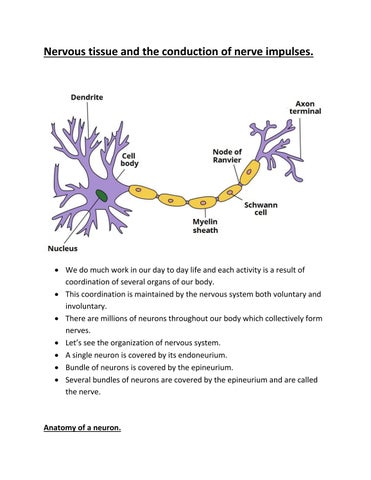
• Neurons can transmit impulses away and as well as towards the neuron cell body. • Sensory neurons conduct impulses from sensory organs toward the cell body. • Motor neurons transmit impulses away from the cell body toward the target organs. • Intermediate neurons are found in between sensory and motor neurons. • A neuron is wrapped with neuroglia. • This is times thicker than the axon and it provides nutrition to the nerve. • The neuron has a large cell body star shaped or irregular shaped. • It contains the usual cell organelles that a typical animal cell has. • But it does not have centrioles so neurons can’t undergo mitosis. • There is a long extension starting from the cell body known as the axon. • The place where the axon starts is called the axonhilloc. • Axon is covered with Schwann cells which are type of fat. • Schwann cells are not uniformly present around the axon so it is of no uniform diameter. • The place where there are no Schwann cells is called a Ranvier node and the distance between 2 nodes is called an internode. • There are some short extensions arise from the cell body known as dendrites that conduct impulses towards the cell body. • They are not myalinated or do not have Schwann cells wrapped with. • At the end of the axons there are synaptic bulbs which contain neurotransmitters. • They also contain numerous mitochondria to provide the energy.
How nerve conduction occurs. Nerve impulses have a domino effect. Each neuron receives an impulse and must pass it on to the next neuron and make sure the correct impulse continues on its path. Through a chain of chemical events, the dendrites (part of a neuron) pick up
an impulse that’s shuttled through the axon and transmitted to the next neuron. The entire impulse passes through a neuron in about seven milliseconds — faster than a lightning strike. Here’s what happens in just six easy steps:
Polarization of the neuron’s membrane: Sodium is on the outside, and potassium is on the inside.
Cell membranes surround neurons just as any other cell in the body has a membrane. When a neuron is not stimulated — it’s just sitting with no impulse to carry or transmit — its membrane is polarized. Not paralyzed. Polarized. Being polarized means that the electrical charge on the outside of the membrane is positive while the electrical charge on the inside of the membrane is negative. The outside of the cell contains excess sodium ions (Na+); the inside of the cell contains excess potassium ions (K+). (Ions are atoms of an element with a positive or negative charge.)
In addition to the K+, negatively charged protein and nucleic acid molecules also inhabit the cell; therefore, the inside is negative as compared to the outside.
Then, if cell membranes allow ions to cross, how does the Na+ stay outside and the K+ stay insidE? The answer is that the Na+ and K+ do, in fact, move back and forth across the membrane. There are Na+/K+ pumps on the membrane that pump the Na+ back outside and the K+ back inside. The charge of an ion inhibits membrane permeability (that is, makes it difficult for other things to cross the membrane).
• Resting potential gives the neuron a break.
When the neuron is inactive and polarized, it’s said to be at its resting potential. It remains this way until a stimulus comes along.
• Action potential: Sodium ions move inside the membrane.
When a stimulus reaches a resting neuron, the gated ion channels on the resting neuron’s membrane open suddenly and allow the Na+ that was on the outside of the membrane to go rushing into the cell. As this happens, the neuron goes from being polarized to being depolarized.
Remember that when the neuron was polarized, the outside of the membrane was positive, and the inside of the membrane was negative. Well, after more positive ions go charging inside the membrane, the inside becomes positive, as well; polarization is removed and the threshold is reached.
Each neuron has a threshold level — the point at which there’s no holding back. After the stimulus goes above the threshold level, more gated ion channels open and allow more Na+ inside the cell. This causes complete depolarization of the neuron and an action potential is created. In this state, the neuron continues to open Na+ channels all along the membrane. When this occurs, it’s an all-or-none phenomenon. “All-or-none” means that if a stimulus doesn’t exceed the threshold level and cause all the gates to open, no action potential results; however, after the threshold is crossed, there’s no turning back: Complete depolarization occurs and the stimulus will be transmitted.
When an impulse travels down an axon covered by a myelin sheath, the impulse must move between the uninsulated gaps called nodes of Ranvier that exist between each Schwann cell.
Repolarization: Potassium ions move outside, and sodium ions stay inside the membrane.
After the inside of the cell becomes flooded with Na+, the gated ion channels on the inside of the membrane open to allow the K+ to move to the outside of the membrane. With K+ moving to the outside, the membrane’s repolarization restores electrical balance, although it’s opposite of the initial polarized membrane that had Na+ on the outside and K+ on the inside. Just after the K+ gates open, the Na+ gates close; otherwise, the membrane couldn’t repolarize.
Hyperpolarization: More potassium ions are on the outside than there are sodium ions on the inside.
When the K+ gates finally close, the neuron has slightly more K+ on the outside than it has Na+ on the inside. This causes the membrane potential to drop slightly lower than the resting potential, and the membrane is said to be hyperpolarized because it has a greater potential. (Because the membrane’s potential is lower, it has more room to “grow.”). This period doesn’t last long, though (well, none of these steps take long!). After the impulse has traveled through the neuron, the action potential is over, and the cell membrane returns to normal (that is, the resting potential).
Refractory period puts everything back to normal: Potassium returns inside, sodium returns outside.