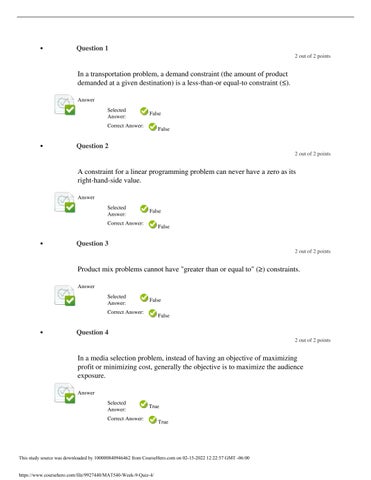
Question 1
2 out of 2 points
In a transportation problem, a demand constraint (the amount of product demanded at a given destination) is a lessthanor equalto constraint (≤). Answer Selected Answer:
False
Correct Answer:
False
Question 2
2 out of 2 points
A constraint for a linear programming problem can never have a zero as its righthandside value. Answer Selected Answer:
False
Correct Answer:
False
Question 3
2 out of 2 points
Product mix problems cannot have "greater than or equal to" (≥) constraints. Answer Selected Answer:
False
Correct Answer:
False
Question 4
2 out of 2 points
In a media selection problem, instead of having an objective of maximizing profit or minimizing cost, generally the objective is to maximize the audience exposure. Answer Selected Answer:
True
Correct Answer:
True
This study source was downloaded by 100000840946462 from CourseHero.com on 02-15-2022 12:22:57 GMT -06:00
https://www.coursehero.com/file/9927440/MAT540-Week-9-Quiz-4/
Question 5
2 out of 2 points
In a balanced transportation model, supply equals demand such that all constraints can be treated as equalities. Answer Selected Answer:
True
Correct Answer:
True
Question 6
2 out of 2 points
When using a linear programming model to solve the "diet" problem, the objective is generally to maximize profit. Answer Selected Answer:
False
Correct Answer:
False
Question 7
2 out of 2 points
If Xij = the production of product i in period j, write an expression to indicate that the limit on production of the company's 3 products in period 2 is equal to 400. Answer
Selected Answer:
Correct Answer:
X12
Question 8
2 out of 2 points
Compared to blending and product mix problems, transportation problems are unique because Answer
Selected Answer:
This study source was downloaded by 100000840946462 from CourseHero.com on 02-15-2022 12:22:57 GMT -06:00
https://www.coursehero.com/file/9927440/MAT540-Week-9-Quiz-4/
Correct Answer:
The solution values are always integers.
Question 9
2 out of 2 points
The owner of Chips etc. produces 2 kinds of chips: Lime (L) and Vinegar (V). He has a limited amount of the 3 ingredients used to produce these chips available for his next production run: 4800 ounces of salt, 9600 ounces of flour, and 2000 ounces of herbs. A bag of Lime chips requires 2 ounces of salt, 6 ounces of flour, and 1 ounce of herbs to produce; while a bag of Vinegar chips requires 3 ounces of salt, 8 ounces of flour, and 2 ounces of herbs. Profits for a bag of Lime chips are $0.40, and for a bag of Vinegar chips $0.50. What is the constraint for salt? Answer Selected Answer:
2L + 3V ≤ 4800 Correct Answer:
2L + 3V ≤ 4800
Question 10
2 out of 2 points
The following types of constraints are ones that might be found in linear programming formulations: 1. 2. 3.
≤ = >
Answer Selected Answer:
1 and 2
This study source was downloaded by 100000840946462 from CourseHero.com on 02-15-2022 12:22:57 GMT -06:00
https://www.coursehero.com/file/9927440/MAT540-Week-9-Quiz-4/
Correct Answer:
1 and 2
Question 11
2 out of 2 points
In a portfolio problem, X1, X2, and X3 represent the number of shares purchased of stocks 1, 2, an 3 which have selling prices of $15, $47.25, and $110, respectively. The investor has up to $50,000 to invest. The expected returns on investment of the three stocks are 6%, 8%, and 11%. An appropriate objective function is Answer
Selected Answer:
Correct Answer:
MAX .06(15)X1
Question 12
2 out of 2 points
Small motors for garden equipment is produced at 4 manufacturing facilities and needs to be shipped to 3 plants that produce different garden items (lawn mowers, rototillers, leaf blowers). The company wants to minimize the cost of transporting items between the facilities, taking into account the demand at the 3 different plants, and the supply at each manufacturing site. The table below shows the cost to ship one unit between each manufacturing facility and each plant, as well as the demand at each plant and the supply at each manufacturing facility.
What is the demand constraint for plant B? Answer Selected Answer:
Correct Answer:
x 1B + x 2B +x 3B = 150
This study source was downloaded by 100000840946462 from CourseHero.com on 02-15-2022 12:22:57 GMT -06:00
https://www.coursehero.com/file/9927440/MAT540-Week-9-Quiz-4/
Question 13
2 out of 2 points
The production manager for the Softy soft drink company is considering the production of 2 kinds of soft drinks: regular and diet. Two of her resources are production time (8 hours = 480 minutes per day) and syrup (1 of the ingredients) limited to 675 gallons per day. To produce a regular case requires 2 minutes and 5 gallons of syrup, while a diet case needs 4 minutes and 3 gallons of syrup. Profits for regular soft drink are $3.00 per case and profits for diet soft drink are $2.00 per case. What is the time constraint? Answer Selected Answer:
2R + 4D ≤ 480 Correct Answer:
2R + 4D ≤ 480
Question 14
2 out of 2 points
When systematically formulating a linear program, the first step is Answer Selected Answer:
Correct Answer:
Identify the decision variables
Question 15
A systematic approach to model formulation is to first Answer
Selected Answer:
Correct Answer:
This study source was downloaded by 100000840946462 from CourseHero.com on 02-15-2022 12:22:57 GMT -06:00
https://www.coursehero.com/file/9927440/MAT540-Week-9-Quiz-4/
2 out of 2 points