ch9 1.
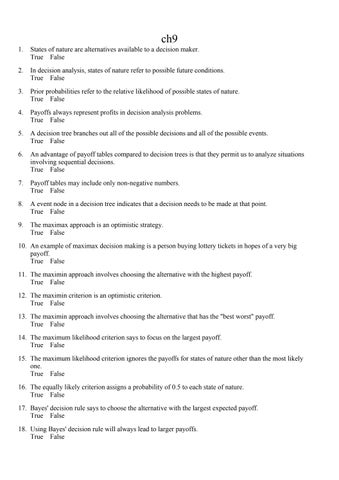
States of nature are alternatives available to a decision maker. True False
2.
In decision analysis, states of nature refer to possible future conditions. True False
3.
Prior probabilities refer to the relative likelihood of possible states of nature. True False
4.
Payoffs always represent profits in decision analysis problems. True False
5.
A decision tree branches out all of the possible decisions and all of the possible events. True False
6.
An advantage of payoff tables compared to decision trees is that they permit us to analyze situations involving sequential decisions. True False
7.
Payoff tables may include only non-negative numbers. True False
8.
A event node in a decision tree indicates that a decision needs to be made at that point. True False
9.
The maximax approach is an optimistic strategy. True False
10. An example of maximax decision making is a person buying lottery tickets in hopes of a very big payoff. True False 11. The maximin approach involves choosing the alternative with the highest payoff. True False 12. The maximin criterion is an optimistic criterion. True False 13. The maximin approach involves choosing the alternative that has the "best worst" payoff. True False 14. The maximum likelihood criterion says to focus on the largest payoff. True False 15. The maximum likelihood criterion ignores the payoffs for states of nature other than the most likely one. True False 16. The equally likely criterion assigns a probability of 0.5 to each state of nature. True False 17. Bayes' decision rule says to choose the alternative with the largest expected payoff. True False 18. Using Bayes' decision rule will always lead to larger payoffs. True False
19. Sensitivity analysis may be useful in decision analysis since prior probabilities may be inaccurate. True False 20. Graphical analysis can only be used in sensitivity analysis for those problems that have two decision alternatives. True False 21. The EVPI indicates an upper limit in the amount a decision-maker should be willing to spend to obtain information. True False 22. A posterior probability is a revised probability of a state of nature after doing a test or survey to refine the prior probability. True False 23. Bayes' theorem is a formula for determining prior probabilities of a state of nature. True False 24. The Sensit Plot tool is useful for examining the impact of changes in several data values at once. True False 25. The Sensit Spider graph is useful for examining the impact of changes in several data values at once. True False 26. An advantage of Sensit's Spider graph when compared to Sensit's Tornado chart is that it allows data values to be varied by different percentages. True False 27. A risk seeker has a decreasing marginal utility for money. True False 28. Utilities can be useful when monetary values do not accurately reflect the true values of an outcome. True False 29. Most people occupy a middle ground and are classified as risk neutral. True False 30. A utility function for money can be constructed by applying a lottery procedure. True False 31. The exponential utility function assumes a constant aversion to risk. True False 32. Two people who face the same problem and use the same decision-making methodology must always arrive at the same decision. True False 33. Which of the following is not a criterion for decision making? A. EVPI. B. Maximin. C. Maximax. D. Bayes' decision rule. E. Maximum likelihood. 34. Which one of the following statements is not correct when making decisions? A. The sum of the state of nature probabilities must be 1. B. Every probability must be greater than or equal to 0. C. All probabilities are assumed to be equal. D. Probabilities are used to compute expected values. E. Perfect information assumes that the state of nature that will actually occur is known.
35. Testing how a problem solution reacts to changes in one or more of the model parameters is called: A. analysis of tradeoffs. B. sensitivity analysis. C. priority recognition. D. analysis of variance. E. decision analysis. 36. Determining the worst payoff for each alternative and choosing the alternative with the "best worst" is the criterion called: A. minimin. B. maximin. C. maximax. D. maximum likelihood. E. Bayes decision rule. 37. The maximin criterion refers to: A. minimizing the maximum return. B. maximizing the minimum return. C. choosing the alternative with the highest payoff. D. choosing the alternative with the minimum payoff. E. None of these.
38. The maximax strategy is: A. Buy. B. Rent. C. Lease. D. High. E. Low. 39. The maximin strategy is: A. Buy. B. Rent. C. Lease. D. High. E. Low. 40. The maximum likelihood strategy is: A. Buy. B. Rent. C. Lease. D. High. E. Low. 41. The Bayes' decision rule strategy is: A. Buy. B. Rent. C. Lease. D. High. E. Low.
42. The expected value of perfect information is: A. 12. B. 55. C. 57. D. 69. E. 90.
43. The maximax strategy is: A. small. B. medium. C. medium large. D. large. E. extra large. 44. The maximin strategy is: A. small. B. medium. C. medium large. D. large. E. extra large. 45. The maximum likelihood strategy is: A. small. B. medium. C. medium large. D. large. E. extra large. 46. The Bayes' decision rule strategy is: A. small. B. medium. C. medium large. D. large. E. extra large. 47. The expected value of perfect information is: A. 4.5. B. 9. C. 40.5. D. 49.5. E. 60.
48. The maximax strategy is: A. A. B. B. C. C. D. D. E. E. 49. The maximin strategy is: A. A. B. B. C. C. D. D. E. E. 50. The maximum likelihood strategy is: A. A. B. B. C. C. D. D. E. E. 51. The Bayes' decision rule strategy is: A. A. B. B. C. C. D. D. E. E. 52. The expected value of perfect information is: A. -28. B. 0. C. 10.5. D. 19. E. 23. The operations manager for a local bus company wants to decide whether he should purchase a small, medium, or large new bus for his company. He estimates that the annual profits (in $000) will vary depending upon whether passenger demand is low, moderate, or high, as follows.
53. If he uses the maximum likelihood criterion, which size bus will he decide to purchase? A. Small. B. Medium. C. Large. D. Either small or medium. E. Either medium or large. 54. If he uses Bayes' decision rule, which size bus will he decide to purchase? A. Small. B. Medium. C. Large. D. Either small or medium. E. Either medium or large.