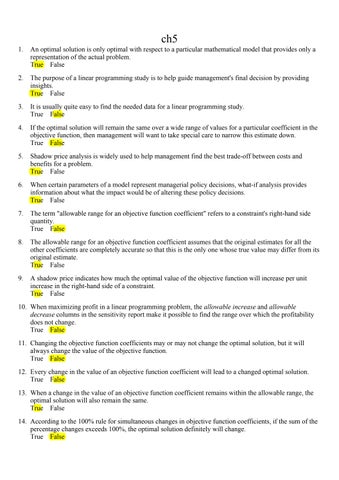
ch5 1.
An optimal solution is only optimal with respect to a particular mathematical model that provides only a representation of the actual problem. True False
2.
The purpose of a linear programming study is to help guide management's final decision by providing insights. True False
3.
It is usually quite easy to find the needed data for a linear programming study. True False
4.
If the optimal solution will remain the same over a wide range of values for a particular coefficient in the objective function, then management will want to take special care to narrow this estimate down. True False
5.
Shadow price analysis is widely used to help management find the best trade-off between costs and benefits for a problem. True False
6.
When certain parameters of a model represent managerial policy decisions, what-if analysis provides information about what the impact would be of altering these policy decisions. True False
7.
The term "allowable range for an objective function coefficient" refers to a constraint's right-hand side quantity. True False
8.
The allowable range for an objective function coefficient assumes that the original estimates for all the other coefficients are completely accurate so that this is the only one whose true value may differ from its original estimate. True False
9.
A shadow price indicates how much the optimal value of the objective function will increase per unit increase in the right-hand side of a constraint. True False
10. When maximizing profit in a linear programming problem, the allowable increase and allowable decrease columns in the sensitivity report make it possible to find the range over which the profitability does not change. True False 11. Changing the objective function coefficients may or may not change the optimal solution, but it will always change the value of the objective function. True False 12. Every change in the value of an objective function coefficient will lead to a changed optimal solution. True False 13. When a change in the value of an objective function coefficient remains within the allowable range, the optimal solution will also remain the same. True False 14. According to the 100% rule for simultaneous changes in objective function coefficients, if the sum of the percentage changes exceeds 100%, the optimal solution definitely will change. True False
15. Whenever proportional changes are made to all the unit profits in a problem, the optimal solution will remain the same. True False 16. The term "allowable range for the right-hand-side" refers to coefficients of the objective function. True False 17. If the change to a right-hand side is within the allowable range, the value of the shadow price remains valid. True False 18. If the change to a right-hand side is within the allowable range, the solution will remain the same. True False 19. A shadow price tells how much a decision variable can be increased or decreased without changing the value of the solution. True False 20. The allowable range gives ranges of values for the objective function coefficients within which the values of the decision variables are optimal. True False 21. When a change occurs in the right-hand side values of one of the constraints, a proportional change will occur in one of the coefficients of the objective function. True False 22. Managerial decisions regarding right-hand sides are often interrelated and so frequently are considered simultaneously. True False 23. If the sum of the percentage changes of the right-hand sides does not exceed 100%, then the solution will definitely remain optimal. True False 24. Solver Table re-solves the problem for a whole range of values of a data cell. True False 25. Solver Table can only be used to investigate changes in a single data cell at a time. True False 26. Solver Table can be used to easily investigate the changes in any number of data cells. True False 27. A shadow price reflects which of the following in a maximization problem? A. The marginal cost of adding additional resources. B. The marginal gain in the objective value realized by adding one unit of a resource. C. The marginal loss in the objective value realized by adding one unit of a resource. D. The marginal gain in the objective value realized by subtracting one unit of a resource. E. None of these. 28. In linear programming, what-if analysis is associated with determining the effect of changing: A. I and II B. II and III C. I, II, and III D. I and III E. None of these.
29. What-if analysis can: A. be done graphically for problems with two decision variables. B. reduce a manager's confidence in the model that has been formulated. C. increase a manager's confidence in the model that has been formulated. D. All of these. E. a. and c. only. 30. What-if analysis: A. may involve changes in the objective function coefficients. B. requires that only one parameter change while the rest are held fixed. C. may involve changes in the right-hand side values. D. All of these. E. None of these. 31. If a change is made in only one of the objective function coefficients: A. the slope of the objective function line always will change. B. the optimal solution always will change. C. one or more of the decision variables always will change. D. All of these. E. None of these. 32. If the right-hand side value of a constraint in a two variable linear programming problems is changed, then: A. the optimal measure of performance may change. B. a parallel shift must be made in the graph of that constraint. C. the optimal values for one or more of the decision variables may change. D. All of these. E. None of these. 33. Which of the following are benefits of what-if analysis? A. It pinpoints the sensitive parameters of the model. B. It gives the new optimal solution if conditions change. C. It tells management what policy decisions to make. D. All of these. E. None of these. 34. When even a small change in the value of a coefficient in the objective function can change the optimal solution, the coefficient is called: A. optimal. B. sensitive. C. out of the range. D. within the range. E. None of these. 35. In a problem with 4 decision variables, the 100% rule indicates that each objective coefficient can be safely increase by what amount without invalidating the current optimal solution? A. 25%. B. 25% of the allowable increase of that coefficient. C. 100%. D. 25% of the range of optimality. E. It can't be determined from the information given.
36. What is the optimal objective function value for this problem? A. It cannot be determined from the given information. B. $7.78. C. $240. D. $90. E. $330. 37. What is the allowable range for changes in the objective coefficient for Activity 2? A. -10 ≤ A2 ≤ 50. B. -44 ≤ A2 ≤ 16. C. -4 ≤ A2 ≤ 56. D. 30 ≤ A2 ≤ 90. E. 20 ≤ A2 ≤ 80. 38. What is the allowable range for changes in the right-hand-side for Resource C? A. 18 ≤ RHS ≤ ∞. c
B. ∞ ≤ RHS ≤ 62. c
C. -2 ≤ RHS ≤ ∞.. c
D. -∞ ≤ RHS ≤ 40. c
E. 0 ≤ RHS ≤ 22. c
39. If the coefficient for Activity 1 in the objective function changes to $40, then the objective function value: A. will increase by $77.80. B. will increase by $23. C. will increase by $30. D. will remain the same. E. can only be discovered by resolving the problem. 40. If the coefficient for Activity 3 in the objective function changes to $30, then the objective function value: A. will increase by $70. B. is $0. C. will increase by $30. D. will remain the same. E. will increase by an unknown amount. 41. If the coefficient of Activity 1 in the objective function changes to $10, then: A. the original solution remains optimal. B. the problem must be resolved to find the optimal solution. C. the shadow price is valid. D. the shadow price is not valid. E. None of these. 42. If the right-hand side of Resource A changes to 10, then the objective function value: A. will decrease by $12.50. B. will decrease by $125. C. will decrease by $77.80. D. will remain the same. E. can only be discovered by resolving the problem.
43. If the right-hand side of Resource B changes to 10, then the objective function value: A. will decrease by $120. B. will decrease by $60. C. will decrease by $20. D. will remain the same. E. can only be discovered by resolving the problem. 44. If the right-hand side of Resource B changes to 10, then: A. the original solution remains optimal. B. the problem must be resolved to find the optimal solution. C. the shadow price is valid. D. the shadow price is not valid. E. None of these. 45. If the coefficients of Activity 1 and Activity 2 in the objective function are both increased by $10, then: A. the optimal solution remains the same. B. the optimal solution may or may not remain the same. C. the optimal solution will change. D. the shadow prices are valid. E. None of these. 46. If the right-hand side of Resource B is increased by 30, and the right-hand side of Resource C is decreased by 10, then: A. the optimal solution remains the same. B. the optimal solution will change. C. the shadow prices are valid. D. the shadow prices may or may not be valid. E. None of these. 47. Which parameter is most sensitive to an increase in its value? A. The objective coefficient of Activity 1. B. The objective coefficient of Activity 2. C. The objective coefficient of Activity 3. D. All of these. E. None of these.
48. What is the optimal objective function value for this problem? A. It cannot be determined from the given information. B. $1,200. C. $975. D. $8,250. E. $500.