Hole’s Essentials of Human Anatomy & Physiology 15e Instructor’s Manual
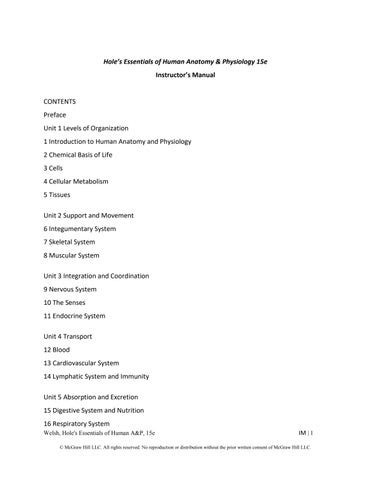
CONTENTS Preface Unit 1 Levels of Organization 1 Introduction to Human Anatomy and Physiology 2 Chemical Basis of Life 3 Cells 4 Cellular Metabolism 5 Tissues Unit 2 Support and Movement 6 Integumentary System 7 Skeletal System 8 Muscular System Unit 3 Integration and Coordination 9 Nervous System 10 The Senses 11 Endocrine System Unit 4 Transport 12 Blood 13 Cardiovascular System 14 Lymphatic System and Immunity Unit 5 Absorption and Excretion 15 Digestive System and Nutrition 16 Respiratory System Welsh, Hole's Essentials of Human A&P, 15e
IM | 1
© McGraw Hill LLC. All rights reserved. No reproduction or distribution without the prior written consent of McGraw Hill LLC.
17 Urinary System 18 Water, Electrolyte, and Acid-Base Balance Unit 6 The Human Life Cycle 19 Reproductive Systems 20 Pregnancy, Growth, Development, and Genetics Appendix A In Case Your Wondered PREFACE The Instructor’s Manual is designed to assist instructors who use Hole’s Essentials of Human Anatomy and Physiology, Fifteenth Edition, in their human anatomy and physiology courses by offering Lecture Suggestions and Guidelines, Application Questions, and Critical Thinking Issues for many of the Learning Outcomes that precede each textbook chapter. Appendix A is entitled: In Case You Wondered.
CHAPTER 1: INTRODUCTION TO HUMAN ANATOMY AND PHYSIOLOGY 1.1 Introduction Learning Outcome 1: Identify some of the early discoveries that led to our understanding of the body. 1) Lecture Suggestions and Guidelines a) Give an overview of the roles of primitive doctors. b) Compare various beliefs regarding the connection between natural forces and the human body. Welsh, Hole's Essentials of Human A&P, 15e
IM | 2
© McGraw Hill LLC. All rights reserved. No reproduction or distribution without the prior written consent of McGraw Hill LLC.
c) Identify the origins of basic terms used in the study of anatomy and physiology. 2) Application Question(s) a) Ask students to develop a chart of basic terms found in the language of anatomy and physiology. Answer: Responses should include a minimum of 50 modern terms accompanied by their Greek/Latin derivatives.
3) Critical Thinking Issue(s) a) Compare and contrast several ancient uses of herbs and potions. Answer: Students may be required to research this topic via the library, used bookstores, or Internet. 1.2 Anatomy and Physiology Learning Outcome 1: Explain how anatomy and physiology are related. 1) Lecture Suggestions and Guidelines a) Describe anatomy as the study of the structure of the human body. b) Describe physiology as the study of the function of the human body. c) Discuss ways in which the function of a body part depends upon the way it is constructed. 2) Application Question(s) a) Ask students to choose a body part and explain how its unique structure is related to its function. Answer: Some excellent examples would include the hand, (adapted for grasping), the heart, (adapted for receiving and pumping blood), the mouth, (adapted for speaking and receiving food), and the urinary bladder (adapted for storing urine). 3) Critical Thinking Issue(s) a) Ask students to consider the implications of changes in function of a body part that has been altered in structure.
Welsh, Hole's Essentials of Human A&P, 15e
IM | 3
© McGraw Hill LLC. All rights reserved. No reproduction or distribution without the prior written consent of McGraw Hill LLC.
Answer: Examples may include loss of pumping ability of the heart due to scar tissue formation, loss of the ability to grasp when the thumb, (opposable digit), is injured, inability to plantar flex and evert the foot due to injury to the peroneus muscles. 1.3 Levels of Organization Learning Outcome 1: List the levels of organization in the human body and the characteristics of each. 1) Lecture Suggestions and Guidelines a) Emphasize the fact that the body is composed of parts with different levels of organization. b) Introduce the levels of complexity from simplest to most complex, including atoms, molecules, macromolecules, cells, tissues, organs, organ systems, organism. c) Discuss how organs within a system are grouped together to accomplish a unified purpose. 2) Application Question(s) a) Ask students to apply their knowledge of levels of organization to an example outside the human body. Answer: For example, begin with a single book. Combining several books together will form a bookshelf. Several bookshelves combine to form a bookcase. Many bookcases are joined together to form a section of a library. Many sections of the library can combine to form one whole library. Many libraries are linked together to form a library system, etc. 3) Critical Thinking Issue(s) a. Ask students to describe a system from the simplest to most complex level. Answer: The skeletal system serves as an excellent example. Discussion should begin with a brief overview of atoms, molecules, and macromolecules, followed by a description of bone cells (osteocytes), which combine to form osseous tissue, which form more complex structures called bones (organs). The 206 bones of the human body, when taken together, form the skeletal system (organ system). This system combines with other organ systems to become an organism. 1.4 Characteristics of Life Welsh, Hole's Essentials of Human A&P, 15e
IM | 4
© McGraw Hill LLC. All rights reserved. No reproduction or distribution without the prior written consent of McGraw Hill LLC.
Learning Outcome 1: List and describe the major characteristics of life. 1) Lecture Suggestions and Guidelines a) Define the characteristics of life as traits that all organisms share. b) List the major characteristics of life and give an example of each. Include a discussion of growth, reproduction, responsiveness, movement, and metabolism. c) Explain to students that metabolism includes respiration, digestion, circulation, and excretion. 2) Application Question(s) a) Ask students to list the major characteristics of life and briefly describe why each characteristic is important in maintaining human life. Relate each characteristic to a specific body system. Answer: Responses should include a discussion of growth (all body systems), reproduction (reproductive system), responsiveness (nervous, endocrine, integumentary systems), movement (muscular and skeletal systems), metabolism (respiratory system (respiration), digestive system (digestion, excretion), cardiovascular system (circulation), lymphatic system (circulation), urinary system (excretion)). 3) Critical Thinking Issue(s) a) Ask students to describe the importance of monitoring vital signs and their relationships to the major characteristics of life. Answer: Vital signs include the measurement of various organ system functions that are necessary to maintain life. They include measurements of breathing, pulse, responsiveness, blood pressure, temperature, movement, reflexes, and brain activity. Learning Outcome 2: Give examples of metabolism. 1) Lecture Suggestions and Guidelines a) Define metabolism as the sum total of all the chemical reactions in the body. b) Describe respiration as an example of a metabolic process. c) Describe digestion as an example of a metabolic process. 2) Application Question(s) Welsh, Hole's Essentials of Human A&P, 15e
IM | 5
© McGraw Hill LLC. All rights reserved. No reproduction or distribution without the prior written consent of McGraw Hill LLC.