Instructor Manual: Lynn B. Hoeltke, The Complete Textbook of Phlebotomy, 2025, 9780357932797; Chapter 1: Introduction to Phlebotomy
Instructor Manual For Lynn B. Hoeltke, The Complete Textbook of Phlebotomy, 2025, 9780357932797; Chapter 1: Introduction to Phlebotomy
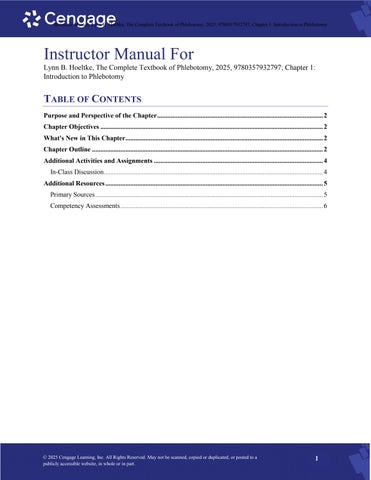
TABLE OF CONTENTS Purpose and Perspective of the Chapter ................................................................................................... 2 Chapter Objectives ..................................................................................................................................... 2 What's New in This Chapter ...................................................................................................................... 2 Chapter Outline .......................................................................................................................................... 2 Additional Activities and Assignments ..................................................................................................... 4 In-Class Discussion................................................................................................................................... 4 Additional Resources .................................................................................................................................. 5 Primary Sources ........................................................................................................................................ 5 Competency Assessments ......................................................................................................................... 6
© 2025 Cengage Learning, Inc. All Rights Reserved. May not be scanned, copied or duplicated, or posted to a publicly accessible website, in whole or in part.
1
Instructor Manual: Lynn B. Hoeltke, The Complete Textbook of Phlebotomy, 2025, 9780357932797; Chapter 1: Introduction to Phlebotomy
PURPOSE AND PERSPECTIVE OF THE CHAPTER The purpose of this chapter is to provide the basic information that is needed before one can perform phlebotomy. It outlines the duties of the people who will be working with the phlebotomist both in the laboratory and in a health care facility. The student will gain familiarity with the departments of the laboratory and the testing that is performed in each department. The student will also better understand the agencies that regulate how health care facilities must operate.
CHAPTER OBJECTIVES The following objectives are addressed in this chapter: 1. 2. 3. 4. 5. 6. 7.
Identify members of the laboratory staff. Describe the duties of laboratory staff members and their education path. Outline the phlebotomist’s responsibilities as a member of the health care team. Describe what it means to be a professional as a phlebotomist. Identify departments in the laboratory and explain their function. Identify departments within the hospital and explain their function. Identify each section of the laboratory and give examples of tests that would be performed in that section. 8. Describe the importance of communication and maintaining quality care within the laboratory and with other departments of the hospital. 9. List five patient rights and explain how these patient rights would affect a phlebotomist’s job. 10. Explain advance directives and how they can direct a patient’s care. 11. Describe the standards and agencies that govern laboratory practice. [return to top]
WHAT'S NEW IN THIS CHAPTER The following elements are improvements in this chapter from the previous edition:
Expanded discussion of areas in the hospital
[return to top]
CHAPTER OUTLINE The following outline organizes activities (including any existing discussion questions in PowerPoints or other supplements) and assessments by chapter (and therefore by topic), so that you can see how all the content relates to the topics covered in the text. I.
Phlebotomy’s Role In Health Care (PPT Slides 2–10; LO 1.1, 1.2, 1.3, 1.4, 1.5, 1.6, 1.7) a. Phlebotomists in the Hospital Setting i. Definition of the phlebotomist’s task ii. Differences between centralized and decentralized phlebotomy b. Areas of the Hospital and Health Care Settings
© 2025 Cengage Learning, Inc. All Rights Reserved. May not be scanned, copied or duplicated, or posted to a publicly accessible website, in whole or in part.
2
Instructor Manual: Lynn B. Hoeltke, The Complete Textbook of Phlebotomy, 2025, 9780357932797; Chapter 1: Introduction to Phlebotomy
i. Explanation of the different departments in the hospital ii. Nursing is the largest department interacting with phlebotomists iii. Chart of the hospital departments with definitions c. Laboratory Sections i. Laboratory sections and their purposes ii. Types of tests performed in the laboratory d. Three Phases of Sample Testing i. Preexamination ii. Examination iii. Postexamination Activity: Concept Check 1: Areas of the Hospital Concept Check 2: Area of Nursing and Type of Care II.
III.
The U.S. Health Care System and Laboratories in the Twenty-First Century (PPT Slides 10–12; LO 1.8) a. Managed care a complex system to coordinate the provision of health care services b. Health maintenance organizations formed to provide health coverage for both hospital and physician services c. Explanation of point of care testing d. Differences in types of laboratories i. Hospital laboratories ii. Regional laboratories Laboratory Staff (PPT Slides 13; LO 1.8) a. Laboratory Staff Roles i. Education requirements for phlebotomists ii. List and explain the members of the laboratory staff iii. Organizational chart/chain of command b. Certification for Laboratory Staff i. Medical Laboratory Scientist (Medical Technologist) ii. Medical Laboratory Technician iii. Phlebotomist Activity: Concept Check 3: Abbreviations and Certifications
IV.
The Patient Care Partnership (PPT Slides 14–16, LO 1.9, 1.10) a. Patient’s Bill of Rights i. Drafted in 1973 ii. Revised in 1992 iii. Replaced with Patient Care Partnership in 2003 b. Patient Rights i. The 12 patient rights defined ii. Rights and responsibilities required of phlebotomists c. Professional Attitude i. Attitude ii. Professional grooming iii. Dress code restrictions d. Advance Directives
© 2025 Cengage Learning, Inc. All Rights Reserved. May not be scanned, copied or duplicated, or posted to a publicly accessible website, in whole or in part.
3
Instructor Manual: Lynn B. Hoeltke, The Complete Textbook of Phlebotomy, 2025, 9780357932797; Chapter 1: Introduction to Phlebotomy
V.
i. Living wills ii. Power of attorney Standard Used in the Laboratory (PPT Slides 17–18; LO 1.11) a. Regulatory agencies i. The Joint Commission ii. College of American Pathologists iii. National Accrediting Agency for Clinical Laboratory Sciences iv. Clinical Laboratory Standards Institute v. Clinical Laboratory Improvement Act of 1988 vi. Occupational Safety and Health Administration b. College of American Pathologists c. State Board of Health d. Clinical Laboratory Standards Institute e. Clinical Laboratory Improvement Act i. Waived tests ii. Physician-performed microscopy tests iii. Moderate-complexity tests iv. High-complexity tests f. National Accrediting Agency for Clinical Laboratory Sciences c. Activity: Concept Check 4. Abbreviations and Certifications
VI.
Quality Assurance in Phlebotomy (PPT Slide 17; LO 2.7) a. Joint Commission’s 10 steps to a quality assurance plan b. Seven phlebotomist quality improvement areas c. Six Sigma Lean i. Helps develop workflow programs for laboratory operation ii. Helps identify and improve quality d. Quality Assurance and Quality Control i. Quality assurance standards for phlebotomists ii. Quality improvement c. Activity: Concept Check 5. Panels and Tests Concept Check 6: Requisition
[return to top]
ADDITIONAL ACTIVITIES AND ASSIGNMENTS Discuss the critical thinking questions at the end of the chapter. Divide the students into two groups, with each group covering one of the two questions. After 15 minutes, bring the class back together and have each group share their thoughts on the subject.
IN-CLASS DISCUSSION 1. What would you do if a patient wanted you to show them their test results? 2. A terminally ill patient you are ready to collect blood from says, ―I don’t want my blood drawn. I’m just going to die anyway.‖ How would you handle this situation?
© 2025 Cengage Learning, Inc. All Rights Reserved. May not be scanned, copied or duplicated, or posted to a publicly accessible website, in whole or in part.
4
Instructor Manual: Lynn B. Hoeltke, The Complete Textbook of Phlebotomy, 2025, 9780357932797; Chapter 1: Introduction to Phlebotomy
[return to top]
ADDITIONAL RESOURCES PRIMARY SOURCES
Clinical Laboratory Improvement Act (CLIA) of 1988, Personnel requirements Healthcare-associated infections (HAIs)
© 2025 Cengage Learning, Inc. All Rights Reserved. May not be scanned, copied or duplicated, or posted to a publicly accessible website, in whole or in part.
5