Instructor Solution Manual For Organizational Behaviour Improving Performance And Commitment In The Workplace 5ce Jason A. Colquitt, Jeffery A. LePine, Michael J. Wesson, Ian Gellatly Chapter 1-15
Chapter 1: What Is Organizational Behaviour?
Copyright © 2022 McGraw Hill Limited
1
NOTE FROM THE AUTHOR My name is Ian Gellatly, and I‘m the author responsible for the 5th Canadian edition of Colquitt-LePine-Wesson-Gellatly textbook, Organizational Behaviour. I want to encourage Canadian adopters to reach out to me if I can help in any way with the book. I‘m also happy to share the PowerPoints I use in my own teaching, that go along with the 5th Canadian edition of our book. The PowerPoints also include my own teaching notes. In sum, I enjoy corresponding with adopters very much, so please do not hesitate to reach out to me. My email address is ian.gellatly@ualberta.ca. CHAPTER OVERVIEW Organizational behaviour is a field of study devoted to understanding and explaining the attitudes and behaviours of individuals and groups in organizations. The two primary outcomes of organizational behaviour are job performance and organizational commitment. This chapter explores the factors that affect these outcomes, and shows how scientific studies provide evidence that good organizational behaviour policies are linked to employee productivity, firm profitability, and even firm survival. This chapter also shows how we ―know what we know‖ about organizational behaviour by describing the scientific research process. LEARNING GOALS After reading this chapter, you should be able to answer the following questions: 1.1 1.2 1.3 1.4 1.5 1.6
What is the definition of ―organizational behaviour‖ (OB)? What are the two primary outcomes in studies of organizational behaviour? What factors affect the two primary OB outcomes? Why might firms that are good at OB tend to be more profitable? What is the role of theory in the scientific method? How are correlations interpreted?
CHAPTER OUTLINE 1.
WHAT IS ORGANIZATIONAL BEHAVIOUR? Try This!: Open the very first class by asking them to picture their worst coworker ever and to list the things that person did to earn ―worst coworker‖ status. Then have them do the same with the best coworker ever, listing the things that person did to earn ―best coworker‖ status. Both of these lists should be written on the board, a process that will result in a table similar to Table 1-1. Then get them to understand the importance of explaining why the two people act so differently. That process of explanation is what OB is all about.
A.
Organizational Behaviour Defined
Copyright © 2022 McGraw Hill Limited
2
Organizational behaviour is a field of study devoted to understanding, explaining, and ultimately improving the attitudes and behaviours of individuals and groups in organizations B.
Role of Management Theory Organizational behaviour is a field of study that has an important historical context, and has evolved from several historical movements and landmark studies – including Scientific Management and the Human Relations movement
C.
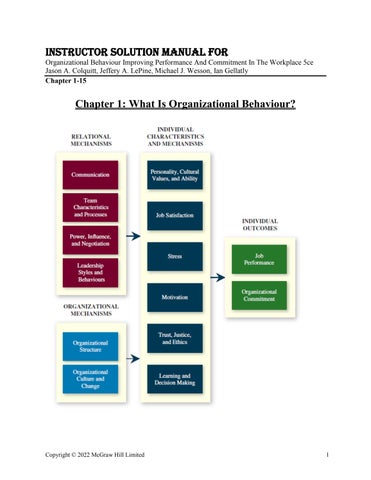
An Integrative Model of OB 1.
Provides a roadmap for the field of organizational behaviour, and shows how different chapters in the text are related
2.
Individual Outcomes – These are the two primary goals of organizational behaviour a. b.
3.
Individual Characteristics and Mechanisms - These directly affect job performance and organizational commitment a.
b. c. d. e. f.
4.
Job performance (Chapter 2) – how well employees do on the job Organizational commitment (Chapter 3) – how likely employees are to remain with an organization. Employee retention is a huge issue for many Canadian firms.
Personality, Cultural Values, and Ability (Chapter 4) – describe various individual traits and characteristics that say what we are like and what we can do Job Satisfaction (Chapter 5) – what employees feel about their work Stress (Chapter 6) – psychological responses to job demands that tax or exceed an employee‘s capabilities Motivation (Chapter 7) – energetic forces that drive an employee‘s work Trust, justice, and ethics (Chapter 8) – degree to which employees feel that their company does business with fairness, honesty, and integrity Learning and decision making (Chapter 9) – how employees gain job knowledge and use that knowledge to make decisions
Relational Mechanisms – These affect and provide a context for the individual mechanisms mentioned above a.
b.
Communication (Chapter 10) – describe the communication process as well as the different mediums information is exchanged within organizations; formal and informal communication networks Team characteristics and processes (Chapter 11) – the qualities that teams possess, including norms, roles, and the way team members
Copyright © 2022 McGraw Hill Limited
3
c. d.
5.
Organizational Mechanisms – Also affect individual mechanisms, because they influence the environment in which work is done a.
b.
2.
depend on and relate to each other. Also how teams behave with regard to task work, teamwork, cooperation, and managing conflict. Power, influence, and negotiation (Chapter 12) – the process by which individuals gain authority over other individuals Leader styles and behaviours (Chapter 13) – describes the specific actions leaders take to influence others at work
Organizational structure (Chapter 14) – shows how various units within an organization communicate; how an organization coordinates human activity. Organization culture and change (Chapter 15) – describes the shared rules, norms, and values that shape behaviour for organizational employees, and how to change or manage cultures.
DOES ORGANIZATIONAL BEHAVIOUR MATTER? OB Internationally. This feature is a valuable tool to help students understand how the relationships among OB concepts, and their applications, varies across cultures. A good way to begin discussing international issues in Chapter 1 is to ask students to describe their international experiences. How many students are international students? How many were born or raised in another country prior to moving to Canada? How many have lived or worked abroad? How many have gone abroad on study trips or vacations? Once you‘ve gotten a feel for the experience levels of the class, ask students if they believe that the importance of the concepts in the integrative model of OB will vary across cultures, or whether their importance will be universal. If they believe the importance varies, should multinational corporations design their OB policies to function differently at different branches? What are the pluses and minuses of such a strategy?
A.
Building a Conceptual Argument 1. 2.
Resource-based view of organizations – looks at what makes resources capable of creating long-term profits for a firm Resources are considered to be more valuable when they are: a. Rare – ―good people are hard to find‖ b. Inimitable – people are difficult to imitate for three reasons: i. History – people have a collective pool of experience, wisdom, and knowledge that benefits the organization ii. Numerous Small Decisions – big decisions are easy to copy – it is the small decisions that people make day-in and day-out that are significant for an organization
Copyright © 2022 McGraw Hill Limited
4
Try This! Ask students to think of all the times when one company copied a big decision made by another. For example, consider the recent move by Microsoft to open retail stores in Canada that mimic the look and feel of Apple Stores. What are some examples of times where that copying has proven successful? What are some examples of times when that copying seem to be successful? What explains those differences in copying success? iii. Socially Complex Resources – resources like culture, teamwork, trust and reputation come from the social dynamics of a given firm in a given time B.
Research Evidence 1.
Study 1 a. Survey of executives from 968 publicly held firms with 100 or more employees b. High performance work practices were related to decreased turnover, increased sales, increased market value, and increased profitability
2.
Study 2 a. The prospectuses of 136 companies undergoing IPOs in 1988 were examined for evidence that the company valued OB issues b. Firms which valued OB had a 19% higher survival rate than those that did not
3.
Study 3 a. ―Best Companies to Work For‖ lists (e.g., Top 100 employers). Many of these companies demonstrate exceptional OB practices, and are very profitable – even in difficult economic times. Try This! If the students have on-line access, have them work in small groups and look up some of the Canadian companies that have made the ―Best Companies‖ or ―Top Employers‖ lists (going beyond the companies listed in Table 1-3). Ask them to consider how these lists could be used to scientifically test whether being good at OB improves profitability. Usually students can guess many of the details of the study described in the book.
C.
So What‘s So Hard? 1.
Many organizations do a bad job of managing OB issues because they don‘t view OB issues in a comprehensive fashion a. No single OB practice can increase profitability by itself b. Rule of One-Eighth
Copyright © 2022 McGraw Hill Limited
5