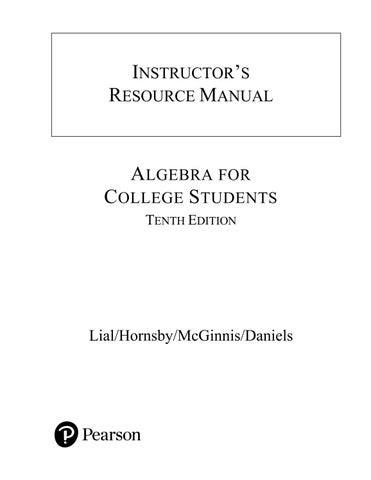
,16758&725¶6 5(6285&( 0$18$/
$ /*(%5$ )25 & 2//(*( 6 78'(176 7(17+ (',7,21
/LDO +RUQVE\ 0F*LQQLV 'DQLHOV
&RS\ULJKW E\ 3HDUVRQ (GXFDWLRQ ,QF RU LWV DIILOLDWHV 5LYHU 6WUHHW +RERNHQ 1- $OO 5LJKWV 5HVHUYHG 7KLV SXEOLFDWLRQ LV SURWHFWHG E\ FRS\ULJKW DQG SHUPLVVLRQ VKRXOG EH REWDLQHG IURP WKH SXEOLVKHU SULRU WR DQ\ SURKLELWHG UHSURGXFWLRQ VWRUDJH LQ D UHWULHYDO V\VWHP RU WUDQVPLVVLRQ LQ DQ\ IRUP RU E\ DQ\ PHDQV HOHFWURQLF PHFKDQLFDO SKRWRFRS\LQJ UHFRUGLQJ RU RWKHUZLVH )RU LQIRUPDWLRQ UHJDUGLQJ SHUPLVVLRQV UHTXHVW IRUPV DQG WKH DSSURSULDWH FRQWDFWV ZLWKLQ WKH 3HDUVRQ (GXFDWLRQ *OREDO 5LJKWV DQG 3HUPLVVLRQV GHSDUWPHQW SOHDVH YLVLW ZZZ SHDUVRQHG FRP SHUPLVVLRQV 8QOHVV RWKHUZLVH LQGLFDWHG KHUHLQ DQ\ WKLUG SDUW\ WUDGHPDUNV ORJRV RU LFRQV WKDW PD\ DSSHDU LQ WKLV ZRUN DUH WKH SURSHUW\ RI WKHLU UHVSHFWLYH RZQHUV DQG DQ\ UHIHUHQFHV WR WKLUG SDUW\ WUDGHPDUNV ORJRV LFRQV RU RWKHU WUDGH GUHVV DUH IRU GHPRQVWUDWLYH RU GHVFULSWLYH SXUSRVHV RQO\ 6XFK UHIHUHQFHV DUH QRW LQWHQGHG WR LPSO\ DQ\ VSRQVRUVKLS HQGRUVHPHQW DXWKRUL]DWLRQ RU SURPRWLRQ RI 3HDUVRQ¶V SURGXFWV E\ WKH RZQHUV RI VXFK PDUNV RU DQ\ UHODWLRQVKLS EHWZHHQ WKH RZQHU DQG 3HDUVRQ (GXFDWLRQ ,QF RU LWV DIILOLDWHV DXWKRUV OLFHQVHHV RU GLVWULEXWRUV
3HDUVRQ 3URGXFW ,' $
Mini-Lecture R.1
3
ALEGEBRA FOR COLLEGE STUDENTS
Fractions, Decimals, and Percents Learning Objectives: 1. 2. 3. 4. 5. 6. 7. 8.
Write fractions in lowest terms. Convert between improper fractions and mixed numbers. Perform operations with fractions. Write decimals as fractions. Perform operations with decimals. Write fractions as decimals. Write percents as decimals and decimals as percents. Writer percents as fractions and fractions as percents.
Examples: 2. Simplify each fraction. 5 a) b) 10
16 64
c)
42 77
d)
88 90
3. Change each improper fraction to a mixed number or a whole number, or change each mixed number to an improper fraction. 8 34 3 2 a) b) c) 2 d) 6 5 4 4 9 4. Find each product and write in lowest terms. 5 3 5 9 a) b) c) 9 15 6 2
4 18 9
d)
1 1 3 1 2 4
5. Find each quotient and write in lowest terms. 5 3 5 9 a) y y b) c) 9 15 6 2
5 36 y 24 24
d)
5 3 y8 3 4
d)
5 7 6 8
h)
3 1 12 10 8 4
6. Find each sum or difference and write in lowest terms. 3 4 2 1 2 1 a) b) c) 14 14 3 3 4 8 e)
7 9 12 30
f)
2 2 1 3 24 6
g)
8
3 1 1 10 10
7. Write the following decimal numbers as fractions. Do not write in lowest terms. a) 0.42 b) 1.285 c) 0.9375 8. Add or subtract as indicated.. a) 5 0.586 b) 45.3 33.306
c)
4.1 1.03 2.12
9. Multiply or divide as indicated. b) 1687.14 y 23.4 c) a) 5.864 y 3.2
7.86375 y 2.25
10. Write each fraction as a decimal. 24 7 b) a) 5 9
3 8
c)
d) 57.4 y 1000
Copyright © 202 Pearson Education, Inc.
ALEGEBRA FOR COLLEGE STUDENTS
4
Mini-Lecture R.1
11. Write each percent as a decimal. b) 255%
c)
3 4 % 4
12. Write each decimal as a percent. a) 0.428 b) 3.21
c)
0.305
a)
53%
13. Write each percent as a fraction. Give answers in lowest terms. a) 7% b) 185% c) 12.4% 14. Write each fraction as a percent. 3 1 a) b) 5 3
c)
9 2
Teaching Notes: x x x x x x x
Encourage students to simplify fractions by dividing numerator and denominator by the same number and by factoring into primes and dividing out common factors. Some students try to multiply/divide whole number parts together, and then multiply/divide fractional parts together when working with mixed numbers. Some students add/subtract the denominators when adding/subtracting fractions. Many students are confused by percents that are less than 1%. It may be helpful to have the students distinguish between 0.2 and 0.2%. Many students are confused by percents that are greater than 100%. It may be helpful to show that 100% =1 Mention to students that another way to convert a fraction to a percent is to first convert the fraction to a decimal and then convert the decimal to a percent.
Answers: 1a) prime, b) composite, 5 13 , c) prime, d) composite, 2 2 2 3 3 3 ; 2a) 21 , b) 41 , c) 116 , d) 44 45 ; 3a) 1 53 , b) 8 21 , c) 114 , d) 569 ; 4a) 91 , b) 154 or 3 43 , c) 8, d) 358 or 4 83 ; 5a) 259 or 2 79 , b) 275 , c) 365 , d) 214 ; 6a) 21 , b) 1 3
41 53 11 2 1 , c) 85 , d) 24 or 1 17 24 , e) 60 , f) 12 , g) 9 5 , h) 2 8 ;7a)
9375 42 1285 , b) , c) ; 8a) 4.414, b) 11.994, c) 5.19, 100 1000 10, 000
9a) 1.8325, b) 72.1, c)3.495, d) 0.0574; 10a) 4.8, b) 0.7 , c) 0.375; 11a) 0.53, b) 2.55, c) 0.475; 12a) 42.8%, 7 17 31 b) 321%, c) 30.5%; 13a) , b) 1 , c) , 14a) 60%, b) 33.3% , c) 450% 20 100 250
Copyright © 202 Pearson Education, Inc.
Mini-Lecture R.2
5
ALEGEBRA FOR COLLEGE STUDENTS
Basic Concepts from Algebra Learning Objectives: 1. 2. 3. 4. 5. 6.
Write sets using set notation. Use number lines. Classify numbers Find additive inverses. Use absolute value. Use inequality symbols.
Examples: 3 ½ 1. List all numbers from the set ® 10, 5, 2 , 0, 5, 10¾ that are: 4 ¯ ¿ a) natural numbers b) whole numbers c) integers d) rational numbers e) irrational numbers f) real numbers
1 1 2. Graph each of the numbers on a number line: 5, 5, 4 , 1 , S . 3 2
3. Select the lesser number in each pair. 4 1 a) –3, 8 b) , 5 3
c)
10, –12
4. For each number, find the additive inverse. a) 6 b) –5 c)
2.7
5. Simplify. a) 3
13 16
b)
6
c)
6. Decide whether the statement is true or false. b) 3 d 5 c) a) 5 t 11
7 ! 1
7. Write the following in interval notation and graph the interval. a) ^ x | x d 5` b) ^ x | x ! 8` c) ^ x | 1 x d 3`
Teaching Notes: x x x x x
Many students need to be reminded of set notation. Remind students that integers are rational numbers; any integer can be written as the ratio of itself and 1. Decimal numbers that terminate or repeat in a fixed block are examples of rational numbers; ask students to give examples of both. The decimal form of an irrational number neither terminates nor repeats. The number line is a good way to illustrate opposite numbers/additive inverses
3 3 Answers: 1a) 10, b) 0, 10, c) –10, –5, 0, 10, d) –10, –5, 2 , 0, 10, e) 5 , f) –10, –5, 2 , 0, 5 , 10; 4 4 4 2) ; 3a) –3, b) , c) –12; 4a) –6, b) 5, c) –2.7; 5a) 3, b) –6, c) 3; 5 6a) true, b) true, c) false; 7a) f,5@
b) 8, f
c)
1,3@
Copyright © 202 Pearson Education, Inc.