HW 02: Animal Form & Function
5/13/15 4:53 PM
HW 02: Animal Form & Function Due: 11:59pm on Sunday, March 22, 2015 You will receive no credit for items you complete after the assignment is due. Grading Policy
Chapter 46 Question 5 Part A During human gestation, rudiments of all organs develop ANSWER: in the second trimester. in the first trimester. while the embryo is in the oviduct. in the third trimester. during the blastocyst stage.
Correct
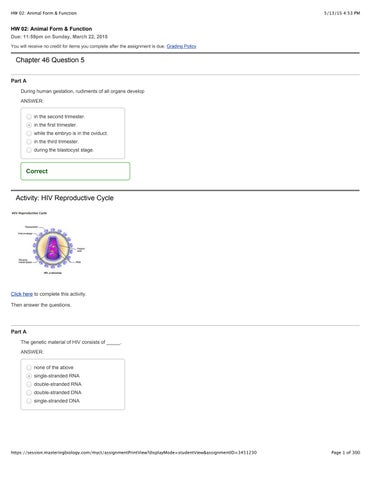
Activity: HIV Reproductive Cycle
Click here to complete this activity. Then answer the questions.
Part A The genetic material of HIV consists of _____. ANSWER: none of the above single-stranded RNA double-stranded RNA double-stranded DNA single-stranded DNA
https://session.masteringbiology.com/myct/assignmentPrintView?displayMode=studentView&assignmentID=3451230
Page 1 of 300
HW 02: Animal Form & Function
5/13/15 4:53 PM
Correct The genetic material of HIV consists of two molecules of single-stranded RNA.
Part B Which of these binds to receptor molecules on the host cell membrane?
ANSWER: E D B A C
Correct Glycoproteins on the viral envelope recognize and bind to receptors on the host cell.
Part C What is the function of reverse transcriptase? ANSWER: catalyzing the formation of RNA from a polypeptide template catalyzing the formation of RNA from a DNA template catalyzing the formation of a polypeptide from a RNA template catalyzing the formation of DNA from a RNA template catalyzing the formation of DNA from a polypeptide template
Correct This is the function of reverse transcriptase
Part D What is the source of a viral envelope?
https://session.masteringbiology.com/myct/assignmentPrintView?displayMode=studentView&assignmentID=3451230
Page 2 of 300
HW 02: Animal Form & Function
5/13/15 4:53 PM
ANSWER: provirus host cell membrane viral glycoproteins prophages host cell DNA
Correct The viral envelope is derived from host cell membrane.
Part E Which of these is reverse transcriptase?
ANSWER: D E B C A
Correct This is reverse transcriptase.
Part F Which of these is the viral genome?
https://session.masteringbiology.com/myct/assignmentPrintView?displayMode=studentView&assignmentID=3451230
Page 3 of 300
HW 02: Animal Form & Function
5/13/15 4:53 PM
ANSWER: D A E B C
Correct HIV is a RNA virus.
Part G To view the animation, click here. Then click Start on the image to start the animation. What enzyme is responsible for the process seen here? ANSWER: DNA ligase DNA polymerase reverse transcriptase endonuclease RNA polymerase
Correct Reverse transcriptase catalyzes the formation of DNA from a RNA template.
Part H Double-stranded viral DNA is incorporated into a host cell as a _____. ANSWER:
https://session.masteringbiology.com/myct/assignmentPrintView?displayMode=studentView&assignmentID=3451230
Page 4 of 300
HW 02: Animal Form & Function
5/13/15 4:53 PM
promoter provirus transposon lac homeoboxes
Correct "Provirus" is the name given to double-stranded viral DNA that has been incorporated into a host cell's genome.
Chapter 40 Question 6 Part A You are studying a large tropical reptile that has a high and relatively stable body temperature. How would you determine whether this animal is an endotherm or an ectotherm? ANSWER: You measure the metabolic rate of the reptile, and because it is higher than that of a related species that lives in temperate forests, you conclude that this reptile is an endotherm and its relative is an ectotherm. You subject this reptile to various temperatures in the lab and find that its body temperature and metabolic rate change with the ambient temperature. You conclude that it is an ectotherm. You know that it is an ectotherm because it is not a bird or mammal. You know from its high and stable body temperature that it must be an endotherm. You note that its environment has a high and stable temperature. Because its body temperature matches the environmental temperature, you conclude that it is an ectotherm.
Correct
Chapter 51 Question 5 Part A Although many chimpanzees live in environments containing oil palm nuts, members of only a few populations use stones to crack open the nuts. The likely explanation is that ANSWER: the cultural tradition of using stones to crack nuts has arisen in only some populations. members of different populations differ in manual dexterity. the behavioral difference is caused by genetic differences between populations. members of different populations have different nutritional requirements. members of different populations differ in learning ability.
Correct
Chapter 50 Question 4 https://session.masteringbiology.com/myct/assignmentPrintView?displayMode=studentView&assignmentID=3451230
Page 5 of 300