lOMoARcPSD|11700591
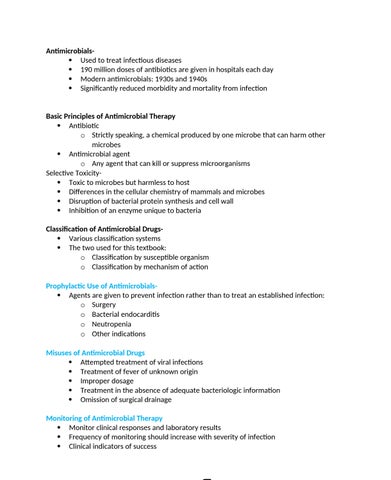
Antimicrobials Used to treat infectious diseases 190 million doses of antibiotics are given in hospitals each day Modern antimicrobials: 1930s and 1940s Significantly reduced morbidity and mortality from infection Basic Principles of Antimicrobial Therapy Antibiotic o Strictly speaking, a chemical produced by one microbe that can harm other microbes Antimicrobial agent o Any agent that can kill or suppress microorganisms Selective Toxicity Toxic to microbes but harmless to host Differences in the cellular chemistry of mammals and microbes Disruption of bacterial protein synthesis and cell wall Inhibition of an enzyme unique to bacteria Classification of Antimicrobial Drugs Various classification systems The two used for this textbook: o Classification by susceptible organism o Classification by mechanism of action Prophylactic Use of Antimicrobials Agents are given to prevent infection rather than to treat an established infection: o Surgery o Bacterial endocarditis o Neutropenia o Other indications Misuses of Antimicrobial Drugs Attempted treatment of viral infections Treatment of fever of unknown origin Improper dosage Treatment in the absence of adequate bacteriologic information Omission of surgical drainage Monitoring of Antimicrobial Therapy Monitor clinical responses and laboratory results Frequency of monitoring should increase with severity of infection Clinical indicators of success
lOMoARcPSD|11700591
o Reduction of fever, resolution of signs/symptoms related to the affected organ Serum drug levels for toxicity
Classification of Antibiotics Drugs work on: Cell wall synthesis Cell membrane permeability Protein synthesis (lethal) Nonlethal inhibitors of protein synthesis Synthesis of nucleic acids Antimetabolites Viral enzyme inhibitors Classification of Antibiotics (Cont.) Bacteriocidal Drugs are directly lethal to bacteria at clinically achievable concentrations Bacteriostatic Drugs can slow bacterial growth but do not cause cell death Dosage Size and Duration Antibiotic must be present: o At the site of infection o For a sufficient length of time Antibiotics must not be discontinued prematurely Teach patients to complete full prescription Antibiotic Combinations Antimicrobial effects of antibiotic combinations o Additive, potentiative, antagonistic Indications o Mixed infections, prevention of resistance, decreased toxicity, enhanced bacterial action Disadvantages of combinations Penicillins (Cont.) Action- Weaken the call wall of bacteria. Resistance- Is determined by inability to reach the target, inactivation by bacterial enzymes and production of penicillin binding proteins that have a low affinity for it. Active against a variety of bacteria Direct toxicity: Low Principal adverse effect: Allergic reaction Structure includes a beta-lactam ring
lOMoARcPSD|11700591
Beta-lactam family: Includes cephalosporins, aztreonam, imipenem, meropenem, and ertapenem. Only Potassium penicillin G can be giving through IV
Penicillin Allergy Development of penicillin allergy Skin tests for penicillin allergy Management of patients with a history of penicillin allergy Assess for penicillin allergy in each patient who will be receiving penicillin o If history of mild reaction, consider cephalosporin o If history of anaphylaxis, avoid administration of penicillin or cephalosporins Types o Immediate (reaction in 2 to 30 minutes) o Accelerated (reaction in 1 to 72 hours) o Delayed (reaction takes days or weeks to develop) Anaphylaxis o Laryngeal edema o Bronchoconstriction o Severe hypotension Treatment o Epinephrine o Respiratory support o Prevention: Skin testing Drug Interactions Aminoglycosides Bacteriostatic antibiotics Probenecid Preadministration Assessment Therapeutic Goal- Treatment of infections caused by sensitive bacteria. Baseline Data- The prescriber may order tests to identify the infecting organism and its drug sensitivity. Take samples for microbiologic culture before starting treatment. Identifying High-Risk Patients- Penicillins should be used with extreme caution, if at all, in patients with a history of severe allergic reactions to penicillins, cephalosporins, or carbapenems. Implementation Routes- administered orally, IM, and IV.