CS 70 Spring 2017 1
Discrete Mathematics and Probability Theory Rao
HW 5
Sundry
Before you start your homework, write down your team. Who else did you work with on this homework? List names and email addresses. (In case of homework party, you can also just describe the group.) How did you work on this homework? Working in groups of 3-5 will earn credit for your "Sundry" grade. Please copy the following statement and sign next to it: I certify that all solutions are entirely in my words and that I have not looked at another student’s solutions. I have credited all external sources in this write up. I certify that all solutions are entirely in my words and that I have not looked at another student’s solutions. I have credited all external sources in this write up. (Signature here)
2
Count and Prove
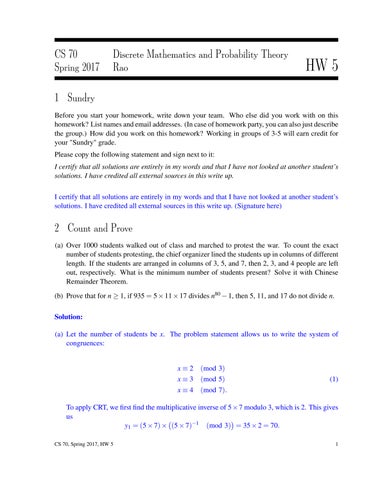
(a) Over 1000 students walked out of class and marched to protest the war. To count the exact number of students protesting, the chief organizer lined the students up in columns of different length. If the students are arranged in columns of 3, 5, and 7, then 2, 3, and 4 people are left out, respectively. What is the minimum number of students present? Solve it with Chinese Remainder Theorem. (b) Prove that for n ≥ 1, if 935 = 5 × 11 × 17 divides n80 − 1, then 5, 11, and 17 do not divide n. Solution: (a) Let the number of students be x. The problem statement allows us to write the system of congruences: x≡2
(mod 3)
x≡3 x≡4
(mod 5) (mod 7).
(1)
To apply CRT, we first find the multiplicative inverse of 5 × 7 modulo 3, which is 2. This gives us y1 = (5 × 7) × (5 × 7)−1 (mod 3) = 35 × 2 = 70. CS 70, Spring 2017, HW 5
1
Second, we compute the multiplicative inverse of 3 × 7 modulo 5, which is 1. We have y2 = (3 × 7) × (3 × 7)−1 (mod 5) = 21 × 1 = 21. Finally, the the multiplicative inverse of 3 × 5 modulo 7 is 1. Thus, y3 = (3 × 5) × (3 × 5)−1 (mod 7) = 15 × 1 = 15. By CRT, we can write down the unique solution x (modulo 105 = 3 × 5 × 7): x = a1 y1 + a2 y2 + a3 y3
(mod 105)
= 2 × 70 + 3 × 21 + 4 × 15 (mod 105) = 263 (mod 105) = 53 (mod 105). Now, we have x = 105k + 53 for some integer k. The smallest k for x > 1000 is 10. Thus, the mininum number of students is 105 × 10 + 53 = 1103. (b) Note that 935 = 5 × 11 × 17. We wish to prove that if n80 ≡ 1 (mod 935) then 5, 11, 17 - n. Since n80 ≡ 1 (mod 935), we know that n80 = 935k + 1 for some integer k. Thus, we know n80 ≡ 1 (mod 5), n80 ≡ 1 (mod 11), and n80 ≡ 1 (mod 17). We will now prove the statement by contradiction. Let us now assume the contrary; i.e., that n80 ≡ 1 (mod 935) and either 5 | n or 11 | n or 17 | n. Then we have 3 possible cases: • If 5 | n then, n = 5k, which implies n ≡ 0 (mod 5), which in turn implies n80 ≡ 0 (mod 5), • If 11 | n then, n = 11k, which implies n ≡ 0 (mod 11), which in turn implies n80 ≡ 0 (mod 11), • If 17 | n then, n = 17k, which implies n ≡ 0 (mod 17), which in turn implies n80 ≡ 0 (mod 17), which are all false as under the assumptions that n80 ≡ 1 (mod 935), since this implies n80 ≡ 1 (mod 5), n80 ≡ 1 (mod 11), and n80 ≡ 1 (mod 17). Thus we have reached a contradiction, and we must have that 5, 11, 17 - n.
3
RSA Lite
Woody misunderstood how to use RSA. So he selected prime P = 101 and encryption exponent e = 67, and encrypted his message m to get 35 = me mod P. Unfortunately he forgot his original message m and only stored the encrypted value 35. But Carla thinks she can figure out how to recover m from 35 = me mod P, with knowledge only of P and e. Is she right? Can you help her figure out the message m? Show all your work. Solution: CS 70, Spring 2017, HW 5
2
Recall that the security of RSA depended upon the supposed hardness of factoring N = P × Q. However, since N = P in this problem, we can consider it to have been already factored! Indeed, recall that the private key d in RSA is defined to be the multiplicative inverse of e modulo (P − 1)(Q − 1), because we can then use the following relation to decrypt the message: mk(P−1)(Q−1)+1 ≡ m (mod N) Note that in our case where N = P, an analogous relation immediately holds by Fermat’s Little Theorem: mk(P−1)+1 ≡ m (mod P) Therefore, if we can find d which is the multiplicative inverse of e modulo P − 1, we can decrypt the message by simply computing med (mod P) = 35d (mod P). It is easy to see by inspection that 67 × 3 = 201 ≡ 1 (mod 100), so the desired multiplicative inverse d = 3, which means that m = 51 (mod 101). (Otherwise, one can find the multiplicative inverse by applying Extended Euclid’s algorithm to e = 67 and P − 1 = 100: (c, a, b) = extended-gcd(100, 67) = (c, b1 , a1 − b100/67cb1 ) where (c, a1 , b1 ) = extended-gcd(67, 33) = (c, b2 , a2 − b67/33cb2 ) where (c, a2 , b2 ) = extended-gcd(33, 1) = (c, b3 , a3 − b33/1cb3 ) where (c, a3 , b3 ) = extended-gcd(1, 0) = (1, 1, 0) Therefore, (c, a2 , b2 ) = (1, 0, 1), (c, a1 , b1 ) = (1, 1, −2), and (c, a, b) = (1, −2, 3) respectively. We can verify that 1 = c = ax + by = −2 × 100 + 3 × 67. Hence, the multiplicative inverse of 67 modulo 100 is 3.)
4
RSA with Three Primes
Show how you can modify the RSA encryption method to work with three primes instead of two primes (i.e. N = pqr where p, q, r are all prime), and prove the scheme you come up with works in the sense that D(E(x)) ≡ x mod N. Solution: N = pqr where p, q, r are all prime. Then, let e be co-prime with (p − 1)(q − 1)(r − 1). Give the public key: (N, e) and calculate d = e−1 mod (p − 1)(q − 1)(r − 1). People who wish to send me a secret, x, send y = xe mod N. I decrypt an incoming message, y, by calculating yd mod N. Does this work? We prove that xed − x ≡ 0 mod N and thus xed ≡ x mod N. To prove that xed − x ≡ 0 mod N, we factor out the x to get x · (xed−1 − 1) = x · (xk(p−1)(q−1)(r−1)+1−1 − 1) because ed ≡ 1 mod (p − 1)(q − 1)(r − 1). As a reminder, we are considering the number: x · (xk(p−1)(q−1)(r−1) − 1). We now argue that this number must be divisible by p, q, and r. Thus it is divisible by N and xed − x ≡ 0 mod N. To prove that it is divisible by p: CS 70, Spring 2017, HW 5
3
• If x is divisible by p, then the entire thing is divisible by p. • If x is not divisible by p, then that means we can use FLT on the inside to show that (x p−1 )k(q−1)(r−1) − 1 ≡ 1 − 1 ≡ 0 mod p. Thus it is divisible by p. To prove that it is divisible by q: • If x is divisible by q, then the entire thing is divisible by q. • If x is not divisible by q, then that means we can use FLT on the inside to show that (xq−1 )k(p−1)(r−1) − 1 ≡ 1 − 1 ≡ 0 mod q. Thus it is divisible by q. To prove that it is divisible by r: • If x is divisible by r, then the entire thing is divisible by r. • If x is not divisible by r, then that means we can use FLT on the inside to show that (xr−1 )k(p−1)(q−1) − 1 ≡ 1 − 1 ≡ 0 mod r. Thus it is divisible by r.
5
Squared RSA
(a) Prove the identity a p(p−1) ≡ 1 (mod p2 ), where a is relatively prime to p and p is prime. (b) Now consider the RSA scheme: the public key is (N = p2 q2 , e) for primes p and q, with e relatively prime to p(p − 1)q(q − 1). The private key is d = e−1 (mod p(p − 1)q(q − 1)). Prove that the scheme is correct, i.e. xed ≡ x (mod N). You may assume that x is relatively prime to both p and q. (c) Continuing the previous part, prove that the scheme is unbreakable, i.e. your scheme is at least as difficult as ordinary RSA. Solution: (a) Consider the set S of all numbers between 1 and p2 − 1 (inclusive) which are relatively prime to p. Consider the map f (x) = ax, and let T be the image of S, i.e. T = f (S). Since a is relatively prime to p, and therefore relatively prime to p2 , we know that a−1 (mod p2 ) exists, modulo p2 . Since the inverse exists, we know that f (x) has an inverse map, and is therefore a bijection: |S| = |T |. To show that S = T , it suffices to show that T ⊆ S. But if t ∈ T , then t = as for some s ∈ S with s relatively prime to p2 . Since a is also relatively prime to p2 , then as = t is also relatively prime to p2 . We have shown that t ∈ T implies t ∈ S, so T ⊆ S (and by
CS 70, Spring 2017, HW 5
4
the discussion above, T = S). Finally, observe that the product of the elements of S is the same as the product of the elements of T , so |S|
|S|
∏{s : s ∈ S} = ∏{t : t ∈ S} i=1
(mod p2 )
i=1
|S|
= a|S| ∏{s : s ∈ S} (mod p2 ) i=1
so we can conclude that a|S| ≡ 1 (mod p2 ). To conclude the argument, we show that |S| = p(p − 1). But there are p2 numbers between 1 and p2 , and if we subtract the p multiples of p, we end up with |S| = p2 − p = p(p − 1). (b) By the definition of d above, ed = 1 + kp(p − 1)q(q − 1) for some k. Look at the equation xed ≡ x (mod N) modulo p2 first: xed ≡ x1+kp(p−1)q(q−1) ≡ x · (x p(p−1) )kq(q−1) ≡ x
(mod p2 )
where we used the identity above. If we look at the equation modulo q2 , we obtain the same result. Hence, xed ≡ x (mod p2 q2 ). (c) We consider the scheme to be broken if knowing p2 q2 allows you to deduce p(p − 1)q(q − 1). (Observe that knowing p(p − 1)q(q − 1) is enough, because we can compute the private key with this information.) Suppose that the scheme can be broken; we will show how to break ordinary RSA. For an ordinary RSA public key (N = pq, e), square N to get N 2 = p2 q2 . By our assumption that the squared RSA scheme can be broken, knowing p2 q2 allows us to find p(p − 1)q(q − 1). We can divide this by N = pq to obtain (p − 1)(q − 1), which breaks the ordinary RSA scheme. This proves that our scheme is at least as difficult as ordinary RSA. Remark: The first part of the question mirrors the proof of Fermat’s Little Theorem. The second and third parts of the question mirror the proof of correctness of RSA.
6
Breaking RSA
(a) Eve is not convinced she needs to factor N = pq in order to break RSA. She argues: "All I need to know is (p − 1)(q − 1)... then I can find d as the inverse of e mod (p − 1)(q − 1). This should be easier than factoring N." Prove Eve wrong, by showing that if she knows (p − 1)(q − 1), she can easily factor N (thus showing finding (p − 1)(q − 1) is at least as hard as factoring N). Assume Eve has a friend Wolfram, who can easily return the roots of polynomials over R (this is, in fact, easy). (b) When working with RSA, it is not uncommon to use e = 3 in the public key. Suppose that Alice has sent Bob, Carol, and Dorothy the same message indicating the time she is having her birthday party. Eve, who is not invited, wants to decrypt the message and show up to the party. Bob, Carol, and Dorothy have public keys (N1 , e1 ), (N2 , e2 ), (N3 , e3 ) respectively, where CS 70, Spring 2017, HW 5
5