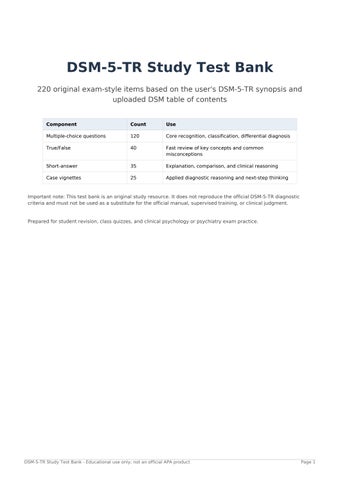
DSM-5-TR Study Test Bank 220 original exam-style items based on the user's DSM-5-TR synopsis and uploaded DSM table of contents
Component
Count
Use
Multiple-choice questions
120
Core recognition, classification, differential diagnosis
True/False
40
Fast review of key concepts and common misconceptions
Short-answer
35
Explanation, comparison, and clinical reasoning
Case vignettes
25
Applied diagnostic reasoning and next-step thinking
Important note: This test bank is an original study resource. It does not reproduce the official DSM-5-TR diagnostic criteria and must not be used as a substitute for the official manual, supervised training, or clinical judgment.
Prepared for student revision, class quizzes, and clinical psychology or psychiatry exam practice.
DSM-5-TR Study Test Bank - Educational use only; not an official APA product
Page 1
How to Use This Test Bank Use the MCQs for rapid recall, the true/false section for misconception correction, the short-answer section for written exam preparation, and the vignettes for applied clinical reasoning. For formal diagnosis, always consult the official DSM-5-TR and use supervision where appropriate.
Coverage Map ●
DSM basics, use of manual, coding, specifiers, and DSM-5-TR updates
●
Neurodevelopmental disorders
●
Schizophrenia spectrum and other psychotic disorders
●
Bipolar and depressive disorders
●
Anxiety, obsessive-compulsive, trauma, dissociative, and somatic symptom disorders
●
Feeding, eating, elimination, sleep-wake, sexual dysfunctions, and gender dysphoria
●
Disruptive, impulse-control, conduct, substance-related, addictive, neurocognitive, personality, and paraphilic disorders
●
Section III measures, cultural formulation, emerging conditions, and ethical/forensic caution
Scoring Suggestion MCQ: 1 mark each. True/False: 1 mark each. Short-answer: 2-4 marks each depending on detail. Vignettes: 3-5 marks each for diagnosis/category, differential diagnosis, and safety/contextual reasoning. Total suggested score: 220+ marks depending on teacher weighting.
DSM-5-TR Study Test Bank - Educational use only; not an official APA product
Page 2
Part A - Multiple-Choice Questions (120 items) Foundations, DSM-5-TR Updates, and Use of the Manual 1. What is the main purpose of DSM-5-TR in clinical practice? A. To replace clinical judgment with a checklist B. To provide a common diagnostic language and classification system C. To prescribe first-line medications for every disorder D. To determine legal responsibility in all forensic cases
2. Which update is specifically highlighted in the DSM-5-TR synopsis provided by the user? A. Removal of all substance-related disorders B. Addition of Prolonged Grief Disorder C. Elimination of ICD coding D. Replacement of Section III with medication tables
3. Why are ICD codes included with DSM diagnoses? A. To replace the clinical interview B. To support reporting, billing, statistics, and health record documentation C. To indicate the cause of every disorder D. To rank disorders by severity
4. Which statement best describes DSM criteria sets? A. They are educational tools only and cannot be used clinically B. They are diagnostic guides that must be interpreted in context C. They are legal definitions of insanity D. They provide psychotherapy scripts
5. In the DSM structure, diagnostic criteria and codes are mainly located in which section? A. Section I B. Section II C. Section III D. Appendix only
6. What is the function of Section III in DSM? A. It lists only medications B. It contains emerging measures and models C. It replaces all Section II diagnoses D. It is used only for legal reports
7. Which DSM-5-TR feature helps clinicians flag suicidal behavior even when another diagnosis is not required? A. A specifier only for depression B. Codes for suicidal behavior C. A new personality disorder cluster D. A mandatory risk score
DSM-5-TR Study Test Bank - Educational use only; not an official APA product
Page 3
8. A cautious DSM-based assessment should include which step? A. Assigning the first disorder that comes to mind B. Considering medical, substance-related, cultural, developmental, and contextual explanations C. Avoiding collateral information D. Ignoring impairment if symptoms are present
9. Which term best refers to additional clinical details such as course, severity, or special presentation? A. Specifier B. Index C. Glossary D. Copyright notice
10. What is a key limitation of using a test bank based on a table of contents and synopsis? A. It can replace the official DSM-5-TR B. It cannot reproduce full diagnostic criteria or serve as a diagnostic manual C. It is legally equivalent to DSM-5-TR D. It removes the need for supervision
11. Which kind of information should be documented when a diagnosis is uncertain? A. Only the final diagnosis, without reasoning B. Differential diagnoses, missing information, and need for further assessment C. The patient's social media history only D. A medication list only
12. Which of the following is most aligned with culturally informed assessment? A. Assuming the same symptom meaning in every culture B. Asking how the person and their community understand the problem C. Avoiding culture because it biases the interview D. Using only a numerical score
13. What is the safest educational use of DSM labels in a classroom? A. Using labels as insults B. Using them as shorthand for patterns while preserving person-first, contextual thinking C. Applying them to classmates D. Skipping ethical cautions
14. Which statement about impairment is most accurate? A. Symptoms alone always establish a disorder B. Clinical significance often involves distress, impairment, risk, or dysfunction C. Impairment is never relevant D. Only occupational impairment matters
15. Which manual component helps students understand terminology and cultural concepts? A. Glossaries in the appendix B. Only the cover page
DSM-5-TR Study Test Bank - Educational use only; not an official APA product
Page 4
C. The copyright page D. Medication tables
16. Which appendix material is useful when looking up diagnoses by code or name? A. Alphabetical and numerical listings of diagnoses and codes B. Only the index of authors C. Only the preface D. Only the cover authentication page
17. What is the best reason to include functional impairment in a case formulation? A. It shows how symptoms affect real-life roles and helps judge clinical significance B. It replaces the symptom history C. It proves a legal disability automatically D. It removes the need for differential diagnosis
18. A patient has symptoms but information is too limited to specify why full criteria are not met. Which category type may be used? A. Unspecified disorder category B. A definite full diagnosis without evidence C. A personality cluster label only D. No documentation at all
19. Which part of DSM helps users understand important terminology such as diagnostic language and cultural concepts? A. Glossaries B. Only medication tables C. Only the copyright notice D. Only the author list
20. Why should clinicians be cautious when using DSM in forensic contexts? A. A clinical diagnosis does not by itself determine legal questions B. DSM automatically decides guilt C. DSM eliminates need for evidence D. DSM is only for judges
Neurodevelopmental Disorders 21. Which disorder group includes intellectual disability, communication disorders, autism spectrum disorder, ADHD, specific learning disorder, and motor disorders? A. Neurodevelopmental disorders B. Dissociative disorders C. Neurocognitive disorders D. Personality disorders
22. A child has persistent problems with social communication and restricted, repetitive patterns of behavior. Which DSM category is most relevant? A. Autism spectrum disorder
DSM-5-TR Study Test Bank - Educational use only; not an official APA product
Page 5