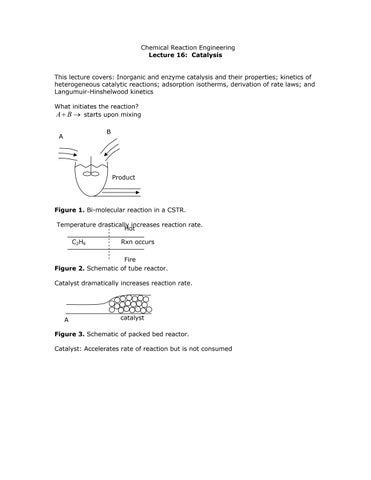
Chemical Reaction Engineering Lecture 16: Catalysis This lecture covers: Inorganic and enzyme catalysis and their properties; kinetics of heterogeneous catalytic reactions; adsorption isotherms, derivation of rate laws; and Langumuir-Hinshelwood kinetics What initiates the reaction? A + B → starts upon mixing B
A
Product Figure 1. Bi-molecular reaction in a CSTR. Temperature drastically increases reaction rate. Hot C2H6 Rxn occurs Fire Figure 2. Schematic of tube reactor. Catalyst dramatically increases reaction rate.
A
catalyst
Figure 3. Schematic of packed bed reactor. Catalyst: Accelerates rate of reaction but is not consumed
transition state E
reactants
~Ea
products
rxn coordinate Figure 4. Reaction diagram. rate constant:
k BT ⎡ (G − Greactants ) ⎤ exp ⎢ − ts ⎥ h RT ⎣ ⎦ G = H − TS k=
e − G / RT = e− H / RT e S / R no catalyst E
with catalyst
rxn coordinate
H k2 5. Reaction diagram with and without catalyst. Figure ⊕
ROR → ROH + R ⊕
The reaction k3 forms many intermediates. A catalyst lowers the energy of these intermediates. R ⊕ + H 2O → ROH + H ⊕ Acid/Base catalysis
ROR + H 2O → 2ROH ROR + H ⊕
k1
H
ROR k−1
⊕
H
ROR , R ⊕
QSSA
⊕
⎡ H ⎤
d ⎢ ROR ⎥ H ⊕ ⎦ = k ⎡ H + ⎤ ROR − (k + k ) ⎡ ROR ⎤ O≈ ⎣ [ ] ⎢ ⎥ − 1⎣ 1 2 ⎦ dt ⎣ ⊕ ⎦
⎡ H ⎤ k1 ⎡⎣ H + ⎤⎦ [ ROR ] = ⎢ ROR ⎥ ⊕ k k + −1 2 ⎣ ⎦ QSSA d [ ROH ] dt
⎡ H ⎤ = 2k2 ⎢ ROR ⎥ ⎣ ⊕ ⎦ QSSA
d [ ROH ] 2k1k2 ⎡⎣ H + ⎤⎦ [ ROR ] = r ≈ dt k−1 + k2 rA ∼ [ A] rA ∼ [ catalyst ]
(where ∼ denotes “proportional to”)
N + ⎡ H ⎤ ⎡⎣ H + ⎤⎦ + ⎢ R O R ⎥ + ⎡⎣ R + ⎤⎦ = H added = ⎡⎣ H + ⎤⎦ added ⊕ V ⎣ ⎦ ⎛ k [ ROR ] ⎞ k1k2 [ ROR ] ⎡⎣ H + ⎦⎤ ⎜1 + 1 = ⎣⎡ H + ⎦⎤ + ⎟ ⎜ ⎟ added k1 + k2 k3 (k−1 + k2 ) [ H 2O ] ⎠ ⎝ r=
r=
keff [ ROR ] ⎡⎣ H + ⎤⎦ 1+ k [ ROR ]
added
k [ catalyst ] [ A]
1+ k A [ A] + k B [ B ] + ... All the things that the catalyst binds to
Langmuir-Hinshelwood: all reagents bind to catalyst, bound forms react Eley-Rideal: one reagent binds, 2nd reagent reacts with bound form
dN A = VrA dt
(
f [ A] , ⎡⎣ H + ⎤⎦
Chemical Reaction Engineering
)