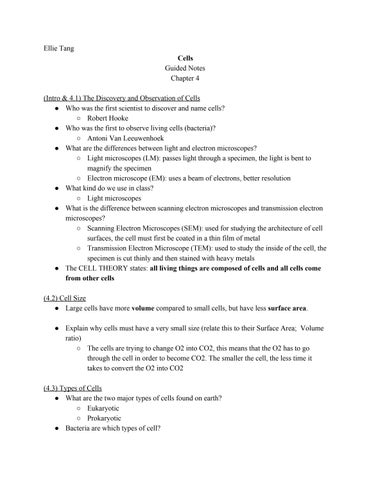
Ellie Tang Cells Guided Notes Chapter 4 (Intro & 4.1) The Discovery and Observation of Cells ● Who was the first scientist to discover and name cells? ○ Robert Hooke ● Who was the first to observe living cells (bacteria)? ○ Antoni Van Leeuwenhoek ● What are the differences between light and electron microscopes? ○ Light microscopes (LM): passes light through a specimen, the light is bent to magnify the specimen ○ Electron microscope (EM): uses a beam of electrons, better resolution ● What kind do we use in class? ○ Light microscopes ● What is the difference between scanning electron microscopes and transmission electron microscopes? ○ Scanning Electron Microscopes (SEM): used for studying the architecture of cell surfaces, the cell must first be coated in a thin film of metal ○ Transmission Electron Microscope (TEM): used to study the inside of the cell, the specimen is cut thinly and then stained with heavy metals ● The CELL THEORY states: all living things are composed of cells and all cells come from other cells (4.2) Cell Size ● Large cells have more volume compared to small cells, but have less surface area. ● Explain why cells must have a very small size (relate this to their Surface Area; Volume ratio) ○ The cells are trying to change O2 into CO2, this means that the O2 has to go through the cell in order to become CO2. The smaller the cell, the less time it takes to convert the O2 into CO2 (4.3) Types of Cells ● What are the two major types of cells found on earth? ○ Eukaryotic ○ Prokaryotic ● Bacteria are which types of cell?
● ●
● ● ●
●
○ Prokaryotic Plants, animals, fungi and protists are which type of cell? ○ Eukaryotic List 4 things ALL cells have in common: ○ 1. Plasma Membrane ○ 2. Chromosomes ○ 3. Ribosomes ○ 4. DNA Which type of cell is generally larger? ○ Eukaryotic What is the nucleoid and what type of cell is it found in? ○ Houses the DNA in a prokaryotic cell. Contrast pili with flagella ○ Pili are short projections and they help to attach the prokaryotes to things ○ Flagella are longer projections and they help to move the cell through its environment List 4 differences between prokaryotic and eukaryotic cells: Prokaryotic Cells
Eukaryotic Cells
Does not have a nucleus
Has a nucleus
Does not have any organelles
Has many organelles
Very small
Very large
Has capsule
No capsule
(4.4) Eukaryotic Cells ● What are organelles and why is it important to compartmentalize the cell? ○ Organelles are membrane-bound structures that perform specific functions in the cell. It is important to compartmentalize the cell because each organelle has a specific function and they need to be separate in order to keep the cell going ● What are the 4 basic functional groups and the organelles that make them up? ○ 1. Manufacturing: Nucleus, Ribosomes, Endoplasmic Reticulum, and Golgi Body ○ 2. Hydrolysis of Molecules: Lysosomes, Vacuoles, and Peroxisomes ○ 3. Energy Production: Mitochondria and Chloroplasts ○ 4. Structural Support, Movement, and Communication: Cytoskeleton, Plasma Membrane, Cell Wall ● Which structures are found in animal cells but not plant cells? ○ Lysosomes and Centriole
● Plant cells contain a rigid cell wall around the plasma membrane. ● What does this structure do for the plant cell? ○ It helps to protect the cell and maintain its shape ● What is it composed of? ○ The Polysaccharide cellulose ● Which organelle performs photosynthesis in plant cells? ○ The Chloroplast ● What is the importance of the central vacuole in plant cells? ○ It stores water and chemicals for the plant (4.5) Plasma Membrane ● The cell membrane (plasma membrane) and other biological membranes are mainly composed of phospholipids. ● These molecules have a hydrophilic head and hydrophobic tails. ● Which parts are hydrophobic vs. hydrophilic? ○ The head is hydrophilic and the tail is hydrophobic ● These molecules form a 2-layer sheet called a phospholipid bilayer. ● Heads face outward while the tails face inward. ● What other type of macromolecule is found in the plasma membrane and what are their functions? ○ Proteins, they form channels that allow certain ions and other hydrophilic molecules to pass through the bilayer (4.6) Organelles ● What is the function of the nucleus? ○ It contains the DNA and controls the cell's activities by directing protein synthesis ● What is the difference between chromatin and chromosomes? ○ Eukaryotic chromosomes are made up of Chromatin. Chromatin is made of complex proteins and DNA ● The nucleus is enclosed by a nuclear envelope which is perforated with protein-lined pores which are used to control the flow of materials in and out of the nucleus. ● Where is the Nucleolus? ○ Inside of the nucleus
● What is synthesized there and what is their significance? ○ rRNA (ribosomal RNA), it is the code for the creation of the subunits of Ribosomes ● The DNA in the nucleus is copied into messenger RNA (mRNA) which exits the nucleus does what? ○ mRNA (messenger RNA), is the instructions for the creation of proteins (4.7) Ribosomes ● Ribosomes carry out protein synthesis. ● Why would a human pancreas cell have a high number of ribosomes and nucleoli? ○ They need to be able to digest the enzymes that come through the pancreas ● Although free and bound ribosomes are structurally identical with a large subunit and a small subunit, what are the differences between free and bound ribosomes? ○ Free ribosomes float in the cytoplasm, and are used in the creation of proteins that are used in the cytoplasm ○ Bound ribosomes are bound to the Endoplasmic Reticulum, and are used in the creation of proteins that will be inserted into the membrane, packaged in certain organelles or exported from the cell (4.8) ● What is a Vesicle? ○ A sac made of membrane ● Which organelles are included in the endomembrane system? ○ Nuclear Envelope ○ Endoplasmic Reticulum ○ Golgi Apparatus ○ Lysosomes ○ Vacuoles ○ Plasma membrane ● Which organelle has a membrane that is continuous with the nuclear envelope? ○ The Endoplasmic Reticulum ● What is a major function of the endomembrane system? ○ It divides the cell into separate compartments (compartmentalization) (4.9) ● What is the main observable difference between rough and smooth endoplasmic reticulum?
○ The rough endoplasmic reticulum has ribosomes bound to it and the smooth endoplasmic reticulum does not ● Smooth Endoplasmic Reticulum (Smooth ER) synthesizes lipids (including oils, phospholipids, and steroids). Smooth ER also contains detoxifying enzymes, which is why liver cells have an abundance of smooth ER. ● Explain how the function of the Smooth ER causes tolerance to some drugs? ○ As you consume more drugs, or alcohol, the smooth endoplasmic reticulum builds up more enzymes and therefore a tolerance to the drugs which makes you crave more of them in order to reach the same high. ● Smooth ER also functions in storing Calcium Ions. ● One function of the Rough Endoplasmic Reticulum is to produce more membrane which can enlarge the ER and other components of the endomembrane system. ● Rough ER has ribosomes attached to it, which produce proteins that will be inserted in the ER membrane, transported to other organelles, or secreted (exported) by the cell. ● Describe the 4 steps shown in Figure 4.9B (synthesis and packaging of a secretory protein by the Rough ER) ○ 1. As the polypeptide is synthesised by a bound ribosome, it slides through a pore, which was created by a protein complex, in the rough endoplasmic reticulum. As it enters the rough endoplasmic reticulum, the new proteins begin to form their 3D shape ○ 2. Short chains of sugars are often linked to the polypeptide, making the molecule a glycoprotein (glyco means sugar, sugar-protein) ○ 3. When the protein is completed, it is packaged in a transport vesicle, a vesicle that is on its way to another part of the cell ○ 4. The vesicle detaches from the endoplasmic reticulums membrane and the vesicale travels to the Golgi Apparatus for further processing ● Once proteins are made by the Rough ER, what happens to them? ○ They are exported out of the cell (4.10) ● The Golgi Apparatus consists of flattened sacs layered on top of eachother. ● They are NOT interconnected like the organelle endoplasmic reticulum. ● What is the function of the Golgi apparatus?