lOMoARcPSD|11448692
Purchased from factrecall.com. Adopted from AQA Mark Schemes. To support us, please do not reshare/reupload this document.
AQA A-LEVEL BIOLOGY COMPLETE MARK SCHEME BANK YEAR 1 SPECIFICATION CODE 3.1 – 3.4
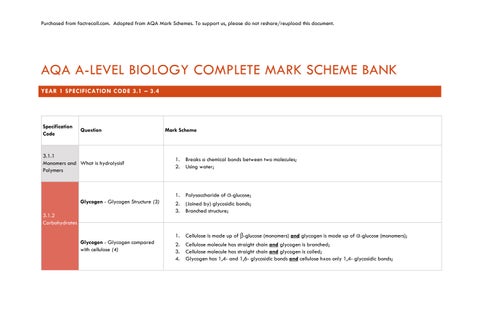
Specification Code
Question
3.1.1 Monomers and What is hydrolysis? Polymers
Glycogen - Glycogen Structure (3) 3.1.2 Carbohydrates Glycogen - Glycogen compared with cellulose (4)
Mark Scheme
1. 2.
Breaks a chemical bonds between two molecules; Using water;
1.
Polysaccharide of α-glucose;
2. 3.
(Joined by) glycosidic bonds; Branched structure;
1.
Cellulose is made up of β-glucose (monomers) and glycogen is made up of α-glucose (monomers);
2. 3. 4.
Cellulose molecule has straight chain and glycogen is branched; Cellulose molecule has straight chain and glycogen is coiled; Glycogen has 1,4- and 1,6- glycosidic bonds and cellulose hxas only 1,4- glycosidic bonds;
Downloaded by arshad hussain (aashi.arshad575@gmail.com)
lOMoARcPSD|11448692
Purchased from factrecall.com. Adopted from AQA Mark Schemes. To support us, please do not reshare/reupload this document.
Glycogen - Glycogen structure related to function (5)
Starch – Relate 3 properties to its function (6)
3.1.3 Lipids
Phospholipids compared with Triglycerides (8)
3.1.4 Proteins Protein - Protein Structure (7)
1.
Insoluble (in water), so doesn’t affect water potential;
2.
Branched / coiled / (α-)helix, so makes molecule compact;
3.
Polymer of (α-)glucose so provides glucose for respiration;
4. 5.
Branched / more ends for fast breakdown / enzyme action; Large (molecule), so can’t cross the cell membrane
1. 2.
Insoluble; Don’t affect water potential;
3. 4.
Helical; Compact;
5. 6.
Large molecule; Cannot leave cell;
1. 2. 3. 4. 5. 6. 7. 8.
Both contain ester bonds (between glycerol and fatty acid); Both contain glycerol; Fatty acids on both may be saturated or unsaturated; Both are insoluble in water; Both contain C, H and O but phospholipids also contain P; Triglyceride has three fatty acids and phospholipid has two fatty acids plus phosphate group; Triglycerides are hydrophobic/non-polar and phospholipids have hydrophilic/polar and hydrophobic/polar region; Phospholipids form monolayer (on surface)/micelle/bilayer (in water) but triglycerides don’t;
1. 2. 3. 4. 5.
Polymer of amino acids; Joined by peptide bonds; Formed by condensation; Primary structure is order of amino acids; Secondary structure is folding of polypeptide chain due to hydrogen bonding;
Downloaded by arshad hussain (aashi.arshad575@gmail.com)
lOMoARcPSD|11448692
Purchased from factrecall.com. Adopted from AQA Mark Schemes. To support us, please do not reshare/reupload this document.
6. 7.
Tertiary structure is 3-D folding due to hydrogen bonding and ionic/disulfide bonds; Quaternary structure is two or more polypeptide chains;
Enzymes – “Induced Fit” Model (3)
1. 2. 3.
(before reaction) active site not complementary to/does not fit substrate; Shape of active site changes as substrate binds/as enzyme-substrate complex forms; Stressing/distorting/bending bonds (in substrate leading to reaction);
Enzymes – Increased temperature and reaction rate (4)
1. 2. 3. 4.
particles have more kinetic energy therefore they move more so there are more collisions between substrates and active sites so more ES complexes form
Enzymes – Denaturation (5)
1. 2. 3. 4. 5.
Heat above the optimum breaks hydrogen bonds this causes the tertiary structure to unfold so the active site changes shape substrate can no longer bind to the active site, as it’s no longer complementary so fewer ES complexes form
Enzymes – Effect of Changes in pH (4)
1. 2. 3. 4.
Ionic bonds holding tertiary structure break active site distorts and substrate no longer binds to active site charges on amino acids in active site affected fewer ES complexes form
1.
(Rate of) increase in concentration of product slows as substrate is used up OR High initial rate as plenty of substrate/more E-S complexes; No increase after 25 minutes/at end/levels off because no substrate left;
Enzymes – Concentration of Substrate (2)
2.
Reject ref. to enzyme being used up
Downloaded by arshad hussain (aashi.arshad575@gmail.com)
lOMoARcPSD|11448692
Purchased from factrecall.com. Adopted from AQA Mark Schemes. To support us, please do not reshare/reupload this document.
Enzymes – Describe and explain the temperature graph of enzyme rate (5)
Enzymes – Comparison of Competitive and Non Competitive Inhibition (4)
1. 2. 3. 4. 5.
Initial rate of reaction faster at 37 °C (than 25 °C); Because more kinetic energy; So more E–S collisions/more E–S complexes formed; Graph reaches plateau /levels off at 37 °C; Because all substrate used up;
1.
Competitive inhibitor binds to active sites of enzyme but non-competitive inhibitor binds at allosteric site/away from active site; (Binding of) competitive inhibitor does not cause change in shape of active site but (binding of) non-competitive does (cause change in size of active site); So with competitive inhibitor, at high substrate concentrations (active) enzyme still available but with noncompetitive inhibitor (active) enzymes no longer available; At higher substrate concentrations likelihood of enzyme-substrate collisions increases with competitive inhibitor but this is not possible with non-competitive inhibitor;
2. 3. 4.
(As temperature increases,)
Enzymes – Effect of temperature linked to plant growth (6)
3.1.5 Nucleic Acids are Important Information-
DNA Replication (8)
1. 2. 3. 4. 5. 6.
Enzyme activity reduced/(some) enzymes denatured; Less photosynthesis, so fewer sugars formed (plants only); Less (complex) biological molecules/organic substances made (that add to mass); Less respiration; Less energy/ATP for growth; Less energy for named function associated with growth (eg mitosis)
1. 2. 3. 4. 5. 6.
Helicase unzips DNA double helix by breaking hydrogen bonds free DNA nucleotides in the nucleus complementary base pair OR A to T and C to G; with exposed bases on both strands hydrogen bonds between complementary base pairs reform both strands act as a template
Downloaded by arshad hussain (aashi.arshad575@gmail.com)
lOMoARcPSD|11448692
Purchased from factrecall.com. Adopted from AQA Mark Schemes. To support us, please do not reshare/reupload this document.
Carrying Molecules
7.
DNA polymerase (causes);
Nucleotides to join together (to form new strand)/phosphodiester bonds to form;
DNA Semi-Conservative Replication (2)
1. 2.
Idea of both original strands being copied/both are template strands; Each new DNA molecule consists of one original and one new strand of DNA;
ATP – Uses and properties as an energy source (5)
1. 2. 3. 4. 5.
Releases relatively small amount of energy / little energy lost as heat; Releases energy instantaneously; Phosphorylates other compounds, making them more reactive; Can be rapidly re-synthesised; Does not leave cells;
ATP – Structure compared with DNA nucleotide (3)
1. 2. 3.
ATP has ribose and DNA has deoxyribose; ATP has 3 phosphates and DNA nucleotide has one phosphate; Base is always adenine in ATP and bases vary in DNA nucleotide (A,C,G or T);
Water – Properties that make water important for organisms (6)
1. 2. 3. 4. 5. 4.
A metabolite in condensation/hydrolysis/photosynthesis/respiration; A solvent so (metabolic) reactions can occur; High heat capacity so buffers changes in temperature; Large latent heat of vaporisation so provides a cooling effect (through evaporation); Cohesion (between water molecules) so supports columns of water (in plants); Cohesion (between water molecules) so produces surface tension supporting organisms;
3.1.6 ATP
3.1.7 Water
Test for a reducing sugar (2) Biomolecules Test (11)
1. 2.
Heat with Benedict’s reagent (1); colour change from blue to brick-red (1)
Downloaded by arshad hussain (aashi.arshad575@gmail.com)