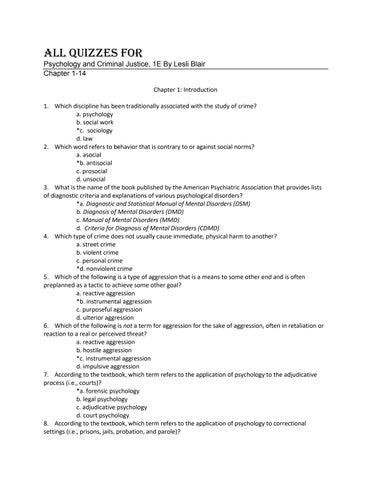
All Quizzes For Psychology and Criminal Justice, 1E By Lesli Blair Chapter 1-14 Chapter 1: Introduction 1. Which discipline has been traditionally associated with the study of crime? a. psychology b. social work *c. sociology d. law 2. Which word refers to behavior that is contrary to or against social norms? a. asocial *b. antisocial c. prosocial d. unsocial 3. What is the name of the book published by the American Psychiatric Association that provides lists of diagnostic criteria and explanations of various psychological disorders? *a. Diagnostic and Statistical Manual of Mental Disorders (DSM) b. Diagnosis of Mental Disorders (DMD) c. Manual of Mental Disorders (MMD) d. Criteria for Diagnosis of Mental Disorders (CDMD) 4. Which type of crime does not usually cause immediate, physical harm to another? a. street crime b. violent crime c. personal crime *d. nonviolent crime 5. Which of the following is a type of aggression that is a means to some other end and is often preplanned as a tactic to achieve some other goal? a. reactive aggression *b. instrumental aggression c. purposeful aggression d. ulterior aggression 6. Which of the following is not a term for aggression for the sake of aggression, often in retaliation or reaction to a real or perceived threat? a. reactive aggression b. hostile aggression *c. instrumental aggression d. impulsive aggression 7. According to the textbook, which term refers to the application of psychology to the adjudicative process (i.e., courts)? *a. forensic psychology b. legal psychology c. adjudicative psychology d. court psychology 8. According to the textbook, which term refers to the application of psychology to correctional settings (i.e., prisons, jails, probation, and parole)?
a. rehabilitation psychology b. prison psychology *c. correctional psychology d. forensic psychology 9. According to the textbook, which term refers to the application of psychology to matters of crime detection and investigation (i.e., police and law enforcement)? *a. police psychology b. law enforcement psychology c. forensic psychology d. investigation psychology 10. What is the term used for engaging in criminal behavior after a previous conviction? *a. recidivism b. reoffending c. rearrest d. relapse 11. In scientific research, what is the word used to describe whether the measure is really capturing the concept we wish to examine? a. reliability b. accuracy *c. validity d. truthiness 12. In scientific research, what is the word used to describe whether the measure is consistent every time a measurement is taken/gathered? *a. reliability b. consistency c. validity d. accuracy 13. Which type of variable influences the things we are trying to study, often unbeknownst to the researchers? a. dependent variable b. independent variable c. control variable *d. confounding variable 14. Which type of variable is used by researchers to attempt to constrain its influence on what is being studied? a. dependent variable b. independent variable *c. control variable d. confounding variable 15. What type of study gathers all of the available empirical research on a specific topic and presents a comprehensive summary of what all of this research has to say on the topic? a. meta-analysis *b. systematic review c. summary research d. peer review 16. What type of research is a study of studies using specific research methods and statistics to reach an overall conclusion on a topic based on the results from many studies? *a. meta-analysis
b. systematic review c. summary research d. peer review 17. What is the term for the claim that scientific journals are less likely to publish empirical research that has “null” findings, creating a problem for researchers attempting to gather all existing research on a topic? *a. publication bias b. research bias c. peer-review bias d. null bias 18. Which area of psychology does not have its own chapter in the textbook, but instead is included throughout the textbook? a. psychoanalysis b. clinical psychology c. forensic psychology *d. cognitive psychology
Chapter 2: Biopsychology 1. Which of the following involves the study of the psychological effects of biological processes? *a. biopsychology b. psychobiology c. molecular genetics d. evolutionary psychology 2. Which of the following are chemical messengers that originate in the nervous system? a. neurons b. hormones *c. neurotransmitters d. neural pathways 3. How are neural pathways created and strengthened? *a. repeated use of the same sets of neurons b. they are encoded in our DNA c. concentrating really hard d. doing mental gymnastics 4. Which areas of the brain has research linked with criminal behavior? a. temporal lobe and frontal lobe *b. prefrontal cortex and limbic system c. frontal lobe and prefrontal cortex d. temporal lobe and limbic system 5. Where in our heads is the prefrontal cortex? a. at the base of our skull b. behind our left ear *c. behind our forehead d. in the middle 6. Which of the following is not considered an executive function of the prefrontal cortex? a. decision making b. self-control c. planning *d. fight-flight-freeze-or-fawn response 7. Which part of the brain is thought to be responsible for the fight-flight-freeze-or-fawn response? *a. limbic system b. prefrontal cortex c. parietal lobe d. brain stem 8. According to the textbook, which part of part of the limbic system believed to be the primary emotional center? a. hypothalamus *b. amygdala c. hippocampus d. prefrontal cortex 9. Which neurotransmitter is related to the experience of pleasure? a. serotonin b. cortisol *c. dopamine
d. epinephrine 10. Which neurotransmitter is considered a mood regulator (among many other functions)? *a. serotonin b. cortisol c. dopamine d. epinephrine 11. Which of the following are chemical messengers that originate in the endocrine system and are transported via the bloodstream? a. neurons *b. hormones c. neurotransmitters d. bloodtransmitters 12. Which hormone’s primary role is in our response to stress? a. epinephrine b. testosterone c. dopamine *d. cortisol 13. Which hormone is found in much higher concentrations in males than females? a. estrogen *b. testosterone c. cortisol d. dopamine 14. What is the evolutionary process whereby members of a species with characteristics best suited for survival are able to pass on those characteristics to their offspring? a. heredity *b. natural selection c. behavioral genetics d. extinction 15. Which of the following are sections of DNA responsible for the construction and maintenance of our bodies, as well as our individual traits and characteristics? *a. genes b. chromosomes c. amino acids d. double helix 16. Which of the following is the study of the sections of DNA that make up our genes and identifying what those genes do? a. evolutionary psychology b. heredity *c. molecular genetics d. twin studies 17. What percentage of our genes dictate what makes us human rather than another animal or plant? a. 76% b. 81% c. 95% *d. 99% 18. What is the term for the 21st century understanding the both nature and nurture impact human outcomes (rather than nature or nurture)? a. nature-nurture interaction