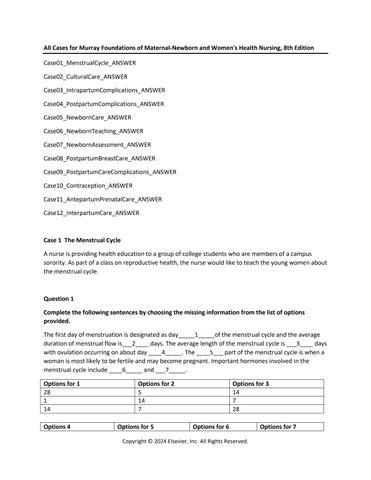
All Cases for Murray Foundations of Maternal-Newborn and Women's Health Nursing, 8th Edition Case01_MenstrualCycle_ANSWER Case02_CulturalCare_ANSWER Case03_IntrapartumComplications_ANSWER Case04_PostpartumComplications_ANSWER Case05_NewbornCare_ANSWER Case06_NewbornTeaching_ANSWER Case07_NewbornAssessment_ANSWER Case08_PostpartumBreastCare_ANSWER Case09_PostpartumCareComplications_ANSWER Case10_Contraception_ANSWER Case11_AntepartumPrenatalCare_ANSWER Case12_InterpartumCare_ANSWER
Case 1 The Menstrual Cycle A nurse is providing health education to a group of college students who are members of a campus sorority. As part of a class on reproductive health, the nurse would like to teach the young women about the menstrual cycle.
Question 1 Complete the following sentences by choosing the missing information from the list of options provided. The first day of menstruation is designated as day_____1_____of the menstrual cycle and the average duration of menstrual flow is___2____ days. The average length of the menstrual cycle is ___3____ days with ovulation occurring on about day ____4_____. The ____5___ part of the menstrual cycle is when a woman is most likely to be fertile and may become pregnant. Important hormones involved in the menstrual cycle include ____6_____ and ___7_____. Options for 1 28 1 14 Options 4
Options for 2 5 14 7 Options for 5
Options for 3 14 7 28 Options for 6
Copyright © 2024 Elsevier, Inc. All Rights Reserved.
Options for 7
28 7 14
beginning middle end
progesterone insulin cortisol
serotonin estrogen prolactin
Answer Key Question 1 Options for 1 28 1 14 Options 4 28 7 14
Options for 2 5 14 7 Options for 5 beginning middle end
Options for 3 14 7 28 Options for 6 progesterone insulin cortisol
Options for 7 serotonin estrogen prolactin
Case 2 Providing Culturally Appropriate Care
Question 1 Use an X for the nursing actions listed below that are Indicated (appropriate or necessary), Contraindicated (could be harmful), or Non-Essential (makes no difference or not necessary) for the conversation between the client and the nurse through the interpreter. Nursing Action Assume that the client’s daughter will serve as the interpreter for the nurse since she is bilingual
Indicated
Contraindicated
Non-Essential
Ask the client about her preferences regarding her daughter remaining in the room during the conversation Copyright © 2024 Elsevier, Inc. All Rights Reserved.
Engage in eye contact and address the client while speaking through the interpreter Ask the client about her immigration status Ask the client’s daughter if she has any children of her own Encourage the interpreter to take the lead on client teaching because they often work on the unit and are familiar with client care Share printed information in Spanish with the client as she prepares for discharge
Case 2 Providing Culturally Appropriate Care Answer Key Question 1 Nursing Action Assume that the client’s daughter will serve as the interpreter for the nurse since she is bilingual
Indicated
Contraindicated
NonEssential
X
Copyright © 2024 Elsevier, Inc. All Rights Reserved.
Rationale It is best practice to utilize the services of a professional interpreter. In emergency situations, it may be appropriate to ask a
Ask the client about her preferences regarding her daughter remaining in the room during the conversation
X
Engage in eye contact and address the client while speaking through the interpreter
X
Ask the client about her immigration status
family member to interpret. It is important to be sure that the client is comfortable with the family member serving in this capacity. It is always best practice to ask clients if they would like others to step out of the room during conversations about their health care.
X
Ask the client’s daughter if she has any children of her own Encourage the
X
X Copyright © 2024 Elsevier, Inc. All Rights Reserved.
Non-verbal body language is important when communicating with clients through an interpreter. Eye contact and speaking directly to the client rather than the interpreter shows that the nurse is engaging with the client and addressing them rather than the interpreter. This question is, culturally biased and inappropriate. Further, asking this question may cause stress and fear for clients who are undocumented. This question is not necessary or relevant to the nursing care being provided When utilizing the
interpreter to take the lead on client teaching because they often work on the unit and are familiar with client care
Share printed information in Spanish with the client as she prepares for discharge
X
services of an interpreter, it is important that the nurse provide the client teaching, and that the interpreter is conveying information that the nurse shares with the client. Culturally and linguistically appropriate educational materials with appropriate text and graphics should be made available to non-English speaking clients. This information can enhance client learning and preparation.
Case 3 Intrapartum Complications A 28-year-old G3P2002 is in labor at 39 weeks of gestation. The client has been in the second stage of labor for 3 hours. Upon reviewing the client’s health record, the nurse notes the following findings:
1.
Small amounts of bloody show during vaginal exam
2.
History of gestational diabetes
3.
History of genital herpes
4.
Estimated fetal weight of 4000g (8.8lbs)
5.
Lactose intolerance
6.
Initiated prenatal care at 14 weeks
7.
History of preterm birth
8.
History of shoulder dystocia
Question 1
Copyright © 2024 Elsevier, Inc. All Rights Reserved.