All Cases For Halter: Varcarolis’ Foundations of Psychiatric-Mental Health Nursing, 9th Edition
Case 1-6 Solutions are at the End of Each Case Title: Addiction Scenario: A 54-year-old client with a 30+ year history of alcohol abuse is admitted with a fall-related left femur fracture. Client reports, ―I was drinking with some buddies when I fell down the steps.‖
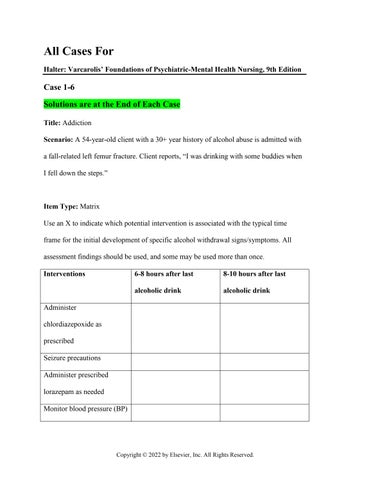
Item Type: Matrix Use an X to indicate which potential intervention is associated with the typical time frame for the initial development of specific alcohol withdrawal signs/symptoms. All assessment findings should be used, and some may be used more than once. Interventions
6-8 hours after last
8-10 hours after last
alcoholic drink
alcoholic drink
Administer chlordiazepoxide as prescribed Seizure precautions Administer prescribed lorazepam as needed Monitor blood pressure (BP)
Copyright © 2022 by Elsevier, Inc. All Rights Reserved.
Next-Generation NCLEX™ (NGN) —Style Case Studies for Psychiatric Nursing Observe presence of ―shakes‖ Monitor heart rate (HR) Assess for disorientation Monitor for delusional thinking Monitor for nausea and vomiting
Cognitive Skill: Take Action
Reference: Halter-Jordon, Margaret. (2018) Chapter 22: Substance-Related and Addiction Disorders, Varcarolis’ Foundations of Psychiatric Mental Health Nursing: A Clinical Approach, (ed. 8). St. Louis: Elsevier.
Halter: Varcarolis’ Foundations of Psychiatric-Mental Health Nursing, 9th Edition
Title: Addiction
Scenario: A 54-year-old client with a 30+ year history of alcohol abuse is admitted with a fall-related left femur fracture. Client reports, ―I was drinking with some buddies when I fell down the steps.‖
Copyright © 2022 by Elsevier, Inc. All Rights Reserved.
1-2
Next-Generation NCLEX™ (NGN) —Style Case Studies for Psychiatric Nursing
Item Type: Matrix Use an X to indicate which potential intervention is associated with the typical time frame for the initial development of specific alcohol withdrawal signs/symptoms. All assessment findings should be used, and some may be used more than once. Interventions
6-8 hours after last
8-10 hours after last
alcoholic drink
alcoholic drink
Administer chlordiazepoxide as prescribed Seizure precautions Administer prescribed lorazepam as needed Monitor blood pressure (BP) Observe presence of ―shakes‖ Monitor heart rate (HR) Assess for disorientation Monitor for delusional thinking Monitor for nausea and vomiting
Copyright © 2022 by Elsevier, Inc. All Rights Reserved.
1-3
Next-Generation NCLEX™ (NGN) —Style Case Studies for Psychiatric Nursing Answer(s): Interventions
Administer
6-8 hours after last
8-10 hours after last
alcoholic drink
alcoholic drink
X
X
chlordiazepoxide as prescribed Seizure precautions
X
Administer prescribed
X
lorazepam as needed Monitor blood pressure (BP)
X
Observe presence of
X
―shakes‖ Monitor heart rate (HR)
X
Assess for disorientation
X
Monitor for delusional
X
thinking Monitor for nausea and
X
vomiting
Rationales: Alcohol withdrawal occurs after reducing or quitting alcohol after heavy and prolonged use. The classic signs of alcohol withdrawal generally begin 6 to 8 hours after last drink. They include tremulousness, commonly called the shakes or the jitters, agitation, lack of appetite, nausea, vomiting, insomnia, impaired cognition, and mild
Copyright © 2022 by Elsevier, Inc. All Rights Reserved.
1-4
Next-Generation NCLEX™ (NGN) —Style Case Studies for Psychiatric Nursing perceptual changes. Both systolic and diastolic blood pressure increases, as does pulse and body temperature. Chlordiazepoxide is useful for tremulousness and mild to moderate agitation. Psychotic and perceptual symptoms such as delusions and hallucinations may begin in 8 to 10 hours after last drink. This time period has an increased risk of unconsciousness, seizures, and delirium. The benzodiazepines lorazepam or chlordiazepoxide can be given either orally or intramuscularly to help manage these signs/symptoms.
Cognitive Skill: Take Action
Reference: Halter-Jordon, Margaret. (2018) Chapter 22: Substance-Related and Addiction Disorders, Varcarolis’ Foundations of Psychiatric Mental Health Nursing: A Clinical Approach, (ed. 8). St. Louis: Elsevier.
Halter: Varcarolis’ Foundations of Psychiatric-Mental Health Nursing, 9th Edition
Title: Anxiety
Scenario: A 50-year-old has been admitted to the mental health unit of the local hospital for stabilization treatment for a diagnosis of generalized anxiety disorder (GAD). The client lives alone and has minimized social contracts over the last 6 months. The client shares that I‘m really anxious on the risks associated with the COVID-19 pandemic.
Item Type: Matrix Copyright © 2022 by Elsevier, Inc. All Rights Reserved.
1-5