All Cases For Microeconomics Case Studies and Applications, 4th Edition Jeff Borland Chapter 1-7
Case 1.1 What did that really cost you? Summary This case study presents a variety of applications of the concept of opportunity cost. The applications are intended to be at a ‘basic’ level, and can be used to supplement presentation of the definition of opportunity cost.
Suggested answers 1
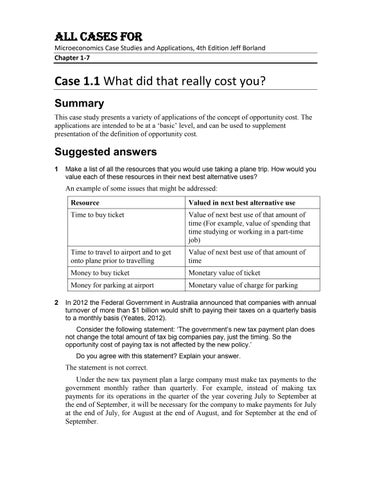
Make a list of all the resources that you would use taking a plane trip. How would you value each of these resources in their next best alternative uses?
An example of some issues that might be addressed:
2
Resource
Valued in next best alternative use
Time to buy ticket
Value of next best use of that amount of time (For example, value of spending that time studying or working in a part-time job)
Time to travel to airport and to get onto plane prior to travelling
Value of next best use of that amount of time
Money to buy ticket
Monetary value of ticket
Money for parking at airport
Monetary value of charge for parking
In 2012 the Federal Government in Australia announced that companies with annual turnover of more than $1 billion would shift to paying their taxes on a quarterly basis to a monthly basis (Yeates, 2012). Consider the following statement: ‘The government’s new tax payment plan does not change the total amount of tax big companies pay, just the timing. So the opportunity cost of paying tax is not affected by the new policy.’ Do you agree with this statement? Explain your answer.
The statement is not correct. Under the new tax payment plan a large company must make tax payments to the government monthly rather than quarterly. For example, instead of making tax payments for its operations in the quarter of the year covering July to September at the end of September, it will be necessary for the company to make payments for July at the end of July, for August at the end of August, and for September at the end of September.
It is correct that this does not change the tax payments made by a large company. However that does not mean that the opportunity cost is not affected. The company must now hand over the tax payments earlier, and hence loses that money for a period of time where it was previously able to use it for its own purposes. This means that the opportunity cost of making the tax payments is higher. The example above can be used to illustrate this conclusion. The company now has to make tax payments for July at the end of July, whereas previously it made those payments at the end of September. Suppose that under the previous system the best use of the money that the company uses to make tax payments for July is to keep it in an interest-paying bank account until the end of September. Therefore the new tax system means that the company is foregoing earning interest for two months on the money that it will use to make its tax payment for July. By the same argument under the new tax system the company will forego earning interest for one month on the money it will use to make its tax payment for August. 3
Sally Stockbroker has to decide whether to return to university to study for a Masters of Business Administration (MBA). The MBA will take three years to complete. Sally knows that the information relevant to calculating opportunity cost is that: (a) MBA fees will cost $20 000 per year; (b) Her salary as a stockbroker in every future year of her work life would be $80 000 per year if Sally does not do an MBA; (c) During her time studying Sally can work as a tutor at the university and earn $10 000 per year; and (d) Other costs such as textbooks that Sally would not otherwise incur are $5000 per year. At present Sally has not incurred any of these costs. What is Sally’s opportunity cost of doing an MBA?
Sally’s opportunity cost can be calculated as: Resource used
Opportunity cost
Fees
Money
3 years $20 000 = $60 000
Salary foregone
Time
3 years ($80 000 – $10 000) = $210 000 The net reduction in income that Sally experiences in each year fromß doing the MBA, compared to not doing it, equals the salary she could have earned as a stockbroker minus the money she can earn by tutoring.
Incidentals (books etc.)
Money
3 $5000 = $15 000
Total 4
$285 000
A recent article in The Age described how Qantas had shelved a project to update its IT system for frequent flyers (O’Sullivan 2013). Qantas had already spent $20 million on the project and its completion was forecast to cost another $40 million. What is the opportunity cost to Qantas of completing the IT project? What does this imply about Qantas’s beliefs regarding the benefits it would obtain from completing the project?
The opportunity cost to Qantas is $40 million: the amount that it would have to spend to complete the project after the date at which it is deciding whether to continue with the project. If Qantas is rational, it will only complete the project if it gains benefits greater than the opportunity cost. Since Qantas has decided to not complete the project, this implies that Qantas expects that the benefits will be less than $40 million.
Case 1.2 Opportunity cost and productivity in agriculture Summary This case study shows how the concept of opportunity cost can be applied to calculate a measure of the value of economic activity that incorporates resource costs due to environmental damage from the activity.
Suggested answers 1
Can you think of other examples of activities that cause environmental damage where the value of that damage would need to be incorporated into the value of inputs used in production in order to construct a ‘true’ measure of the productivity of that activity?
There are many possible examples. Where mining activity causes damage to the natural environment that reduces subsequent revenue from tourism or requires
expenditure of resources to ‘clean up’ that damage, then these would need to be included as resource costs; alternatively, where there is some manufacturing operation that causes air pollution, which causes respiratory problems for the population living nearby, some of whom subsequently require medical treatment, the cost of that medical treatment would need to be incorporated as a resource cost of the manufacturing activity. 2
Simon and Erica give up their jobs in the Economics Department to set up their own consulting firm. To set up their business, they must buy an office for $50 000. Should they choose to cease operating their business at some future date, they know they will be able to sell the office for $40 000. If they did not buy the office they would have invested the money they spent on the office and earned an annual interest rate of 10 per cent. They also need to hire a research assistant. The salary cost of the research assistant is $50 000 per annum. In its first year of operation, Simon and Erica expect to earn revenue of $200 000. What is the total opportunity cost to Simon and Erica of setting up their consulting firm for one year?
One component of opportunity cost involves the $50 000 invested to buy the office. If they decide to cease the business after one year, Simon and Erica can only recoup $40 000. Hence there is a cost of $10 000. As well, had they not bought the office, Simon and Erica could have invested the funds to earn 10 per cent interest. This represents foregone income of $5000. The other component of opportunity cost is the $50 000 salary for the research assistant. Hence the total opportunity cost equals $65 000 ($10 000 + $5000 + $50 000). 3
Since 2015, the Victorian Government has spent over $2.5 billion removing over 30 train level crossings in Melbourne and replacing them with flyovers or tunnels. Their justification for this policy is the significant delays caused for motorists at the train crossings during peak time. For example, it was estimated in 2015 that the crossing at Koornang Road in Carnegie was found to be closed for up to 87 minutes between 7 am and 9 am (Gordon, 2015). How would you calculate the opportunity cost of time spent by motorists at level crossings? How would you evaluate whether the Victorian Government is spending its funds wisely by committing to eliminate the level crossings?
The opportunity cost of time spent by motorists at level crossings is the value of what they could have done with the next best use of that time. For example, if it is assumed that being stuck at a level crossing reduces working time, the opportunity cost for a driver would be the amount of time spent waiting at level crossings (in hours) multiplied by their hourly wage rate. A benefit-cost analysis can be used to calculate whether the Victorian Government is spending its funds wisely. The opportunity cost to the government of eliminating the level crossings is the mount it is paying for their removal. The benefit of eliminating the level crossings is equal to the sum of individual benefits for each driver. The individual benefit to a driver is equal to the value of the reduction in time spent waiting at level crossings, which would be calculated as described above. The
government will be spending its funds wisely if the sum of benefits to drivers is greater than the cost of removing the crossings.
Case study 1.3 The benefits and costs of a university degree Summary This case study describes how the principle for optimal decision-making, to take an action where the addition to total benefit (marginal benefit) outweighs the addition to total cost (marginal cost), can be applied to the decision that a student who has completed high school makes about whether to attend university.
Suggested answers 1
You own an ice-cream stall at Sandy Beach. You can sell each ice-cream for $2. With extra opening hours for your stall, you believe that you can increase your sales as shown in the table below. For each hour the stall is open, your opportunity cost is $15. For how many hours should you open your stall?
Hours of opening
Total sales of ice creams 0
0
1
20
2
35
3
45
4
50
5
50
It is possible to use this information to calculate MB and MC: Hours of opening
Total sales of ice creams
Total revenue ($)
MB ($)
MC ($)
0
0
1
20
40
40
15
2
35
70
30
15
3
45
90
20
15
4
50
100
10
15
5
50
100
0
15
Hence the optimal number of opening hours is 3.