All Cases For Entrepreneurship ISE 12e Robert D. Hisrich, Michael Peters, Dean A. Shepherd Chapter 1-17
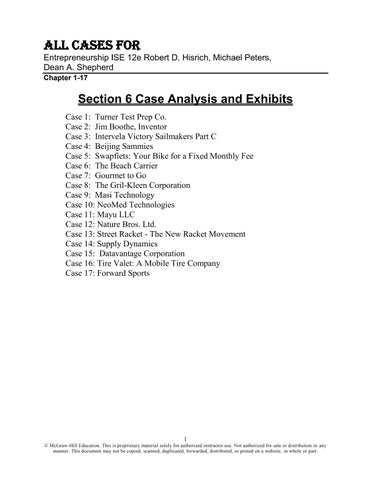
Section 6 Case Analysis and Exhibits Case 1: Turner Test Prep Co. Case 2: Jim Boothe, Inventor Case 3: Intervela Victory Sailmakers Part C Case 4: Beijing Sammies Case 5: Swapfiets: Your Bike for a Fixed Monthly Fee Case 6: The Beach Carrier Case 7: Gourmet to Go Case 8: The Gril-Kleen Corporation Case 9: Masi Technology Case 10: NeoMed Technologies Case 11: Mayu LLC Case 12: Nature Bros. Ltd. Case 13: Street Racket - The New Racket Movement Case 14: Supply Dynamics Case 15: Datavantage Corporation Case 16: Tire Valet: A Mobile Tire Company Case 17: Forward Sports
1 © McGraw-Hill Education. This is proprietary material solely for authorized instructor use. Not authorized for sale or distribution in any manner. This document may not be copied, scanned, duplicated, forwarded, distributed, or posted on a website, in whole or part.
CASE 1 TURNER TEST PREP CO. CASE OVERVIEW Jessica Turner is the founder and CEO of Turner Test Prep, a California company specializing in preparing people for the Certified Public Accountant (CPA) exam. In the Spring of 2003, she felt that she was not achieving market share and growing in the right direction. After three years of operation, Turner had about 10 percent of the market and was facing fierce competition from her primary rival, National Testing Services. Jessica wanted to improve marketing and gain market share.
QUESTIONS FOR DISCUS SION 1.
What is Jessica‘s break-even point?
2.
How does Turner Test Prep overcome the competition from NTC?
3.
How can Jessica achieve greater market share?
SOLUTIONS TO QUESTIO NS FOR DISCUSSION 1.
What is Jessica‟s break-even point? She needs 279 students to break-even. (See Case Exhibit 1A-1)
2.
How does Turner Test Prep overcome the competition from NTC? Case Exhibit 1A-1
Turner Test Prep Co. Break-even Calculation Fixed Costs Professor Salaries for 1200 hours/year @ $75/hour Office Space @ $2000/month Utilities and Insurances @ $1000/month Printing @ $500/month Marketing @ $400/month Travel @ $200/month Total Variable Costs Materials @ $600/student
$90,000.00 24,000.00 12,000.00 6,000.00 4,800.00 2,400.00 $139,200.00
2 $600.00
© McGraw-Hill Education. This is proprietary material solely for authorized instructor use. Not authorized for sale or distribution in any manner. This document may not be copied, scanned, duplicated, forwarded, distributed, or posted on a website, in whole or part.
Selling Price per student
$1100.00
Number of Students Jessica Needs
NTC has the advantage of being a leader in test prep services and has proven through longevity and its high passage rates that it will help students succeed. NTC has the name brand recognition, the proven track record, and the reputation of being the program to take if a student wants to pass the CPA exam. This makes it difficult for Turner to compete, so Jessica needs to market her competitive advantages. Jessica needs to do the following: ●
Publicize her pass rate. This will give her credibility and help her convince students that they should take her course. She needs to emphasize her pass rate in all marketing materials. Her high pass rate will also detract students from trying to study on their own, since her course will provide all the materials and, through the course guarantee, an assurance that they will pass on the first try.
●
Capitalize on her strengths and competitive advantage. Jessica offers a degree of personalized attention that no other program offers. This will be hard for others to imitate since they most likely will not have the resources to work with people one-onone. She needs to highlight her focus on providing individual attention in her marketing materials: ○
A web site will showcase her course and could have testimonials from former students. This will provide even more credibility and assurance to future students.
○
The site could include a glimpse into the types of materials that students will receive. A short practice test, passages from the materials, and a small list of test-taking tips will show future students the quality of her materials.
○
The site could also provide useful logistical information about the CPA exam such as suggested hotels where people could stay, maps to the location, and other practical information. Again, this illustrates that Jessica is providing more than just accounting information but that she is, in fact, a resource.
She also needs to clearly emphasize on her web site and marketing materials that her program is the only one that is taught by professors in the accounting, law, and finance fields. NTC does not have a staff of professors available to answer questions, and students with questions need to rely on NTC teaching staff who are not skilled in a particular background. Turner is also the only program that offers people audiotaped lectures, giving them the advantage of reviewing material after the lectures. These are key advantages that have helped her students pass on the first try, and Jessica needs to make people aware of the benefits of these over what NTC offers.
3 © McGraw-Hill Education. This is proprietary material solely for authorized instructor use. Not authorized for sale or distribution in any manner. This document may not be copied, scanned, duplicated, forwarded, distributed, or posted on a website, in whole or part.
●
3.
Cultivate relationships. Since Jessica is only focused on the San Francisco Bay Area and there is a finite number of students possible each year (approximately 1,000), Jessica needs to create a name for herself in the community and prove to people that she is able to help them pass on the first try. She could host a series of free workshops at each business school to give those considering taking the CPA exam a taste of her program and an idea of what she has to offer. She could also provide some accounting materials or tutorials that accounting graduate students may find helpful as a means of getting them familiar with her program early on. Sponsoring activities in the accounting departments (providing materials, donations, etc.) may also be a way to generate awareness of her program and give people the chance to see her commitment firsthand. Introducing herself to key businesses in the area that have large accounting departments and where there may be opportunities to reach people taking the CPA exam, could also increase her awareness to the community. She could even offer a special discount to people from these firms if they register with her.
How can Jessica achieve greater market share?
Jessica has been operating in a head to head struggle with NTC since she began the program. Not having the brand recognition and working against the market leader has made it extremely difficult to gain market share. Jessica should continue to try to generate interest in the course but could further differentiate herself and generate a market share by creating a niche. One area where she could work is to offer more specialized courses in addition to the one she currently offers. People who register for the course would have the option of selecting additional features for a higher fee. These features could include more practice graded essays, weekly oneon-one sessions with Jessica, special sessions with the professors, more practice exams, and supplemental sessions taught by Jessica regarding test taking techniques and preparation. A variety of options could be created, based on what Jessica feels would be appropriate for helping students who need—and want—more personalized attention. By offering a menu of additional services, Jessica is capitalizing on her advantage of personalized attention. While the regular course offers a high degree of attention, these additional services can help repeater students and those who feel that they need additional help to get more one-on-one attention from Jessica and the professors. Jessica could also hire the professors as tutors to work daily with individual students to supplement the material offered during the class. These services would be offered at a premium and would cater to those students who need additional assistance. By offering this level of attention, the pass rate would be even higher, and Jessica could use it to generate more publicity and more credibility for her program. Jessica could also offer people the choice of coming to lectures, using the audiotapes only, or having both. Again, price differences could be placed according to what people want. Providing options will give people a choice to create the course that most benefits them and their schedules and gives the Turner program the chance to gain all types of people studying for the exam. The NTC program only gives people flexibility in choosing access to what types of information they want, but the Turner program gives students the chance to create a program based on their time schedule and on how much additional assistance they think they will need. Consequently, Turner caters to a wider group of people and makes it much easier as well as more economical for people to choose the Turner program.
4 © McGraw-Hill Education. This is proprietary material solely for authorized instructor use. Not authorized for sale or distribution in any manner. This document may not be copied, scanned, duplicated, forwarded, distributed, or posted on a website, in whole or part.
By creating a menu of options, Jessica is creating a niche with students who need more attention and who want to customize their studying. For students who have failed the CPA exam already or who just feel that more attention will give them an advantage, these options create a definite advantage that will help Jessica to gain name brand recognition, increase her pass rate, and make it easier for her to gain market share.
CASE 2 Jim Boothe Case This case can be used in the first or second class or early in the entrepreneurship course. It provides an opportunity to compare an inventor with an entrepreneur and to discuss whether Jim Boothe has the character to become a successful entrepreneur. It also raises questions about risk and family support. Instructors can also question whether Jim has a complete business plan ready to be submitted to a bank. As we know an inventor may be an entrepreneur but also may not wish to assume the risk and to take the invention or concept to reality. Some inventors simply invent and hope to sell their ideas to someone else to develop into a new venture. A good example of an inventor who actually made invention a business was Thomas Edison. Many of his inventions became huge successes yet he was not the person who turned these inventions into established businesses. It is also noteworthy that the students understand that not all entrepreneurs are inventors. Franchise owners or imitators of others that start a business are still entrepreneurs. Much of the discussion regarding the differences between an entrepreneur and an inventor can be found in Chapter 1. Risk for the entrepreneur involves more than just financial risk. This case can raise the questions of what types of risk would someone like Jim assume if he decided to develop this invention into a business venture. There are at least four risks that can be mentioned here: 1. Financial risk –This is the most obvious and can include not only the $100,000 that he intends to borrow but also the money that he would have earned with his current position as an engineer. 2. Career risk – By starting this business Jim would be giving up a career that may be difficult to reenter should his venture fail. 3. Family risk – This may be very significant in this case since Jim does not seem to have the support of his wife Nora. This could be a serious detriment to getting this business started. Family support for an entrepreneur is critical because of the long hours and frustrations that often occur in early stages of a new venture. 4. Social risk – The risk of failure is often a barrier for many to start a new business. Individuals that look at a glass as half empty all the time are destined for failure as opposed to someone who always looks at the glass as half full. A positive attitude and the conviction to not worry about failure is an important trait for an entrepreneur. Research is very important to an entrepreneur. In this case we see that Jim relied on surveys of his friends that own 15 speed bikes. This data would obviously be biased and too limited to convince anyone that this is a good idea. Instructors can ask the class to think about ways to research this concept. Who would be the target market? Where can you get data about this market? How will he get the derailleur on a bicycle? 5 © McGraw-Hill Education. This is proprietary material solely for authorized instructor use. Not authorized for sale or distribution in any manner. This document may not be copied, scanned, duplicated, forwarded, distributed, or posted on a website, in whole or part.