lOMoARcPSD|11448692
RS NOTES
1.1 – Ancient Philosophical influences
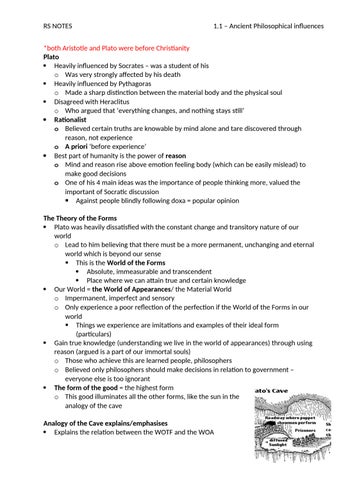
*both Aristotle and Plato were before Christianity Plato Heavily influenced by Socrates – was a student of his o Was very strongly affected by his death Heavily influenced by Pythagoras o Made a sharp distinction between the material body and the physical soul Disagreed with Heraclitus o Who argued that ‘everything changes, and nothing stays still’ Rationalist o Believed certain truths are knowable by mind alone and tare discovered through reason, not experience o A priori ‘before experience’ Best part of humanity is the power of reason o Mind and reason rise above emotion feeling body (which can be easily mislead) to make good decisions o One of his 4 main ideas was the importance of people thinking more, valued the important of Socratic discussion Against people blindly following doxa = popular opinion The Theory of the Forms Plato was heavily dissatisfied with the constant change and transitory nature of our world o Lead to him believing that there must be a more permanent, unchanging and eternal world which is beyond our sense This is the World of the Forms Absolute, immeasurable and transcendent Place where we can attain true and certain knowledge Our World = the World of Appearances/ the Material World o Impermanent, imperfect and sensory o Only experience a poor reflection of the perfection if the World of the Forms in our world Things we experience are imitations and examples of their ideal form (particulars) Gain true knowledge (understanding we live in the world of appearances) through using reason (argued is a part of our immortal souls) o Those who achieve this are learned people, philosophers o Believed only philosophers should make decisions in relation to government – everyone else is too ignorant The form of the good = the highest form o This good illuminates all the other forms, like the sun in the analogy of the cave Analogy of the Cave explains/emphasises Explains the relation between the WOTF and the WOA
lOMoARcPSD|11448692
RS NOTES
1.1 – Ancient Philosophical influences
How physical things can blind us from what is really important (e.g. the prisoners’ whole lives being centred around competitions of guessing and memorising the shadows which they think are real objects) The initial difficulties and hard journey to reaching the understanding of the WOTF (shown by the jagged and difficult path out of the cave) o ‘wisdom starts with owning up to ignorance’ (Plato) o ‘better to be the poor servant of a poor master’ (quote from Homer, used in Plato’s Republic) Better to suffer and endure hardship through knowing the truth than living a life of ignorance Hostility that people feel when faced with philosophical questions that challenge the mainstream, accepted ideas o Shown by the prisoners plotting to kill the next who escaped and the murder of Socrates for his provocative views
Plato – Hierarchy of the Forms Realm of the forms is infinitely superior to realm of appearances If something is true in the world of appearances it is even more true in Forms o Influenced by Pythagoreans obsessions with ratios We need the ‘mind’s eye’ (force of intellect) to appreciate the Forms o Equivalent to our eyes in world of appearance Need the ‘Form of the Good’ to illuminate our understanding o Similar to the idea of to the sun on earth o Highest of forms, top of hierarchy Below it is the ‘Higher forms’ such as beauty, truth and justice o Below that are objects such as humans or chairs These things are eternal too (like our souls) Humans are obsessed with trivial things in life rather than concerned with the true meaning of beauty etc. o Material and sensual things, NOT THE TRUTH o People are ignorant of the true good Strengths and weaknesses of Plato’s Theory of the Forms Use of reason is a lot better than the use of sense which is based on empirical evidence which can be easily manipulated Senses are subject to individual and can be easily coerced E.g. advertising market today, skewed our perception on certain issues and changed societal views on matters such as body image Analogy of the cave is applicable to real life and is logical In example of advertising, advertisers are the puppeteers feeding society false and unimportant information centred around materialism Distracting us from knowing the truth about life Plato stating that Philosophers should be in charge of governmental issues because they know the truth and are able to use reason and are free from being influenced by the senses and emotions Implies that philosophers aren’t influenced by friends and public figures or doxa Ironic as Plato was heavily influenced by Socrates’ (friend and teacher) death
lOMoARcPSD|11448692
RS NOTES
1.1 – Ancient Philosophical influences
Aristotle argued that empirical evidence shouldn’t be disregarded as it is essential for testing our theories on whether they are applicable in real life or practical Sole reason can quickly disintegrate into speculation and imagination Plato claiming the superiority of reason over empiricism and experience is ironic because the use of reason is based on sense experience and cannot exist without it E.g. using reason to state that there are books in a library (despite never going to that particular library) is based on past experiences pf going to a library Aristotle – need to use senses as its far more useful and practical in responding to experience E.g to understand how people vote Those with an absolutist approach to reality (such as Kant) would argue that there are universal truths and shared values on abstract ideas Such as the idea of beauty or justice Must stem from an ideal version of these qualities which exist outside of our world Without this ‘general features of the world’ wouldn’t have any value within themselves, only the value that we believe them to have (Brian Davies) There is not an absolute and conclusive census on abstract values such as ‘beauty’ or ‘justice’ Are subjective Why people decorate homes differently and wear different clothes, We would all be the same if we had the same ideas of ‘good’, the individuality present in the world stems from different interpretations of these abstract values Therefore, there is not necessarily a perfect form of certain values Relativist scholar Mackie would agree with this The existence of TWOTF is just as rational as the existence of God It is comforting to know that there is a place where everything is perfect, and stays so forever Karl Popper – Plato constructed the existence of TWOTF because he was so dissatisfied with the constant change in the world, used it as a coping mechanism Wishing for something to be true doesn’t make it true Similar to Feuerbach’s argument against God’s existence Shows that both religion and the idea of the world of the forms are both irrational and nothing more than wishful thinking Dawkins – it is nonsense to talk of another transcendent world which is beyond the physical No empirical evidence, Plato offers no justification at all Aristotle – complete oversight to say that there is a perfect form of everything How can there be a perfect form of numbers or of colour There are infinite numbers, meaning there must be an infinity of forms which makes no sense Perfection cannot be eternal as this would mean that the perfect version of everything would have to exist in TWOTF from the beginning of time to the end of time The perfect form of a dinosaur would exist no in 2020, perfect form of an iPhone existed in the prehistoric times Possible answer to the problem of evil – our world is imperfect, created as a poor reflection of the world of the forms