lOMoARcPSD|66458793
MEI A level Mathematics Differentiation Topic assessment 1. Using the chain rule, differentiate ( x 2 − 1)6 .
[3]
2. Show that the gradient of y = ( x 2 − 1)( x − 2)3 is given by dy = ( x − 2)2 (5 x 2 − 4 x − 3) . dx 3. Show that the gradient of the curve y =
[4]
x −1 at the point where x = 2 is -3 x2 − 3
[5]
4. A potter is making an open topped vessel shaped as a right circular cylinder of radius r and height 2r. (a) Show that the volume V of the vessel is given by V = 2 r 3 [1] (b) Find the rate at which the volume is increasing when the radius is 2 cm and increasing at a rate of 0.25 cm/s. [4] 3 (c) Given that the volume is increasing at a rate of 5 cm /s when the radius is 5 cm, find the rate at which the surface area is increasing at this point. [6] 5. In this question you must show detailed reasoning. A curve has equation y = 3x 4 − 8 x3 + 6 x 2 + 1 . (a) Find the coordinates of the stationary points and determine their nature. (b) Sketch the curve. (c) Find the values for x for which the curve is convex.
[6] [2] [3]
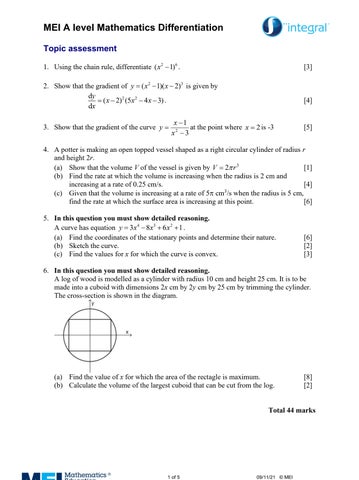
6. In this question you must show detailed reasoning. A log of wood is modelled as a cylinder with radius 10 cm and height 25 cm. It is to be made into a cuboid with dimensions 2x cm by 2y cm by 25 cm by trimming the cylinder. The cross-section is shown in the diagram.
(a) Find the value of x for which the area of the rectagle is maximum. (b) Calculate the volume of the largest cuboid that can be cut from the log.
[8] [2]
Total 44 marks
1 of 5
09/11/21 © MEI
lOMoARcPSD|66458793
MEI A level Maths Differentiation Assessment solutions Topic assessment solutions 1. y = ( x 2 − 1)6 Let u = x 2 − 1
y = u6
du = 2x dx
dy = 6u5 du
Using the chain rule:
dy dy du = = 6u5 2 x dx du dx = 12 x ( x 2 − 1)5 [3]
2. y = ( x 2 − 1)( x − 2)3
du = 2x dx dv Let v = ( x − 2)3 = 3( x − 2)2 dx dy dv du Using the product rule: =u +v dx dx dx 2 = ( x − 1) 3( x − 2)2 + ( x − 2)3 2 x Let u = x 2 − 1
= ( x − 2)2 3( x 2 − 1) + 2 x ( x − 2) = ( x − 2)2 (3x 2 − 3 + 2 x 2 − 4 x ) = ( x − 2)2 (5 x 2 − 4 x − 3) [4] 3. y =
x −1 x2 − 3
du =1 dx dv Let v = x 2 − 3 = 2x dx Let u = x − 1
du dv −u dx dx 2 v 2 ( x − 3) 1 − ( x − 1) 2 x = ( x 2 − 3)2 x 2 − 3 − 2x 2 + 2x = ( x 2 − 3)2 − x 2 − 3 + 2x = ( x 2 − 3)2
dy = Using the quotient rule: dx
v
2 of 5
09/11/21 © MEI
lOMoARcPSD|66458793
MEI A level Maths Differentiation Assessment solutions When x = 2, gradient =
−22 − 3 + 2 2 −4 − 3 + 4 = = −3 . (22 − 3)2 12
[5]
4. (a) V = r 2h = r 2 2r = 2 r 3 [1] (b)
dV = 6 r 2 dr
dV dV dr dr = = 6 r 2 dt dr dt dt d V dr = 6 22 0.25 When r = 2 and = 0.25 : dt dt = 6 Using the chain rule:
= 18.8 cm3 /s (3 s.f.) [4] (c) Surface area A = 2 rh + r
2
= 2 r 2r + r 2 = 4 r 2 + r 2
dA = 10 r dr
= 5 r 2
dA dA dr dV = dt dr dV dt 1 dV 5 dV = 10 r = 6 r 2 dt 3r dt dA 5 5 dV = 5 = When r = 5 and = 5 , dt 3 5 3 dt 2 = 5.24 cm /s (3 s.f.) Using the chain rule:
[6] 5. (a) y = 3x 4 − 8 x 3 + 6 x 2 + 1 dy = 12 x 3 − 24 x 2 + 12 x dx At stationary points, 12 x 3 − 24 x 2 + 12 x = 0
x ( x 2 − 2 x + 1) = 0
When x = 0 , y = 1
x ( x − 1)2 = 0 x = 0 or x = 1
When x = 1, y = 3 − 8 + 6 + 1 = 2
3 of 5
09/11/21 © MEI