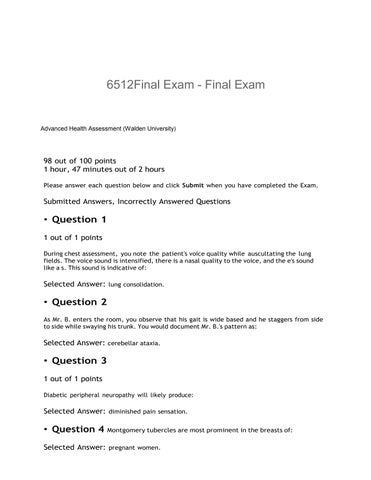
6512Final Exam - Final Exam
Advanced Health Assessment (Walden University)
98 out of 100 points 1 hour, 47 minutes out of 2 hours Please answer each question below and click Submit when you have completed the Exam.
Submitted Answers, Incorrectly Answered Questions
• Question 1 1 out of 1 points During chest assessment, you note the patient's voice quality while auscultating the lung fields. The voice sound is intensified, there is a nasal quality to the voice, and the e's sound like a s. This sound is indicative of:
Selected Answer: lung consolidation.
• Question 2 As Mr. B. enters the room, you observe that his gait is wide based and he staggers from side to side while swaying his trunk. You would document Mr. B.'s pattern as:
Selected Answer: cerebellar ataxia.
• Question 3 1 out of 1 points Diabetic peripheral neuropathy will likely produce:
Selected Answer: diminished pain sensation.
• Question 4 Montgomery tubercles are most prominent in the breasts of: Selected Answer: pregnant women.
• Question 5 Which one of the following techniques is used to detect a torn meniscus?
Selected Answer: McMurray test
• Question 6 Ulnar deviation and boutonniere deformities are characteristic of:
Selected Answer: rheumatoid arthritis.
• Question 7 A pulsation that is diminished to the point of being barely palpable would be graded as:
Selected Answer: 1
• Question 8 In the most effective percussion technique of the posterior lung fields, the patient cooperates by:
Selected Answer: folding the arms in front.
Question 9 When palpating joints, crepitus may occur when:
Selected Answer: irregular bony surfaces rub together.
• Question 10 While collecting personal and social history data from a woman complaining of breast discomfort, you should question her regarding:
Selected Answer: alcohol, tobacco, and caffeine use.
• Question 11 Postural hypotension is defined as a supine readings.
when the patient stands, compared with sitting or
Selected Answer: systolic pressure drop of more than 15 mm Hg with a pulse rate increase
• Question 12 You are examining a patient in the emergency department who has recently sustained head trauma. In order to initially assess this patient's neurologic status, you would:
Selected Answer: test the six cardinal points of gaze.
• Question 13
Temporalis and masseter muscles are evaluated by:
Selected Answer: having the patient clench his or her teeth.
• Question 14 A parent is advised to restrict contact or collision sports participation for their child. An example of a sport in which this child could participate is:
Selected Answer: riflery.
• Question 15 Cranial nerve XII may be assessed in an infant by:
Selected Answer: observing the infant suck and swallow.
• Question 16 The reliability of health-related findings and observations is the responsibility of the:
Selected Answer: professional and the patient.
• Question 17 Normal changes of the aging brain include:
Selected Answer: diminished perception of touch.
• Question 18 The adnexa of the uterus are composed of the:
Selected Answer: fallopian tubes and ovaries.
• Question 19 For purposes of examination and communication of physical findings, the breast is divided into:
Selected Answer: four quadrants plus a tail.
• Question 20 A patient in the deepest coma would be scored a Selected Answer: 3
on the Glasgow Coma Scale.
• Question 21 A patient you are seeing in the emergency department for chest pain is suspected of having a myocardial infarction. During the health history interview of his family history, he relates that his father had died of "heart trouble." The most important follow-up question you should pose is which of the following?
Selected Answer: "What age was your father at the time of his death?"
• Question 22 Nerves that arise from the brain rather than the spinal cord are called:
Selected Answer: cranial.
• Question 23 While examining a 30-year-old woman, you note that one breast is slightly larger than the other. In response to this finding, you should:
Selected Answer: note the finding in the patient’s record.
• Question 24 In the adult, the apical impulse should be most visible when the patient is in what position?
Selected Answer: Upright
• Question 25 A 23-year-old white woman has come to the clinic because she has missed two menstrual periods. She states that her breasts have enlarged and that her nipples have turned a darker color. Your further response to this finding is to:
Selected Answer: suggest pregnancy testing.
• Question 26 Tarry black stool should make you suspect:
Selected Answer: upper intestinal bleeding.
• Question 27 To assess spinal levels L2, L3, and L4, which deep tendon reflex should be tested?