FutureMetrics’ William Strauss shares insights about the pellet export markets in 2022 and beyond.
16 A commitment to Canada
An inside look at Drax Group’s future plans for Canada, wood pellet production and bioenergy with carbon capture and storage.
18 Bringing biopower back
Biomass power generation facility comes back online in a northern B.C. community.
20 Scaling-up straw
Alberta farmer, engineer look to combat climate change by turning straw into pellets.
SIndigenous investments
As Canada looks to scale-up the use of renewable fuels, Indigenous communities lead the way
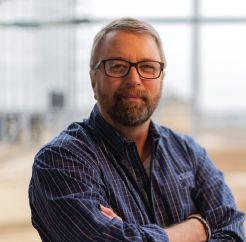
ince joining Canadian Biomass in 2018, I’ve seen a big uptick in investments in biofuel, biogas and bioenergy projects, particularly in the past year. A large percentage of these new investments have been in Indigenous communities where renewable energy sources, such as wood waste, are readily available to replace costly traditional fossil fuels.
For example, in December 2021, BioNorth Energy, a joint-venture partnership between the Arrow Group of Companies, the Nak’azdli Whut’en First Nation, and Nexus Management Group, acquired a shuttered biomass power generation facility in Fort St. James, B.C. The facility came back online in January, providing green energy and jobs to locals. Read more about the biopower project on page 18.
communities, both economically and environmentally, speak for themselves. It is a major step forward for Saskatchewan and Canada as the world begins more earnestly to transition to renewable fuel sources. As Rasmussen told me, the MLTC sees this as just the beginning. Read more about the project on page 10.
Another example of Indigenous-led biomass investments is the Meadow Lake Tribal Council (MLTC)’s new Bioenergy Centre. The MLTC consists of nine First Nations in Meadow Lake, Sask. They saw an opportunity to use wood waste from their mill which was being burned in beehive burners. As stewards of the land, Indigenous communities and organizations have an inherent understanding of how important it is to use as much of every tree as possible, said Tina Rasmussen, corporate development and administration officer with MLTC Industrial Investments.
Now, the Bioenergy Centre will power 5,000 homes in the community, as well as provide heat and power for their sawmill’s new continuous kiln. The project is the first of its kind in Saskatchewan, and sets a strong precedent for investing in Indigenous-led bioeconomy ventures. In my opinion, the multitude of benefits for local
While much of the focus has been on bioenergy power, the backbone of the bioeconomy – the wood pellet industry – has also seen a lot of growth. That growth is predicted to continue as demand for renewable fuels takes off, particularly in Asia and Europe. William Strauss, CEO of FutureMetrics, shares in our annual pellet markets outlook article on page 13 that “the industrial wood pellet markets have been growing at an annualized rate of about 1.66 million metric tonnes per year from 2010 through 2021.”
That’s not a small number by any means. In fact, it reinforces the case for investing in the wood pellet industry, something which international companies such as Drax have realized. Drax came onto the Canadian scene in a big way last year when it acquired Pinnacle Renewable Energy, and recently announced plans to double its pellet production capacity by 2030. Matt White, the company’s executive vice-president, shares some insights about their plans on page 16.
As we move into 2022, I look forward to seeing the Canadian bioeconomy continue to develop, with Indigenous communities leading the charge. •
CANADIAN BIOMASS
Volume 22 No. 1
Editor - Ellen Cools (416) 510-6766 ecools@annexbusinessmedia.com
Managing Editor - Maria Church (226) 931-1396 mchurch@annexbusinessmedia.com
Contributors - Gordon Murray, William Strauss, Jamie Stephen
Group Publisher - Todd Humber 416-510-5248 thumber@annexbusinessmedia.com
Canadian Biomass is published four times a year: Winter, Spring, Summer and Fall. Published and printed by Annex Business Media.
Publication Mail Agreement # 40065710 Printed in Canada ISSN 2290-3097
Subscription Rates: Canada - 1 Yr $57.00; 2 Yr $102.00 Single Copy - $9.00 (Canadian prices do not include applicable taxes) USA – 1 Yr $121.50 CDN; Foreign – 1 Yr $138.00 CDN
CIRCULATION jdoshi@annexbusinessmedia.com Tel: (416) 510-5124 Fax: (416) 510-6875 or (416) 442-2191 111 Gordon Baker Rd., Suite 400, Toronto, ON M2H 3R1
PACBIO TO PERMANENTLY CLOSE IN 2022, DRAX ACQUIRES CONTRACTS
Pacific BioEnergy Corporation (PacBio) in December 2021 announced that it had reached an agreement to assign some of its assets, including the wood pellet long-term sales contracts, to the Drax Group. Through the deal, Drax will get an additional 2.8 million tonnes of orders for sustainable biomass supply.
These contracts are for delivery between 2022 and the mid2030s, of which 0.3 Mt is for delivery in 2022. The total incremental revenues over the contract period are around $675 million. Drax aims to double sales of biomass to third parties to at least four Mt pa by 2030, developing its market presence in Asia and Europe, facilitated by the creation of new business development teams in Tokyo and London during 2022.
The PacBio wood pellet plant in Prince George, B.C., will permanently close this year, resulting in the loss of 55 direct jobs.
PacBio CEO John Stirling stated, “Our company has been battling several challenges for the past few years. Sawmill closures in the region have reduced the volume of available raw materials and increased their cost significantly. Forest fires, landslides, and floods
ALBIOMA ACQUIRES LA GRANAUDIÈRE WOOD PELLET PLANT IN QUEBEC
have severely impacted our ability to transport our product by rail to the export terminal in North Vancouver. The impact has been a significant increase in operating costs. Our sales contracts have been sold to Pinnacle to mitigate the impact on our customers.”
Albioma has acquired the La Granaudière wood pellet production plant located in Quebec. This transaction will diversify the group’s sources of sustainable biomass supplies, supplementing the existing portfolio of contracts with international suppliers.
Ideally positioned to supply Albioma’s Caribbean power plants, La Granaudière produces Sustainable Biomass Program (SBP)-certified pellets from wood waste or low-grade wood from certified sustainably managed forests.
The transaction also includes a long-term agreement granting access to a 45,000-tonne pellet storage facility in the Port of Quebec, as well as raw material supply guarantees issued by Quebec’s Ministry of Forests, Wildlife and Parks (MFFP).
The plant, which has been out of service since July 2021, concomitantly with the receivership procedure, is due to be recommissioned in early 2022, with its nominal annual production capacity of 200,000 tonnes being achieved following some additional investments.
Frédéric Moyne, Albioma’s chairman and CEO, said: “We extend a warm welcome to the staff at La Granaudière, as they bring their expertise to Albioma. Through this transaction, which will enable us to produce pellets to very strict sustainability requirements, Albioma is renewing and stepping up its commitment to the energy transition in overseas France. Supplementing locally-sourced biomass, to which priority will naturally be given in order to stimulate the circular economy, this diversified supply is essential, ensuring that we are able to continuously generate renewable energy in non-interconnected areas.”
GREENLANE RENEWABLES TO SUPPLY BIOGAS UPGRADING SYSTEM TO VANCOUVER LANDFILL
Greenlane Renewables Inc. announced in December that its wholly-owned subsidiary, Greenlane Biogas North America Ltd., has been awarded a $12.1 million contract by FortisBC Energy Inc. for the supply of a biogas upgrading system for a new project at the Vancouver landfill in B.C.
Greenlane will supply its two-stage pressure swing adsorption (PSA) system to upgrade the landfill gas to clean, low-carbon renewable natural gas (RNG) for direct injection into FortisBC’s regional natural gas pipeline system.
“Greenlane is proud to have been chosen by FortisBC as a key supplier in the City of Vancouver’s landfill gas-toRNG project for the supply of our PSA biogas upgrading system,” said Brad Douville, president and CEO of Greenlane.
CHAR TECHNOLOGIES MOVES FORWARD
WITH BIOMASS
TO RNG PROJECT
In November 2021, CHAR Technologies Ltd. announced the commencement of surveying and geotechnical testing at the proposed site of its woody-biomass to renewable natural gas (RNG) high temperature pyrolysis (HTP) project near Kirkland Lake, Ont. This project will potentially produce 500,000 gigajoules per year of RNG, and 10,000 tonnes per year of CHAR’s proprietary CleanFyre biocoal. The Kirkland Lake project will be designed, built, operated and owned by CHAR.
The company had previously entered into a land purchase option agreement (July 2, 2021) with the town of Kirkland Lake with respect to the proposed project site, as well as a letter of interest (July 9, 2021) for biomass supply to the project, and an exclusive letter of interest (Sept. 16, 2021) with a Canadian gas utility for long term RNG off-take. It is anticipated that an off-take contract will be finalized in early 2022. CleanFyre from the proposed Kirkland Lake facility will be earmarked for future sale to the steel making and metal smelting industries.
Andrew White, CHAR CEO, said, “We continue to gain market penetration and interest through the demonstration of our proprietary HTP systems and its solution for reducing greenhouse gas emissions. As society recognizes the value of converting low-value by-products and waste materials to valuable clean energy sources, then we can transition to a circular economy. Renewable natural gas is CHAR’s next vertical in line with our current business objectives.”
ENERKEM ACHIEVES BREAKTHROUGH CONVERTING FOREST BIOMASS INTO SAF
Enerkem, a producer of biofuels from waste materials, has achieved a major breakthrough in converting carbon from forest biomass into sustainable aviation fuel using its proprietary thermochemical process. This milestone happened at Enerkem’s Innovation Centre in Westbury, Que. It will be followed by the demonstration phase and then commercialization in the near future.
The aviation sector accounts for three per cent of total global greenhouse gas emissions. Enerkem’s aviation fuel is already in the process of being certified by Canadian, American and European authorities. The company has the infrastructure in place to move to the commercialization stage (a plant in Edmonton and an innovation centre in Westbury) and will be able to proceed as soon as the market conditions are met.
“Our diligent and innovative approach in developing our forest biomass conversion technology has enabled us to produce a sustainable aviation fuel that will reduce the full life cycle carbon emissions of the aviation industry by over 90 per cent compared to conventional fuel,” said Michel Chornet, Enerkem’s executive vice-president, engineering, innovation and operations.
ANDRÉ BÉDARD JOINS QWEB AS MANAGER OF THE PELLET GROUP
André Bédard has joined the Quebec Wood Export Bureau (QWEB) as the manager of the pellet group. Bédard has worked in the pellet industry for the past 10 years, developing local and international markets, and sitting on various committees including QWEB’s pellet group and the Wood Pellet Association of Canada.
As the manager of the pellet group, Bédard will help meet the needs of his members with regards to market access and export promotion, and help organize seminars and conferences.
ENVIVA TO PROVIDE BIOMASS FOR COAL-FIRED POWER PLANTS IN JAPAN
Enviva Partners, LP, and Tokyo-based utility Electric Power Development Co., Ltd. (J-Power), have signed a memorandum of understanding (MOU) for the long-term, large-scale supply of sustainable wood biomass from Enviva’s manufacturing facilities in the U.S. to J-Power’s power plants. The agreement is designed to develop an executable and investable plan under which Enviva will build new infrastructure to produce and deliver up to five million metric tons of sustainable wood pellets annually to permanently replace coal in J-Power’s existing coal-fired power plants.
The MOU provides a framework to advance the role of biomass as a renewable and sustainable energy source and help J-Power meet its “Blue Mission” goal to be carbon-neutral by 2050.
The parties will jointly evaluate the most sustainable and cost-effective means to deliver on the potential of the coal-to-biomass conversion project, such as security of supply, port reception, delivery and storage logistics, safety measures, and project economics. The investment will leverage J-Power’s existing coal-fired power plants by re-purposing them via conversion, resulting potentially in both dedicated and co-fired biomass plants.
Converting existing coal-fired power plants to sustainable biomass usage is one of the quickest, most cost-effective ways to reduce the lifecycle greenhouse gas emissions of a plant by more than 80 per cent while retaining jobs throughout the supply chain. Coal-to-biomass conversion projects enable former coal plants to continue operating cost-efficiently with their existing supply, generation, and grid infrastructure.
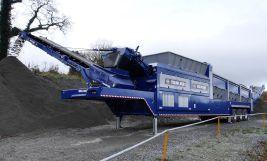
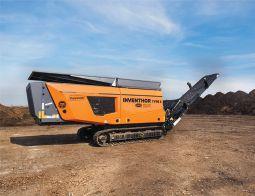
EDGE INNOVATE UNVEILS NEW TRM831 WHEELED MOUNTED TROMMEL
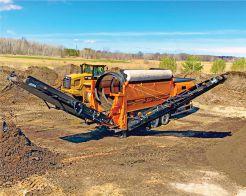
EDGE Innovate’s TRM831 portable trommel is ideal for the high-capacity screening of various applications including topsoil, compost, sand, household waste and construction and demolition waste.
With a screening area of 57m², the EDGE TRM831 is fitted with a variable speed 2.3- x 9.3-metre-long screening drum, powered via an efficient hydrostatic drive system. Screening efficiency is ensured thanks to a 9.3-metre-long drum with hydraulically adjustable drum cleaning brushes.
Offering the largest hopper capacity in its class, the EDGE TRM831 encompasses a 1,500-millimetre-wide, variable speed feed conveyor complete with load sensing and automatic feeder shut down to ensure maximum uptime. Additional hopper options include a reject grid and a two-deck vibrating screen for the pre-treatment of the feed material.
The EDGE TRM831 is powered via a 188-hp Caterpillar C4.4 Tier 4 Final/STAGE V engine, resulting in extremely low engine and noise emissions. Further fuel savings are made possible thanks to EDGE’s unique Eco-Power Saving Mode, which automatically reduces engine speed to idle when not processing material for a set period.
The TRM831 discharges fines material via a radial fines conveyor with a discharge height of up to six metres. With a 180-degree radial functionality as standard, the radial fines conveyor facilitates the creation of impressive stockpiles and reduces the double handling of material by up to 75 per cent. www.edgeinnovate.com
MARTIN ENGINEERING ANNOUNCES NEW V-PLOW DESIGN FOR CONVEYORS
The re-engineered Martin V-Plow HD achieves gains with no compromise in performance. While the previous welded design’s largest dimensions were 17.5 inches wide x 38 inches long, the new modular design’s widest component is less than eight inches and the longest is approximately 31 inches.
The V-Plow HD prevents tail pulleys from becoming fouled and damaged by spillage traveling on the return side of the conveyor belt. Fugitive material commonly migrates from the cargo side to the return side during normal operation. If this spillage reaches the tail pulley, two things can happen: lumps can get caught between the pulley and the belt, gouging and damaging both the belt and pulley face, or spillage can be crushed by the pressure between the pulley and the belt, adhering to the pulley face and the return side of the belt, causing pulley slippage and fouling of idlers along the system.
Engineered for belts as wide as 120 inches with speeds up to 900 feet per minute, the V-Plow HD redesign has made the equipment modular. The V-Plow HD mounting system and security cable assembly is also safer, longer-lasting and less damaging to the belt than competing units. If the V-Plow HD detaches from one mount, the other mount and safety cables keep it in place, protecting the belt and workers. www.martin-eng.com
WERK-BRAU INTRODUCES NEW ROLL-OUT BUCKET FOR WHEEL LOADERS
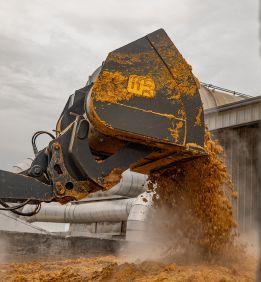
Werk-Brau introduces roll-out buckets, which add 24 inches or more to the dump height of wheel loaders. Designed for light materials (2000 lbs/cubic yard or less), this new bucket allows the loading of standard (13-feet, six-inch) trailers without ramps. Tandem cushioned hydraulic cylinders raise the back of the bucket to achieve the higher dump height, completely clearing materials without the need for jarring material loose. A recessed carriage improves the centre of gravity and prevents “tippyness” while placing less stress on loader arms and bucket linkage. Load out “cycle” time is reduced. Visibility slots on the top of the bucket allow the operator a better sightline. Performance side plates enhance material retention, and rubber skirting keeps the bucket clean after every bucket pass. Werk-Brau roll-out buckets are available for all loader sizes, and are ideal for backfilling, loading trucks, re-handling of materials, and more.
Manufactured with high-strength T-1 steel in all critical wear points, with abrasion resistant wear straps to reinforce the bucket bottom. Werk-Brau manufactures all attachments to OEM specifications for all makes and models of all wheel loaders. www.Werk-Brau.com
Lessons learned
TWPAC looks to build upon the accomplishments of 2021
By Gordon Murray
o know your future you must know your past,” is a philosophy that fits the Wood Pellet Association of Canada (WPAC)’s approach to moving forward through uncertain, challenging, yet exciting times. WPAC’s well-attended virtual Annual General Meeting in September 2021 focused on the growth and achievements of the past year with an eye on the work ahead for our association, our growing membership and our sector at large.
The good news is industrial wood pellet markets have been growing at an annualized rate of about 1.66 million metric tonnes per year from 2010 through 2021 and, according to FutureMetrics, demand is expected to increase by 8.9 per cent from 2021 to 2022 and by another 14.8 per cent from 2022 to 2023. (Editor’s note: read the 2022 wood pellet markets forecast on page 13.)
Yet challenges exist. Over the past year, the world has had its eye on “Beautiful British Columbia” – a province and her people literally put to the test, facing fires and floods on top of the pandemic. The recovery from these extreme weather events will be long for many, but our sector and our members will keep delivering product to customers despite the interruptions to highways and roads and infrastructure. We will keep giving. And our sector will double down to do its part in the fight against climate change.
Through a government Supply Chain Resiliency Grant of $390,000 from B.C.’s Ministry of Jobs, Economic Recovery and Innovation, funds have gone towards the expansion of the Prince Rupert corridor, adding railway tracks, storage and creating an overall stronger and more resilient logistical rail system for the west coast. The investment means major producers of wood pellets, such as Canfor, Witset First Nation, Skeena BioEnergy, La Crete Sawmills, Vanderwell, Pinnacle/Drax, West Fraser and Premium Pellet, will be better able to mitigate any supply chain risks due to weather, late vessels, or mechanical problems.
At a time when B.C.’s infrastructure has suffered catastrophic damage due to recent weather events, this investment mitigates disruptions to the hundreds of jobs associated with production and logistics, without impacting customers.
REFLECTING ON 2021
Looking back, WPAC’s 2020-2021 priorities included enhancing the reputation of superior, reliable, sustainable and ethical business practices, providing leadership on behalf of the Canadian sector in the Sustainable Biomass Program (SBP) and completing two of the regional risk assessments (Quebec and B.C.), with three more underway. We also ramped up efforts domestically,
focusing on challenging information that doesn’t accurately reflect the potential of wood biomass, and we initiated significant advocacy across Canada at every political level.
Of course, our top priority has been and will remain safety. Our sector cannot be successful if our colleagues aren’t safe. People drive safety and our safety initiatives represent a collective effort to make our workplaces safer. Key partnerships with the BC Forest Safety Council, the Biomass and Bioenergy Research Group at the University of British Columbia and Dalhousie University, and the participation of nearly 40 organizations, are
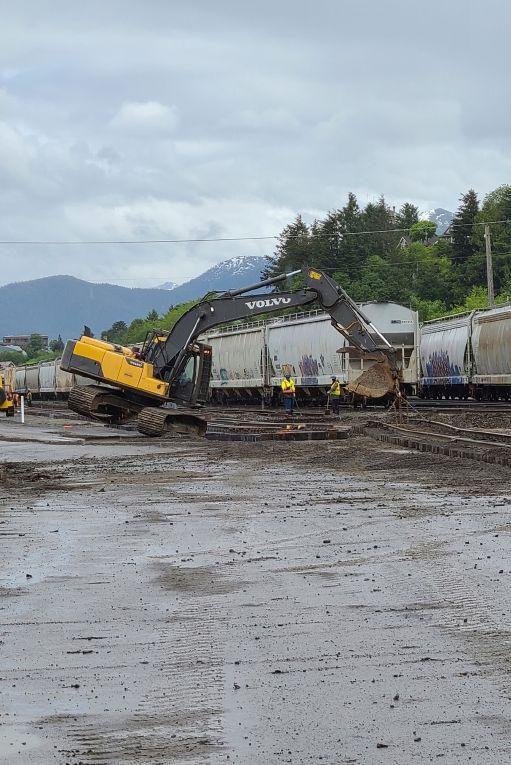
A crew installing tracks for enhanced wood pellet rail car storage at Westview Terminal in Prince Rupert, B.C. The project was funded by the B.C. government’s Supply Chain Resiliency Grant and co-ordinated by WPAC. Photo courtesy WPAC.
driving safety research and innovation in our industry. I am extremely proud of this world-class work and collaboration. People also drive better workplaces. People like Kelly Cooper, founder and president of the Centre for Social Intelligence (CSI), and the folks at the Canadian Institute of Forestry (CIF-IFC) who are leading the Free to Grow in Forestry initiative. WPAC is committed to embracing diversity amongst our employees and contractors, where each individual has opportunities and access to resources to reach their full potential.
People drive safety and our safety initiatives represent a collective effort to make our workplaces safer.
Every day, I am awed by the dedicated women who bring their expertise and passion to this sector. I’m so fortunate to work closely with women like Dr. Fahimeh Yazdan Panah, WPAC’s director of research and technical development; Karen Brandt, our strategic communications advisor; and Brenda Hopkin, who is leading the development of Canadian regional risk assessments being used for SBP sustainability certification. Like many others who walk among us, these women are using their professional skills and unique talents to make a difference in this world, to
make a cleaner, more sustainable world.
I am proud of the high degree of support, enthusiasm and active participation of WPAC members in developing and approving a resolution that formally adopts our values of diversity, equality and inclusion. WPAC: Our Commitment to a Better World truly sets out the collective values of our membership.
GOALS FOR 2022
Looking forward, our 2021-22 priorities include building on our market outreach and advocacy efforts, completing the SBP regional risk assessments for New Brunswick and Nova Scotia and starting on assessments for Alberta and Saskatchewan. Domestically, we will work to grow the domestic market with a focus on the Maritimes. We will also establish a research advisory group in co-operation with the University of British Columbia to tap into the full potential of pellets in the bioeconomy. We are also working to support various provincial and federal climate targets by positioning our renewable forests as to the fight against climate change.
As we move ahead as an organization, may we take the learnings from the past to ensure success in the future and may we continue to meet any challenges with the unfailing optimism, teamwork and sustained commitment and dedication I am humbled to witness each day among our members. It is truly an honour to work alongside the best of the best. I wish you all continued success in 2022. Stay safe! •
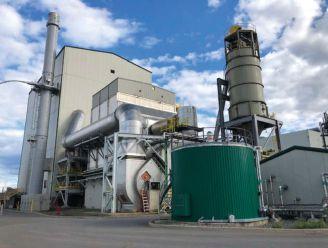
TSI BUILDS MACHINERY FOR THE BIOMASS INDUSTRY
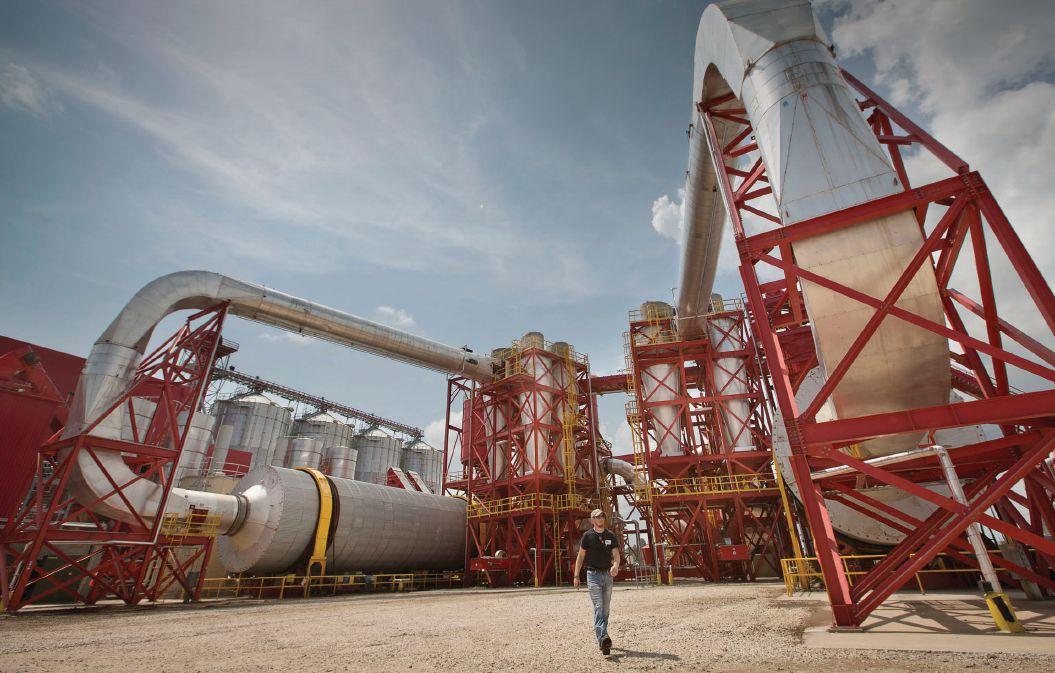
This includes Rotary Drum Dryers coupled with Heat Energy systems; TSI also builds Wet Electrostatic Precipitators when required to meet Client’s emission goals. TSI also offers technology for Torrefaction. TSI machinery is custom designed and ranges from 50,000 tons/year to 450,000 tons/year.
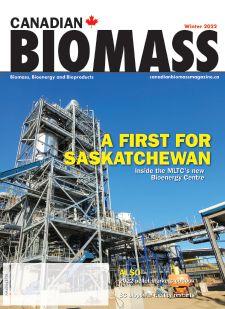
A first for Saskatchewan
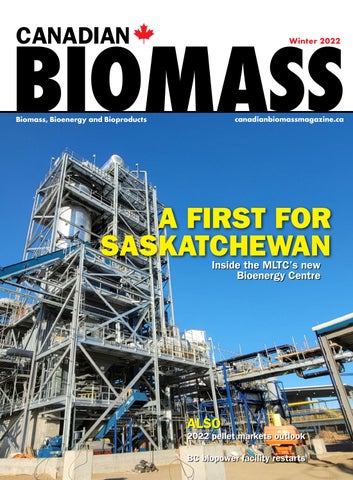
Inside the Meadow Lake Tribal Council’s new Bioenergy Centre
By Ellen Cools
Afirst-of-its-kind project is about to come online in Meadow Lake, Sask.
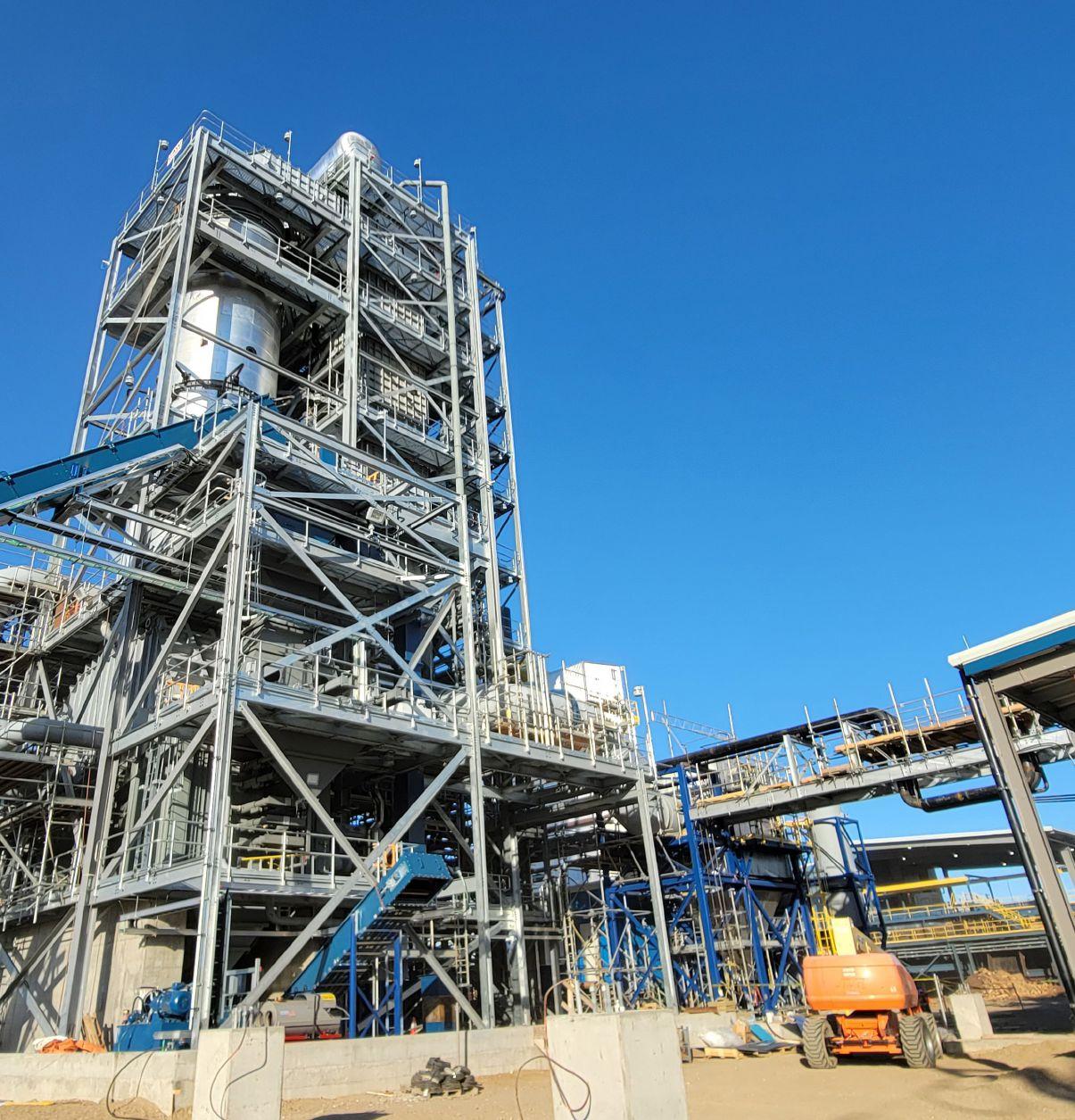
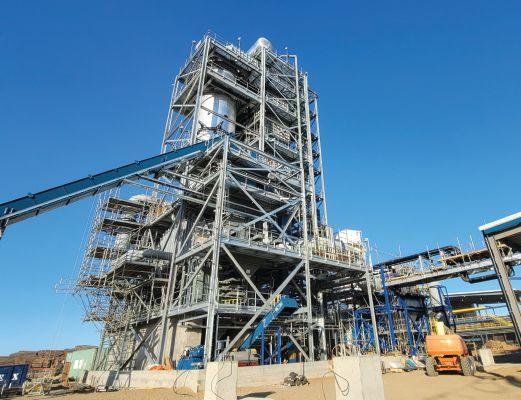
The Meadow Lake Tribal Council (MLTC)’s new Bioenergy Centre, which will be operational by the end of February, will turn wood waste from the nearby NorSask Forest Products sawmill into electricity, powering around 5,000 homes in Saskatchewan and providing heat and power for a new continuous kiln.
The project will not only reduce the MLTC’s greenhouse gas emissions, it will also provide economic benefits to local Indigenous communities and companies, explains Tina Rasmussen, corporate development and administration officer with MLTC Industrial Investments.
The process for getting the new bioenergy plant online has been a long one. Construction on the project began in April 2020. Before that could happen, though, the MLTC (which is made up of nine First Nations) had to negotiate a power purchase agreement with SaskPower and secure federal grant funding to ensure that the project was financially viable.
“Power purchase agreements at this particular point in time in Saskatchewan are not very lucrative. SaskPower can buy power or produce power from sources other than renewables that are a lot less expensive,” Rasmussen says. “So, it was strong commitment to the development of this first-in-Saskatchewan project that allowed us to even end up with a power purchase agreement. In addition, the project never would have been financially feasible if the Tribal Council had not received grant funding to support the construction.”
COMING FULL CIRCLE
However, the potential benefits of the new Bioenergy Centre made it worth it for the MLTC to tackle this project. The council had three main goals: to use the wood waste from NorSask Forest Products, pro-
vide green electricity to the community, and provide economic benefits to the local Indigenous communities, Rasmussen says.
The Tribal Council has operated the NorSask mill for over 30 years. The mill produces 56,000 tonnes of wood waste per year from the sawmilling process, including trim-end, sawdust and bark, all of which was going into a beehive burner.
“One of the really big things with First Nations people is the forest industry’s view of trees as renewable resources,” Rasmussen says. “First Nations people look at trees as a necessity to our lives, existing on our traditional area and supporting many things more than an economy. They support hunting, fishing, trapping, etc. So, it’s a really hard thing for First Nations people to look at harvesting a tree and not getting 100 per cent use of it.”
The MTLC also wanted to provide more opportunities to the local First Nations people to participate in and to gain revenue.
The new facility will create approximately 12 full-time permanent positions, in addition to supporting a large number of other jobs indirectly, Rasmussen says.
The revenue from selling the electricity produced by the facility will also give financial support to the MLTC’s communities in whatever way they see fit – for example, supporting housing, health care, and education.
“Up here in our ancestral territories, 70 per cent of the people that are employed in the forest industry – harvesters, log haulers, people working in sawmills, in the forest management office – are Indigenous,” Rasmussen says. “So, being able to have that kind of equity ownership in the industry has created a huge opportunity to move Indigenous people forward.
“If you’re looking at economic reconciliation from an Indigenous perspective, that truly is an opportunity,” she adds. “And this bioenergy facility is just an extension; it’s a
The MLTC Bioenergy Centre will turn wood waste from the NorSask Forest Products mill into electricity for 5,000 homes in Saskatchewan and heat and power for a new continuous kiln. Photos courtesy Meadow Lake Tribal Council.
CHALLENGES CREATED BY COVID
The MLTC faced a few hurdles in the actual construction of the plant, as construction began soon after the COVID-19 pandemic first hit.
“We’ve managed to weather COVID. And we continue to manage through COVID because, of course, we all know things are getting pretty tense in all of our provinces,” Rasmussen says.
Supply chain issues, a side effect of the pandemic, also posed difficulties for the MLTC. “We had issues related to the costs and delivery of steel, electronics and issues around shipping because of COVID-19’s impact on suppliers in their own locations and their own factories,” Rasmussen says.
completion of the circle, in addition to taking a resource that we have already harvested and turning it into an opportunity.”
Many Indigenous-owned companies were contracted for the construction of the Bioenergy Centre, which had just entered commissioning stages at the time of writing in January 2021. The MLTC chose to self-manage the project – a new undertaking for them – so they could ensure Indigenous-owned companies could take advantage of the construction contracts and job opportunities, Rasmussen says.
“We’re talking about $80-82 million. The Tribal Council had never done a project on that scale before. We started by hiring an Indigenous partnership project management company,” she explains. “They handled the construction RFP [request for proposal] process and oversaw the project, working directly with us as the owners.
“Through our project manager, we were able to put RFPs together that companies owned by Indigenous communities, First Nations communities or Indigenous people were able to bid on and be successful in.”
By the end of the construction and commissioning process, the MLTC expects at least $35 million in construction contracts will have been given to Indigenous companies. All told, the MLTC maintained between 33 and 40 per cent Indigenous employment on this project.
To deal with these issues, the MLTC had to be agile, moving the timeline for the construction and installation of different pieces of equipment. The silo, for example, was only installed at the end of January as a result of supply chain issues. This also led to a delay in installing all of the conveyors at the plant, as the silos first needed to be in place, Rasmussen says.
The MLTC is currently commissioning the equipment, with the plant set to begin producing power by the end of February.
CLOSING THE LOOP
How exactly does the wood waste from NorSask become electricity? First, wood waste from NorSask goes through a grinder from Rawlings Manufacturing, which grinds the wood waste into pieces around three inches by three inches large. This wood waste is then transported by an open-air pipe belt conveyor to the Bioenergy Centre, where the material is dumped into a silo that is approximately 60-feet-wide by 80-feet-tall.
The silo can store up to three days’ worth of fuel, since NorSask does not run on the weekends, but the Bioenergy Centre will run 24/7.
From the silo, the material goes through an auger system and is carried by conveyor to the top of the thermal oil plant, which is a 120-foot-tall building with a reciprocating grate furnace from Classen Apparatebau Wiesloch (CAW) at the bottom. The fibre drops down on top of the furnace, where it is slowly burned. The fire slowly heats tubes in the plant that are filled with thermal oil, similar to radiator heating, Rasmussen says.
Excess power from the Bioenergy Centre goes back into the facility and some of it is used to heat glycol, which is piped to NorSask’s new Muhlbock six-zone Progressive Flo 1306 PRO continuous kiln.
From the thermal oil plant, the oil travels to the Organic Rankin Cycle building, which houses an Organic Rankin Cycle power generation system from Turboden. There, the hot thermal oil heats another oil called cyclopentane.
“That cyclopentane, when it gets to a certain temperature, turns gaseous. When it becomes gaseous, then it turns the turbine, which turns the generator that produces the energy,” Rasmussen explains.
The Bioenergy Centre can produce up to 8.3 megawatts of power, 6.6 of which goes into the SaskPower grid to provide electricity to 5,000 homes. The remaining power goes back into the facility and some of it is used to heat glycol, which is piped to NorSask’s new Muhlbock six-zone Progressive Flo 1306 PRO continuous kiln. Using glycol instead of natural gas to heat the kiln reduces NorSask’s costs and its natural gas usage by 50-60 per cent, Rasmussen says.
JUST THE BEGINNING
With the Bioenergy Centre now almost fully operational, Rasmussen reflects on the entire process, and whether it might be feasible for other sawmills to construct similar bioenergy plants.
“It’s a very expensive process,” she says. “As new mills are being constructed or are being upgraded, there is an opportunity for this, but probably more as their own source of heat and energy.”
For projects like this, the local utilities need to be on board, and some utilities may need to make upgrades to accommodate different sources of power, Rasmussen says. In fact, SaskPower had to upgrade their system to accommodate the 6.6 megawatts from the Bioenergy Centre.
“The thing is, in Saskatchewan, we’re under one Crown corporation. So, they’re the only company we can sell power to,” she explains. “We’re not like Alberta where they have distributed power system where you can sell your excess power to your next door neighbour if you want to.
“There’s very little financial support for these types of projects, and I think the only reason we got financial support for it is because we’re 100 per cent Indigenous-owned,” she adds. “If you look at the majority of these types of bioenergy facilities across Canada, most of them are built to supply heat and energy to their own facility, not to resell, because it becomes quite expensive.”
Consequently, to get additional bioenergy projects off the ground, Rasmussen believes more government support is required. Saskatchewan, as a major agricultural producer, has a lot of potential for similar projects, but because natural gas is so readily available and cheap in Canada, it’s not often seen as an option.
However, with the federal government’s carbon tax, it’s possible more bioenergy projects will take off as coal and natural gas become more expensive, she says. Regardless, the Bioenergy Centre will have a big impact on the Meadow Lake area, providing both environmental and economic benefits.
“We see this as the start,” Rasmussen says. “Saskatchewan and Canada are in a very big way moving into the renewable energy field. As an Indigenous company, we really see this as an opportunity to figure out how to do this and how to participate in the provincial and national economy by producing energy that’s non-fossil fuel, not harmful to the environment.” •
Room for growth
A look at the pellet export markets in 2022 and beyond
By William Strauss
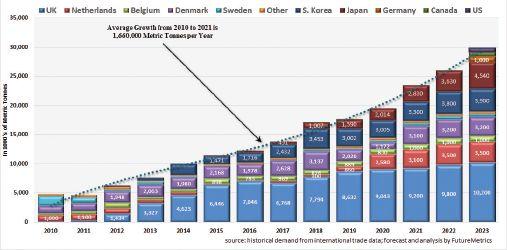
The industrial wood pellet markets have been growing at an annualized rate of about 1.66 million metric tonnes per year from 2010 through 2021.
As the consequences of climate change become increasingly obvious and costlier as a result of more frequent and more severe events globally, the pace of decarbonization will accelerate. Wind and solar power, coupled with massive energy storage solutions, will become the foundation of power generation in many jurisdictions. But it will be at least a decade, and probably much longer, before grid-level energy storage coupled with wind and solar generation, and perhaps the build out of new nuclear generation capacity, is sufficient to allow most traditional thermal generation from coal and natural gas to be eliminated.
There is a well-proven strategy that can bridge this gap. That transition strategy is already a mainstay in some jurisdictions. The strategy is based on the substitution of coal for sustainably sourced pellet fuel in existing coal-fuelled generating stations. Between now and a future that is primarily dependent on wind and solar generation, as well as massive energy storage able to keep electricity flowing at all
times, this well-proven and already deployed strategy will be an important component in how nations decarbonize their power sectors.
Asia and Europe, already significant users of pellet fuel, will continue to use significant quantities. It is likely that other European nations that are seeking a way to lower the CO2 emissions from coal generation will follow. Furthermore, other regions, such as Canada and the U.S., will likely promulgate policies that support this rational, pragmatic, and ready-to-use strategy.
As is shown below, if policies evolve in response to the increasing severity, frequency, and cost of climate change-induced events, those policies, if rational and pragmatic, will lead to higher demand for pellet fuel.
The supply capacity of the pellet fuel sector in not unlimited. It is defined by the limits of working forests for supplying sustainable feedstock to the pellet mills. As is discussed in several FutureMetrics white papers, the limits to growth in the pellet fuel sector are based on the constraint that the managed working forests, which supply wood to the users of forest products, cannot be depleted. The primary users of forest products are the producers of building materi-
Figure 1
Table 1. Source: Argus, December 2021; Analysis by FutureMetrics.
Figure 2
als, paper, packaging, and tissue. Pellet producers use the by-products from those industries and logs that are unsuitable for them.
Current policies that support the substitution of coal for pellets already impose strict standards and rigorous third-party auditing that ensures the carbon stock in the working forests is not being depleted. Future policy must do the same.
There is room for significant growth in the wood pellet industry, but there are limits. In other words, the use of pellet fuel in coal stations can only be a part of a much broader power sector decarbonization strategy.
So, what will this mean for the wood pellet export markets in 2022 and beyond, particularly in Canada? The rest of this article looks to provide some insights on this topic.
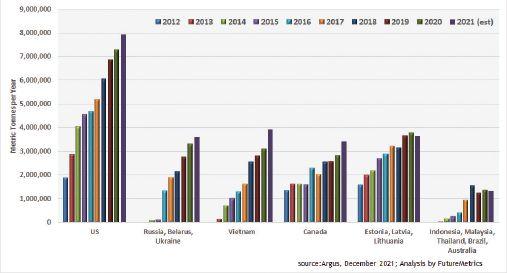
Table 1 and Figure 1 on the previous page show the exports from the major pellet exporting regions.
FutureMetrics expects demand to increase by 8.9 per cent from 2021 to 2022 and by another 14.8 per cent from 2022 to 2023. In 2023, FutureMetrics expects modest new demand in the U.S. and Canada as decarbonization policies evolve. Japan and Germany are expected to add about one million tonnes per year of demand in 2023.
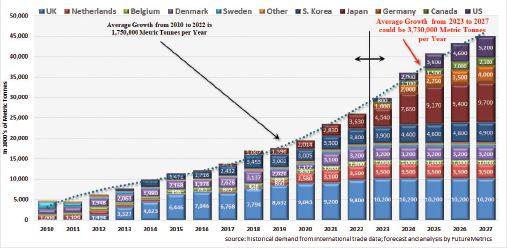
However, under a scenario in which U.S., German, and Japanese policy evolves over the next five years, demand for pellet fuel could grow at an annualized rate of 3.73 million metric tonnes per year. Figure 3 shows this scenario.
As FutureMetrics has discussed in its white papers (free to download from the FutureMetrics website), given the increasing
Figure 3
Figure 4
frequency and severity of climate change-induced events, and given current policies for decarbonization in Japan and Germany, this is a plausible scenario if policymakers and the general public can be educated on the efficacy of substituting coal for pellet fuel and motivated to promulgate supporting policies.
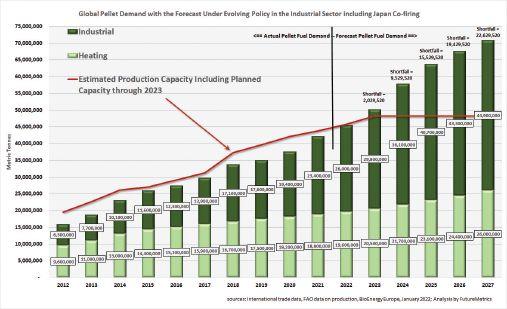
Figure 4 shows the historical and forecast of combined heating and industrial pellet demand. The red line in Figure 4 shows the estimated production capacity, including all of the announced new planned capacity over the next two years. As the chart shows, if policy evolves and pellet fuel demand follows the growth shown in Figure 3, there will be significant supply shortfalls going forward.
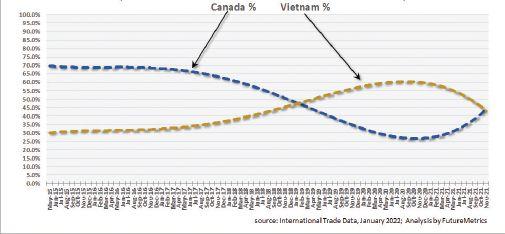
This is good news for all of the major pellet producing regions and, given how demand for pellet fuel is expected to grow in the Japanese and Canadian power sector, for Canadian pellet producers. Western Canadian pellet producers have already established a strong presence in the rapidly growing Japanese market. As Figures 5 and 6 show, Canada is on the brink of reclaiming it leadership in Japanese market share for imported pellet fuel.
As long-term offtake agreements between Canadian producers and Japanese buyers ripen, Canada’s market share will increase. After Japan finalizes its sustainability and greenhouse gas (GHG)
emissions criteria for imported biomass (probably before the end of 2022), it is likely that some Vietnamese producers will be challenged on the sustainability of their feedstock. It is also likely that some palm kernel shell (PKS) imports will be challenged on issues related to palm oil production (for example, land use change and child labour). Longer shipping distance on smaller vessels may also promote a carbon footprint disadvantage. These influences will benefit pellet producers with strong sustainability credentials and optimal supply chain carbon footprints.
In 2021, the large U.S. pellet producer, Enviva, publicly announced offtake agreements into Japan in the millions of tonnes per year. Once those contracts ramp up, the U.S. will join Canada and Vietnam as major suppliers to Japan. To date, however, the U.S. has not been a significant supplier, as Table 2 below shows.
There is a likelihood for significant new pellet fuel production capacity to be developed over the remainder of this decade. Canadian producers with competitive fibre costs, globally respected sustainability credentials, and the potential for optimal GHG footprints from both the west and east coasts are well-positioned to be part of the supply build up.
William Strauss, Ph.D., is the president of FutureMetrics, www.futuremetrics.com. •
Figure 5
Figure 6
Table 2. Source: International Trade Data, December 2021; Analysis by FutureMetrics.
Pellet Imports into Japan from Canada and U.S. (metric tonnes)
A commitment to Canada
An inside look at Drax Group’s future plans for Canada and beyond
By Ellen Cools
In April 2021, Drax Group acquired Pinnacle Renewable Energy, becoming a major player in Canada. Since then, the company has announced plans to double pellet production capacity and increase the amount of pellets it sells to third parties. In a Q&A with Canadian Biomass, Drax Group’s executive vice-president Matt White shares some insights about the company’s plans for Canada and beyond.
Canadian Biomass: What was the motivation behind acquiring Pinnacle Renewable Energy?
Matt White: The acquisition of Pinnacle last year was transformational for Drax. It more than doubled our biomass production capacity, significantly reduced our cost of production and added a major biomass supply business underpinned by long-term contracts with counterparties in Asia and Europe. Drax is now the world’s leading sustainable biomass generation and supply business and is well placed to meet an expected global increase in biomass demand and play a critical role in helping countries meet net zero.
Drax Group’s executive vice-president Matt White. Photo courtesy Drax Group.
The Pinnacle acquisition also supports our plans to use bioenergy with carbon capture and storage (BECCS) and become a carbon negative company by 2030 – permanently removing millions of tonnes of carbon dioxide from the atmosphere each year.
What has the response been from local communities?
Drax is committed to supporting the communities where we operate by promoting sustainable forestry and investing in local economic development, including job creation, and we already have a proven track record of doing just that. We have a long history of supporting the communities in which we operate and our approach in Canada will be no different.
Since buying Pinnacle, we have been engaging with First Nations, local communities, the provincial governments and other stakeholders and will continue to do so to ensure that our activities benefit the people and environment where we operate.
It’s been a very challenging year for Canadians, especially in British Columbia, where communities have had to face floods and wildfires on top of the continued difficulties of COVID-19. Drax has donated $100,000 to communities impacted by these natural disasters to help them get through these hard times.
What are Drax’s plans for the future in Canada?
Drax has already made good progress integrating Pinnacle since the acquisition in April and we’re planning a rebrand for the first half of 2022. A united Drax brand best positions us for long-term
success as we implement our strategy, which is aligned with the expected growth in the global market for sustainable biomass and development of our own plans to deliver BECCS in the UK and internationally by 2030.
In December, Drax announced plans to double pellet production capacity by 2030. How does the company intend to meet this goal?
Drax’s plans to double pellet production capacity to eight million tonnes (Mt) by 2030 are already underway – we’re commissioning a new pellet plant in Demopolis, Ala., (one of the Pinnacle projects we acquired last year) and a smaller satellite plant in Arkansas with more satellite plants in development. These, alongside other developments and expansions, will take us to close to five Mt once complete. We’re also developing a pipeline of projects including new build and capacity expansions at existing projects, principally focused in North America, and we expect to take a final investment decision this year on up to one Mt of new capacity.
Some environmentalists claim wood pellets aren’t a sustainable alternative to fossil fuels. What is Drax’s response to that?
The leading authority on climate science, the United Nation’s Intergovernmental Panel on Climate Change (IPCC), is absolutely clear that sustainable biomass is crucial to achieving global climate targets, both as a provider of renewable power and through its potential to deliver negative emissions with carbon capture and storage.
The science underpinning carbon accounting for bioenergy is also crystal clear and was recently reaffirmed by the IPCC in 2019 following review by tens of thousands of the world’s scientists.
Drax’s sustainable wood pellets are made from waste fibre – including sawmill and harvesting residues – which would otherwise have been burned, landfilled or left to rot. Using this biogenic waste to generate renewable electricity displaces fossil fuels from the energy system. By adding carbon capture and storage, as we plan to do with BECCS, we will permanently remove carbon dioxide from the atmosphere and deliver millions of tonnes of negative emissions, which the UN’s IPCC has said is essential to reaching net zero.
Drax also plans to double the amount of pellets it sells to third parties by 2030, with a focus on Asia and Europe. Why has Drax chosen to focus on those markets?
We see lots of opportunities in these regions in the years ahead as demand for sustainable biomass in markets in Asia and Europe is expected to increase in the transition away from coal to meet climate targets. Japan is closing seven gigawatts of coal power over the next
decade and has set a target to double its use of biomass. South Korea is shutting 30 coal plants and Indonesia is replacing nine million tonnes of coal with biomass. In the EU, bioenergy use is forecast to grow around 70 per cent by 2050.
Our experience converting Drax Power Station from coal to sustainable biomass means we are uniquely positioned to take advantage of these opportunities and we are creating new business development teams in Tokyo and London this year.
The deal we announced in December to acquire the pellet sales contract book of Pacific BioEnergy Corp. demonstrates our commitment to the growth of sustainable biomass in Japan specifically. It adds 2.8 million tonnes of orders for sustainable biomass supply to counterparties in Japan and Europe. This increases our longterm third-party sales book by 15 per cent, to around 23 million tonnes, with total revenues of over US$4.5 billion.
Drax is also focusing on reducing its carbon emissions by expanding its BECCS at Drax Power Station. What are the potential benefits of BECCS in helping to fight climate change?
To meet global climate targets, we need to do more than just reduce carbon emissions – we also need to permanently remove carbon from the atmosphere, which we can do with BECCS. BECCS doesn’t just deliver negative emissions, it also produces reliable renewable power to support the grid and help keep the lights on when the wind doesn’t blow and the sun doesn’t shine. Alongside the climate and energy security benefits, BECCS can also provide a just transi tion for communities – one that sustains and creates jobs and skills
in new clean technologies and supply chains.
Given how critical BECCS is to achieving net zero, we see many opportunities to develop this technology around the world and this is something we are already focused on.
In addition to our UK BECCS project at Drax Power Station, which will permanently remove eight million tonnes of CO2 emissions from the atmosphere a year by 2030, we’re also looking to deliver a further four million tonnes of negative emissions a year from new-build BECCS in North America and Europe.
With regards to the wood pellet industry as a whole, what opportunities do you see in the next five to 10 years?
Sustainable biomass has a vital role to play in keeping the global temperature from rising above 1.5 C, and recently we’ve seen a greater appreciation from global leaders and policymakers for the role it will play in generating renewable power and delivering negative emissions. So, we expect the years ahead to be busy for Drax and the industry as demand for sustainable bioenergy increases.
Drax’s world-leading biomass sourcing policy ensures that the biomass we produce and use delivers positive outcomes for the climate, nature and the communities where we operate. As the world’s largest user of sustainable biomass for energy, Drax abides by a robust regulatory framework in the UK and the EU and we’re always striving to go beyond existing legislation. Drax also engages with NGOs, academics, scientists and other external forestry experts to better understand issues so we can agree common principles and we will continue to do that. •
Bringing biopower back
Biomass power generation facility comes back online in northern BC community
By Ellen Cools
In June 2021, the Fort St. James Green Energy Project, a biomass power generation facility in Fort St. James, B.C., ceased operations. But, the residents of Fort St. James did not have to go long without sustainable, green electricity from the plant. On Jan. 6, 2021, the plant began running again under new ownership, BioNorth Energy Limited Partnership.
BioNorth Energy consists of three partners – the Arrow Group of Companies, Nak’azdli Whut’en, and Nexus Program Management Group, LLC – who came together when Arrow began looking into the possibility of buying the plant, Greg Kilba, division manager with Arrow, tells Canadian Biomass
Arrow was already involved in the biomass industry, supplying hog fuel from a grinder and from local sawmills to the Domtar pulp mill in Kamloops, B.C.
“When this plant became available, we already had trucks up in the area and we obviously knew how to run a grinder, so we thought it was a good fit to be able to buy the plant,” Kilba says. “That’s when we started to look for some partners, and we partnered up with the Nak’azdli and Nexus, who has a lot of experience with building and maintaining these plants.”
The power plant is capable of producing 40 megawatts of energy and still had 26 years left on an electricity purchasing agreement with BC Hydro, Kilba says. This made it a no-brainer for Arrow and its partners to acquire the facility in early December 2021.
The previous owners had “significant challenges with the plant,” Kilba says. “They ended up cutting their losses and selling off their assets. We are quite optimistic that it’s going to be a good business plan for us.”
A GOOD FIT
Acquiring the facility was also a good fit for Arrow because of their experience grinding and trucking wood fibre and biomass logs.
The plant will consume about 250,000 cubic metres of fibre annually, which will come from two streams: wood waste from nearby sawmills and bush grind. Arrow will grind and haul the fibre to the plant. For the grinding part of their operations, Arrow uses a Peterson 5710 grinder, fed by a 2019 Tigercat 875 loader. Five to six trucks then take the bush grind into town.
Despite severe wildfires this past summer and changes to B.C.’s logging policies, Kilba says he is not concerned about the fibre supply to the plant.
“With the current logging that is being done, there is more than enough fibre to feed the plant,” he says. “There’s still piles that will get burned that we won’t need. But, we are going to significantly grind and utilize a lot of the fibre that was once burned.”
However, grinding wood waste in the forest and hauling it to town is not always economically feasible, especially as some biomass logs require a further level of breakdown, Kilba says. As a result, Arrow has applied for funding from the Forest Enhancement Society of BC (FESBC) to help bring in some fibre from longer distances.
The funding has “definitely been helpful,” Kilba says. “Logs is a great form for us to have a sense of security, because in hog form, it gets broken down by microbes, so
you always have a risk of it decomposing or even catching fire if not managed properly. So, in log form, it’s a much better safety net of hog that we can grind on-site, regardless of weather conditions or truck availability.”
COMING ONLINE
Once the hog fuel gets to the BioNorth Energy plant, it is stockpiled in a centralized woodyard.
“Our optimum inventories are a monthand-a-half worth of consumption. So, around 15,000 to 20,000 oven-dried tons of fibre is stored,” Antonio Madia, Arrow’s director of project development, explains.
Wood fibre is loaded into a “receiving pocket,” and then heads into three large concrete silos for storage purposes. Each of the silos can store up to 1,500 oven-dried tons of fuel.
“From there, we have an ability to reclaim from the silos and feed fuel to the high-pressure boiler,” Madia says.
This boiler is an FSE boiler approximately 10 storeys tall, 50-feet-wide by 50-feet-across, and equipped with a Detroit Stoker combustion grate. The furnace is lined with pressure tubes that store and circulate water and high-pressure steam. As the water gets heated, it becomes steam, which is regulated through a governor into the steam turbine generator.
“Once it goes into the steam turbine, it’s essentially vapour. It’s a pressure of 1,500 psi, and it’s now referred to as unsaturated superheated steam,” Madia says.
“As the steam enters the turbine, the thermal energy is converted into kinetic energy and, ultimately, electrical energy by the Siemens generator.”
The turbine rotates at approximately 5,000 rpm, and the resulting energy is channeled into the BC Hydro electrical grid. The turbine, generator and gear box are part of a 40-megawatt Siemens package.
The equipment was installed by the
The BioNorth Energy biomass power generation facility in Fort St. James, B.C., came back online in January. Photo courtesy Arrow Group of Companies.
previous owners, and, for the most part, was in good working condition when Arrow, the Nak’azdli Whut’en and Nexus acquired the plant, Madia says. But, they made a few upgrades before restarting the plant.
“One of the major upgrades that we’ve done thus far is improving the processed water quality into the plant,” Madia explains. “We were able to locate an aquifer that’s providing very clean water into the process. The legacy water was latent with high mineralization and high iron content, so it had very high connectivity, which created its own set of challenges. The water has to be essentially free of any mineralization and contaminants prior to entering the boiler, ancillary equipment and turbine. Poor water quality will result in fouling of pressure parts and scaling of critical components. This will lead to high maintenance costs and poor plant availability.”
They also replaced eight high-pressure valves that were leaky and had been bypassing, leading to higher than expected effluent discharge levels.
Overall, bringing the facility back online was a fairly quick process, taking just over a month from the time the companies acquired it in early December.
However, the cold weather conditions in the area in the first week of January this year posed a few challenges, Madia admits.
“It was -34 C for several days in the first week of January. We struggled with cold weather-related issues. Starting up a biomass plant that relies on processed water is challenging at the best of times, let alone at -34,” he says. “But, I think the crews did a really good job of completing their capital upgrades and ultimately starting the plant up.”
The plant is now operating at 75 per cent capacity, and the companies plan to do some more upgrades in June which will help them reach full capacity. For example, they plan on installing a tipper to help offload trucks more efficiently, Madia says. They will also improve the overall process control infrastructure of the facility.
“We are thrilled to have hired a seasoned professional, Rock Doyer, to lead and mentor the BioNorth operations and maintenance teams,” Madia adds. “We are extremely blessed to have Rock as part of our squad!”
TREMENDOUS IMPACT
The impact of bringing the plant back online has already been felt in the community, adding 35 direct jobs in the facility and another 60 to 70 indirect jobs through suppliers or fibre providers in the area, Madia says. It also helps local sawmills have an end-use for their waste products.
BioNorth Energy is also the single largest tax base for the municipality, bringing a big economic boost to Fort St. James.
Additionally, for the Nak’azdli, the BioNorth Energy plant is “one of the largest investments they’ve made as a Nation,” Madia says. “This is one of the most significant private sector investments in the forest products sector where a First Nations band owns a significant interest [40 per cent] in the venture.
ai1633019768215_ibce22-RegisterHALF-CaBiomassMag.pdf 1 9/30/2021 11:36:10 AM
“So, we’re quite proud of that, and proud to be working with the Nak’azdli. It’s very impactful for their community to have a significant manufacturing investment within close proximity to their community.” •
Scaling-up straw
Alberta farmer, engineer look to combat climate change by turning straw into pellets
By Ellen Cools
As the effects of climate change become more and more evident, there’s a growing sense of urgency that new, alternative fuels need to be developed on a larger scale. Many companies are focusing on scaling up renewable natural gas, wind and solar, but few are aware of the opportunities that agricultural biomass presents.
However, Caith and Campbell Cameron, co-founders of the start-up Wintergreen Pellets in Didsbury, Alta., know just how much potential there is with agricultural biomass. In early 2020, they began working with the University of British Columbia (UBC)’s Biomass and Bioenergy Research Group (BBRG) to explore the viability of turning straw into pellets that can be used to replace or supplement coal and wood pellets.
SHOWCASING STRAW PELLETS
Caith, a farmer and a geologist, has a first-hand understanding of how much straw is underutilized on farms. Although straw is sowed back into the soil and is often used for animal bedding and feeding, there still remains excess straw that is underutilized, he says. Campbell, a mechanical engineer, joined Caith in early 2020 to “make this project a bit of a reality and see what we could find out,” he says.
“Campbell and I, we wanted to be part of the change from fossil fuels,” Caith explains when asked why they started Wintergreen Pellets. “We’ve both worked in the oil patch and we want to see it change from fossil fuels to a greener future. On top of that, we see a big advantage with mirroring the wood pellet industry in the fact that the straw pellets can be sustainable and renewable. We grow the crop every year, whereas with wood pellets, it takes 30 to 70 years for those trees to be mature enough.”
In June 2020, Caith and Campbell connected with the BBRG, which has been working on a project looking at the production, logistics and commercialization of pellets from under-utilized sources, such as straw. The $2.4-million, four-year project is in partnership with the Wood Pellet Association of Canada and BioFuelNet, and funded by the Canadian Agricultural Partnership.
The BBRG were looking for an Alberta farmer to use a pellet mill they had procured to “showcase it to other farmers and advertise the fact that there is potential for straw pelletization in the Canadian agriculture industry that can provide additional value to their crops,” Campbell explains. “It lines up perfectly with what we’re doing. We needed a pellet mill to essentially act as our pilot project.”
Since then, Wintergreen Pellets and the BBRG have been working closely together, researching potential markets for straw pellets and the best way to move forward.
Wintergreen Pellets’ main goal is to collect leftover straw from farms, in addition to their own, to produce straw pellets that other farmers in Alberta can use as an alternative source of heat and power.
There is also the option of producing straw pellets for the chemical industry. This is because “the pellets can absorb up to three times their mass,” Caith explains. “We’re even doing some experiments on the farm here with our spraying and our chemicals. When you have to clean up the sprayer, you need a safe area to do that, so we’re looking at building a bio-bed area with the straw pellets that will be able to absorb and clean those chemicals from the sprayers.”
FACILITATING RESEARCH
Although supply chain problems caused by COVID-19 have delayed the delivery of the pellet mill to Wintergreen Pellets, the pellet mill arrived safely to their farm in mid-January. They are
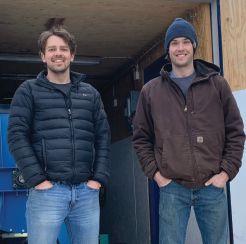
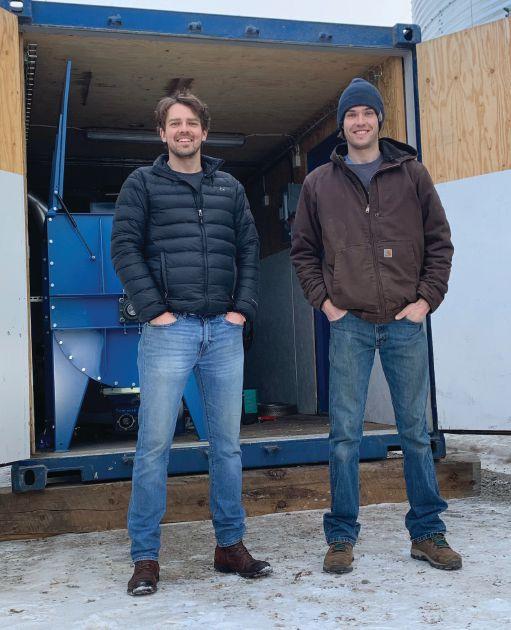
Wintergreen Pellets founders, Campbell Cameron (left) and Caith Cameron, in front of the new Sweden Power Chippers PP150 pellet mill. Photo courtesy Wintergreen Pellets.
optimistic that they will be able to get it operational and begin the research and development phase of their operations soon.
The pellet mill is a Sweden Power Chippers PP150, rated to do 175 kilograms of straw per hour, housed within a 20-foot shipping container.
“It’s meant to be a plug-and-play type operation, fully enclosed within the sea can container,” Campbell explains.
They plan to use the mill for a year, during which time they will determine if it’s viable business for them.
“At that point, we’re going to decide whether we need to go out and buy our own or maybe purchase this one from UBC, and go from there,” Campbell says.
Once the pellet mill is operational, they will begin testing batches of straw, around one to two tonnes at a time. These batches will be tested in different coal and biomass power plants in Alberta that are interested in potentially using straw pellets in the future, Campbell explains. Those power plants will provide feedback on how the straw pellets performed, which will help Wintergreen Pellets’ steer their future operations.
They will also produce batches for the BBRG as requested, using different types of straw, such as wheat, barley and pea straw. Those batches will be sent back to UBC so they can test the pellets for their own research purposes.
“We’re there to facilitate and help them in that research,” Caith explains. “It would be a day-to-day, project-by-project basis, and whatever they want, we’ll pump it out.”
“We’ve never made pellets before ourselves, so we’re excited to learn,” Caith adds. “I think there will be quite a learning curve. I don’t think it’s as easy as it looks, that you just put straw in and out comes a pellet. So, we’re definitely going to take this winter to try to tune it and hone in on the skills.”
SCALING-UP POTENTIAL
According to Campbell, the BBRG’s original goal with this project was to use the pellet mill as a showcase project to demonstrate to farmers that they can have their own pellet mills and produce pellets on their farms.
“But, there’s a lot that goes into understanding the different additives, the different pressures and mechanical aspects that go into producing pellets that maybe would be too difficult for each individual farmer to do,” he says. “So, maybe the ideal logistical model would be to have one large pellet producing facility and you gather the straw from the other farmers in the area.”
If the results of the research and development phase prove that producing straw pellets is a viable business model for Wintergreen Pellets, then they will look at scaling up their operations in a larger facility in Didsbury, Caith says. This larger facility would be capable of producing 50,000 to 60,000 tonnes of straw pellets annually.
“That would become a model that shows other farms there is a market for it, and either that spurs on other facilities to produce it themselves or we look at securing more straw feedstock from local farms throughout Alberta to be a main pellet producer for the straw market,” he says.
However, both Caith and Campbell are aware of the potential challenges that come with producing straw pellets, especially considering that growing straw is reliant on the weather, which is changing drastically thanks to climate change.
“This last year in the agriculture community, we saw a devastating drought throughout Saskatchewan and eastern Alberta that proved that there was no straw available,” Caith says. “So, we’re looking at being flexible in the fact that there could be years like that again.”
One way they might overcome these challenges is by producing wood pellets (in addition to straw pellets) using recycled wood from construction operations in Calgary, he says.
“Another challenge is communicating to farmers that we understand, as a farmer myself, how important straw is for the soil. We’re not trying to take everybody’s straw; we’re only looking at trying to utilize excess straw.”
BUILDING UP BIOMASS
Caith and Campbell agree that communicating and educating farmers about the potential benefits and uses of agricultural biomass will also be key for moving the industry forward.
Although Canada has the potential to be a mass producer of both wood and biomass pellets, the majority of wood pellets produced in Canada are exported to Asia and Europe, something Caith would like to see change in the future through more government support.
“I know they struggle up north finding heat sources. I think government subsidies would really open the door to finding alternatives like straw pellets,” he says.
“We need government supporting the pellet industry, whether it’s wood or straw,” Campbell adds. •
371, Boulevard des Chutes Bureau #102 Québec, QC, G1E 3G1 1-800-463-4862
551, Ferdinand Blvd. Unit 4 Dieppe, NB, E1A 7G1 1-800-931-9611
DThe missing low-carbon infrastructure
How heat networks can help decarbonize Canada’s cities and towns
By Jamie Stephen
espite an economic reliance on rural natural resources, including oil, mining, and forestry, Canada is amongst the most urbanized countries in the world. A higher percentage of Canada’s population lives in urban areas than many geographically smaller but more populated countries such as Germany, Italy, and South Korea.
However, this high rate of urbanization doesn’t translate into less energy consumption. Canada is the highest per capita consumer of energy for buildings of any major economy. Due to a colder climate and/or larger homes, Canada’s per capita building energy consumption is double that of the U.S. and the UK. For a typical family home in Canada, over 80 per cent of the energy consumed is for space heating and hot water. The only countries with comparable building energy consumption per capita are the Nordics, including Sweden, Finland and Denmark, which face a similar climate.
But, if you think this means the greenhouse gas (GHG) emissions from buildings in these countries are similarly high to those in Canada – where buildings account for almost 20 per cent of GHG emissions – you would be mistaken. The building heat GHG emissions for the average Canadian are more than the total GHG emissions for the average Swede, despite a higher GDP for the Swede.
How is that possible?
The first half of the answer is simple: heat networks. In most Northern countries, the building heat market penetration of heat networks, also known as district energy systems, ranges from 55 to 95 per cent. Canada? A pitiful one per cent. These networks, which consist of underground hot water pipes, connect central zero- or low-carbon energy resources to hundreds,
thousands, or even hundreds of thousands of buildings. For example, over 95 per cent of buildings in Stockholm are connected to the city and public pension fund-owned district energy system. In Copenhagen, that figure is 99 per cent and includes single family detached homes.
But, heat networks are like electricity networks – they only deliver the energy. They don’t produce it. Canada has over 180 heat networks operating today, most of which use natural gas. This does virtually nothing for reducing GHG emissions.
This brings us to the second part of the answer: biomass. Biomass dominates the heat network energy supply in the Nordics. A major advantage of heat networks is their ability to utilize a variety of energy resources, from industrial waste heat, sewer heat and geoexchange to natural gas and grid electricity. However, biomass is the essential, irreplaceable and dispatchable renewable resource for supplying heat when people need it. Heat networks are required if we want to increase the proportion of intermittent renewables (wind, solar) on the electricity grid because they can serve as a thermal storage of ‘excess’ energy, in the form of hot water. But biomass is necessary to provide dispatchable energy when wind and solar are unavailable.
Both Stockholm and Copenhagen recognize this and have built 400-550 MWth biomass (wood chip) combined heat and power plants in their downtowns. Because the energy is generated at a central plant, the air pollutant emissions are much lower per unit energy than natural gas furnaces. Our research shows Canada can generate sufficient biomass in a sustainable manner to eliminate all fossil fuel use in the building sector and simultaneously improve forest
health, productivity, and climate resilience.
We are told by energy modellers and climate policy advisors that high-cost, deep energy retrofits of most buildings in Canada are required to meet our 2030 climate target. This is not true. They assume the only way to decarbonize the building sector is electrification with heat pumps. Since affordable electricity supply is massively constrained and heat pumps have cold climate performance limitations, this results in the deep energy retrofit conclusion.
And if you were wondering, no, renewable natural gas and hydrogen are not the answer. Both are too high cost and supply limited. Blue hydrogen is nowhere near zero-carbon and heating buildings with green hydrogen makes no sense from an energy efficiency or cost perspective.
Unfortunately, energy modellers haven’t recognized the climate impact potential and affordability of heat networks combined with biomass. They haven’t sought to understand forest carbon cycles, nor how a market for low-grade biomass increases stored carbon in the forest. Nor have they considered the skills and expertise of Canada’s energy workers, who are ideally positioned to develop and build heat networks and associated thermal energy plants.
It is time Canada faced this truth: heat networks are required to decarbonize cities and towns. Climate goals will not be met without them and the alternatives will lead to energy poverty and poor energy system resilience. We must empower municipalities to develop heat networks and attract public, pension, and sovereign wealth capital to what is, without a doubt, Canada’s largest green infrastructure opportunity. • Jamie Stephen, PhD, is the managing director of TorchLight Bioresources.
It’s been a rough two years, and mental health is in the spotlight more than ever.
What if there was a way to measure the mental health of your employees, giving them practical advice while at the same time providing your leaders with a powerful dashboard?
That’s what the Psychologically Safe Workplace Awards do, powered by Howatt HR’s Mental Fitness Index (MFI). This program is far more than a competition – they provide leaders with credible data, insights to make a real difference.
FIND OUT MORE AT WWW.PSYCHOLOGICALLYSAFEWORKPLACE.COM Presented by: Sponsored by:
2022 WPAC AGM & CONFERENCE
Wood pellets and the bioeconomy
September 20-21, 2022 • Vancouver, BC
The Wood Pellet Association of Canada Conference and AGM is Canada’s largest gathering of the Canadian wood
industry.
Each year, the event attracts hundreds of wood pellet, biomass and bioenergy professionals from across the country, as well the U.S., Europe and Asia, to discuss the issues that are having an impact on the industry here in Canada.
The WPAC Conference and AGM is your opportunity to learn about the most important issues from industry experts around the globe.