WINGS
MAY JUN 2020 CANADA’S NATIONAL AVIATION MAGAZINE
www.wingsmagazine.com
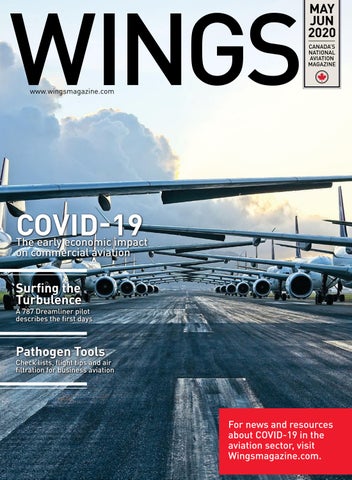
COVID-19
The early economic impact on commercial aviation
Surfing the Turbulence
A 787 Dreamliner pilot describes the first days
Pathogen Tools
Check lists, flight tips and air filtration for business aviation
For news and resources about COVID-19 in the aviation sector, visit Wingsmagazine.com.
MAY/JUNE 2020
UPFRONT 6 Leading edge
From economic shock to recovery
8 On the fly
Saab bid, SpaceJet flight, and Leonardo’s Kopter
12 Alternate Approach
The new airliner reality for Airbus and Boeing
14 Waypoint
Impacting Ghana’s critical aviation plan
16 Position Report
Integrating flight ops and maintenance
BACK 44 Marketplace 46 On final
The five most common traits of pilots
From top: AeroClave’s portable, self-contained RDS 3110 disinfecting device. P.30. Coulson Aviation will fly its FIRELINER Tanker 137 for the first time this fire season. P.34.
IATA projects airlines will see full-year passenger revenues fall by US$252 billion, a decrease of around 44 per cent, in 2020 when compared to 2019. (Photo: Christopher Amendola). P.34
FEATURES 20 COVID-19 AND COMMERCIAL AVIATION
Detailing the early economic impact of the coronavirus pandemic on Canada’s air transport sector BY DAVID CARR
26 SURFING THE TURBULENCE
B787 first officer Glennis Walsh describes how her world changed in the first days of the COVID-19 pandemic BY KENDRA KINCADE
30 COVID-19 AIRCRAFT TECH
Pathogen remediation and air filtration systems to keep business aviation safe on the ground and in the air BY PHIL LIGHTSTONE
PHOTOS FROM TOP: AEROCLAVE, COULSON AVIATION
34 ADVANCES IN AERIAL FIREFIGHTING
An essential sector of aviation prepares its fixed- and rotary-wing assets for the 2020 fire season BY JON ROBINSON
COVER PHOTO: CHRISTOPHER AMENDOLA. VIEW MORE OF HIS WORK AT @HNLRAMPER
WWW.WINGSMAGAZINE.COM
May/June 2020 | WINGS
3
Stay in Touch with Aviation News
Vol. 61, Issue 3 EDITOR
Jon Robinson jrobinson@annexbusinessmedia.com 647-448-6188
SUBSCRIBE
FLIGHT DECK
Online
David Carr, Kendra Kincade, Sam Longo, Phil Lightstone, Carter Mann, Carroll McCormick, Anna Pangrazzi NATIONAL ACCOUNT MANAGER
Mena Miu mmiu@annexbusinessmedia.com • 416-510-6749
TODAY
ACCOUNT CO-ORDINATOR
Barb Vowles bvowles@annexbusinessmedia.com • 416-510-5103 MEDIA DESIGNER
Brooke Shaw
CIRCULATION MANAGER
Jay Doshi jdoshi@annexbusinessmedia.com • 416-442-5600 ext. 5124
wingsmagazine.com/subscribe
GROUP PUBLISHER/VP SALES
Martin McAnulty mmcanulty@annexbusinessmedia.com
Magazine
COO
Weekly E-Newsletter
Scott Jamieson
Digital Edition
WINGS www.wingsmaga
zine.com
Printed in Canada ISSN 0701-1369
CIRCULATION Email: jdoshi@annexbusinessmedia.com Phone: 416-442-5600 ext. 5124 Fax: 519-429-3094 (main) 416-510-5140 Mail: 111 Gordon Baker Rd., Suite 400, Toronto, ON M2H 3R1
Pathogen Remediation
The use of air in business filtration jets
Kotoka Termin al
MAY JUN 2020 CANADA’S NATIONAL AVIATION MAGAZINE
PUBLICATION MAIL AGREEMENT #40065710
COVID-19
Economic imp recovery plan act and s in aviation
Aviation stand Ghana devel still hampers opment
WINGS MAGAZINE
P.O. Box 530, 105 Donly Dr. S., Simcoe, ON N3Y 4N5 Tel: 519-428-3471 Fax: 519-429-3094 Toll Free: 1-888-599-2228
3
For news and about COVID-1resources aviation sect 9 in the or, wingsmagazi visit ne.com.
Published six times per year (Jan/Feb, Mar/Ap, May/Jun, Jul/Aug, Sep/Oct, Nov/Dec) by Annex Business Media SUBSCRIPTION RATES Canada – 1 Year $ 34.50 (plus GST - #867172652RT0001) USA – 1yr -$ 78.50 CDN (USD $60.50) International – 1yr - $90.50 CDN (USD $69.50) Occasionally, Wings magazine will mail information on behalf of industry-related groups whose products
Air Transport Association of Canada
ON THE
WEB
4
WINGS | May/June 2020
WG_CircAd_MayJne20_MLD.indd 1
and services we believe may be of interest to you. If you prefer not to receive this information, please contact our circulation department in any of the four ways listed above. Annex Privacy Office privacy@annexbusinessmedia.com • Tel: 800.668.2374 No part of the editorial content of this publication may be reprinted without the publisher’s written permission. ©2020 Annex Publishing & Printing Inc. All rights reserved. Opinions expressed in this magazine are not necessarily those of the editor or the publisher. No liability is assumed for errors or omissions. All advertising is subject to the publisher’s approval. Such approval does not imply any endorsement of the products or services advertised. Publisher reserves the right to refuse advertising that does not meet the standards of the publication.
Canadian Business Aviation Association
Magazines Canada
AVIATION THIS WEEK Looking to catch up on the latest hot news from around aviation and aerospace? Check out Aviation This Week, a live digital version of the top news stories affecting a variety of key markets. It's quick, essential information you need to know! WWW.WINGSMAGAZINE.COM
2020-04-17 4:03 PM
Three projects. One solution.
We do more than produce aircraft. We inspire future aviators. FAcT, Future Aircrew Training FLIT, Fighter Lead-In Training Snowbird replacement program Leonardo’s family of trainers and Aircrew Training system is designed to capture all three RCAF projects in one integrated solution. The M-345 Tutor II - the world’s most advanced jet trainer – provides seamless progression to the M-346 fighter lead-in trainer. The M-346 successfully prepares pilots to fly the F-35, Typhoon, F-16 and F-15 in allied air forces. One training solution ensures that all RCAF pilots have the potential to fly as a Snowbird pilot in the M-345 Tutor II. Inspired by the vision, curiosity and creativity of the great master inventor Leonardo is designing the technology of tomorrow.
leonardocompany.com Helicopters | Aeronautics | Electronics, Defence & Security Systems | Space
LEADING
EDGE
By Jon Robinson |
From economic shock to recovery
03 April 2020 Economics’ Chart of the Week is under COVID-19 will reverberateIATA for months, even after liquidity control
5 6
WINGS | May/June 2020
Airline liquidity crunch – a $61 billion drain on cash reserves in Q2 AIRLINE INDUSTRY CASH BURN FOR Q2 2020
Cash burn of $ 61bn in Q2
•
•
Today’s chart looks at the rate airlines are expected to burn through their existing cash reserves. You will recall that in our latest impact assessment we estimate that passenger revenues willair be $252 billion traffic at lower leastthis 70year per cent compared to 2019. Of this, the most severe impact will be felt in the current quarter (Q2), mainly because of the lower in the period widespread lock-down of air travel; revenues will be a massive 68% lower in 2Q20 compared to the prior year. relative
liquidity is the immediate tomuch the cash same period last year. Against this backdrop, airlines have taken swift and drastic action to preserve as as they can. More concern of airlines, expected to than 50% of the global passenger fleet has now been grounded which has helpedIATA’s airlines tolatest reduce their variable projections for costs (ie those directly related to operations). Depending on hedging practices, the significantly lower oil price burn through $61B of cash in Q2. lost passenger revenue for has also contributed. However, these variable costs constitute only 51% of the average airline’s total costs.
2020 relative tosome 2019 • The remainder are either fixed or semi-fixed costs, including crew costs. While there is scope to reduce of stood these costs, a proportion are unavoidable the short-term. In addition,billion. airlines have significant liabilities pandemic is contained. One of the inlasting at US$314 from sold but not flown tickets. According to our estimates, airlines have $35 billion of tickets due andaccumulated unprecedented impacts COVID-19 The decrease in passenger volume durfor refund in the second quarter. This of would significantly impact the average airline’s liquidity position if immediate refund is required. will be in how it changes consumer confi- ing the first week of April was outlined by • Putting all of this together, we sectors. estimate that the industry will burn through Toronto a total of $61Airport billion of cash in 2Q20. As CEO dence within individual Greater Authority we have noted previously, the typical airline has cash to cover around two months of revenue loss. The immediate As WINGS went to press, the GovDebra Flint in a statement about the need challenge is managing costs in order to survive with this limited cash reserve until travel demand recovers. ernment of Canada had introduced few for short-term support to handle the initial IATA Economics Terms and Conditions for the use of this IATA Economics Report and its contents can be found here: www.iata.org/economics-terms By using this IATA Report and its contents in any manner,support you agree that the IATA Economics Report Terms and Conditions measures ofEconomics definitive economic economic shock andapplylong-term projects economics@iata.org to you and agree to abide by them. If you do not accept these Terms and Conditions, do not use this report. specifically aimed at the country’s essen- for viable In that week of www.iata.org/economics Seerecovery. the mobile version: iOS first and Android tial aviation sector, clearly one of most April, passenger numbers at Toronto Pearimmediately impacted industries by the son continued to drop from an average pandemic. The government was under- of 130,000 per day to 5,000 per day. The standably initially focused on providing number of flights had dropped from an people across the country with much average of 1,300 per day to approximately needed financial relief, regardless of their 350 per day. industry. The aviation industry, however, Flint also noted only nine passenger faced a liquidity crisis. IATA estimates the airlines were expected to operate at Toindustry will burn through US$61 billion ronto Pearson that week, as compared to in cash in the second quarter of 2020, with 67 airlines that were operating three weeks ago. These numbers came even before Air Canada announced it would suspend TOP DATA BURSTS… in this issue flights to the U.S. until May 22 and West1. Rolls-Royce BR725 engine reaches one-million flying Jet announced it is cutting 600 flights per hours (P. 10) 2. African airlines have already lost more than day from its domestic schedule between $400 million. (P. 14) 3. Airlines are expected to see full May 5 and June 4. Looking beyond the year passenger revenues fall by $252 billion (P. 22) 4. One clear short-term support needs of Canadian aviation, Flint continued to explain gallon inthe RDS 3110 will deliver roughly 13 disinfecting the industry needs what she describes as cycles in a Citation X. (P. 30) 5. On average, it takes more shovel-ready infrastructure projects to acthan 43,000 hours to convert a 737 into a FIRELINER (P. 34) commodate today’s new realities. | W WWW.WINGSMAGAZINE.COM
IMAGE: IATA
U
nder the masthead of the International Air Transport Association’s homepage, Alexandre de Juniac, CEO and director general of the organization representing 290 airlines carrying approximately 82 per cent of all passenger traffic, shares the most critical message for the entire aviation industry to hold: “Stay strong. We will get through this crisis and keep the world connected.” These words of course bear little resemblance to the state of aviation in the first few weeks of the COVID-19 pandemic. The work in response of most international and Canadian aviation associations has been admirable. Their candor, knowledge and immediate action should provide industry with a measure of comfort in these most difficult of times. Most have already turned to focus on recovery plans, which will ultimately serve as the key to how many jobs are saved. In his late-April weekly briefing, de Juniac explains, “We are aligned to beat COVID-19. We must fight the battle as efficiently as possible. And we must prepare confidence-boosting measures – including those for safety and economic stimulus – so that aviation can play its critical role in driving the economic recovery.” This statement follows an IATA-commissioned survey of recent travelers, which found that 60 per cent anticipate a return to travel within one to two months of COVID-19 containment, but that 40 per cent indicate that they could wait six months or more. Just under 70 per cent of respondents indicated they could delay a return to travel until their personal financial situation stabilizes. As de Juniac points out the anticipated slow recovery in air transport will be affected by personal economic and safety concerns after the novel coronavirus
唀匀㨀 䄀氀戀愀渀礀Ⰰ 䄀氀攀砀愀渀搀爀椀愀Ⰰ 䄀甀猀琀椀渀Ⰰ 䈀甀爀戀愀渀欀Ⰰ 䐀愀氀氀愀猀Ⰰ 䜀甀氀昀瀀漀爀琀⼀䈀椀氀漀砀椀Ⰰ 䠀漀甀猀琀漀渀Ⰰ 䤀渀搀椀愀渀愀瀀漀氀椀猀Ⰰ 䰀愀欀攀 䌀栀愀爀氀攀猀Ⰰ 䴀攀搀昀漀爀搀Ⰰ 䴀漀猀攀猀 䰀愀欀攀Ⰰ 伀爀氀愀渀搀漀Ⰰ 刀椀挀栀洀漀渀搀Ⰰ 刀椀瘀攀爀猀椀搀攀Ⰰ 刀漀洀攀Ⰰ 匀愀渀 䄀渀琀漀渀椀漀Ⰰ 匀琀⸀ 䰀漀甀椀猀Ⰰ 匀琀攀渀渀椀猀Ⰰ 匀礀爀愀挀甀猀攀Ⰰ 吀愀氀氀愀栀愀猀猀攀攀Ⰰ 吀漀瀀攀欀愀Ⰰ 吀甀挀猀漀渀Ⰰ 嘀椀挀琀漀爀瘀椀氀氀攀Ⰰ 圀栀椀琀攀 倀氀愀椀渀猀Ⰰ 夀甀洀愀 䌀愀渀愀搀愀㨀 吀漀爀漀渀琀漀Ⰰ 嘀愀渀挀漀甀瘀攀爀Ⰰ 䌀愀氀最愀爀礀 䌀栀椀渀愀㨀 䈀攀椀樀椀渀最 䌀漀氀漀洀戀椀愀㨀 䌀愀爀琀愀最攀渀愀 倀甀攀爀琀漀 刀椀挀漀㨀 匀愀渀 䨀甀愀渀
ON THE FLY For late-breaking news and exclusive web content, please visit us at: www.wingsmagazine.com
THE LEAD COMMERCIAL AIRPORTS BUSINESS AVIATION MRO DRONES
THE LEAD
SAAB PARTNERS FOR CANADA’S FFCP BID Saab on March 2 confirmed the four corporate partners that will be part of its bid for Canada’s Future Fighter Capability Project (FFCP), which aims to replace the Royal Canadian Air Force’s ageing fleet of CF-188 Hornet’s with 88 new-generation fighters. Saab is leading one of three supplier teams currently involved in the procurement competition, which centres around the Saab Gripen E, Boeing F/A-18 Super Hornet and Lockheed Martin F-35 Lightning II fighter jets. Branded as Gripen for Canada Team, Saab’s corporate team members for the bid include IMP Aerospace & Defence, CAE, Peraton Canada and GE Aviation. Canada’s evaluation criteria for its Future Fighter procurement is based on technical merit (60 per cent), cost (20 per cent) and economic benefits (20 per cent). In lateFebruary 2020, the federal government announced it would extend the FFCP submission deadline from March 30 to June 30, but maintained its schedule to choose
the winning bid in 2022 and have the first aircraft delivered by 2025. The 20 per cent weighting toward economic benefits is ultimately defined by dollar-for-dollar obligations – meaning, the fighter supplier provides Canadian companies with revenue opportunities equal to value of the purchased fighters. Saab explains IMP Aerospace & Defence would contribute with in-country production and in-service support for the life of the Canadian Gripen fleet. CAE would provide training and mission systems solutions, while Peraton Canada would provide avionic and test equipment component maintenance, repair and overhaul, and material management. GE Aviation would provide and sustain the fighter’s engines in Canada.
COMMERCIAL Cargojet Inc. on April 1 announced it received approval from the Ontario Superior Court of Justice to increase its foreign ownership levels. The Mississauga-based company, which carriers more than 8 million pounds of cargo each week, announced its plans in late-February based on amendments made to the Canada Transportation Act back in 2018 – aimed at spurring investment and growth in Canadian aviation. Before the CTA amendments, no more than 25 per cent of the voting interests of a Canadian air carrier could be owned or controlled by non-Canadians. The new
Cargojet operates a fleet of 36 aircraft.
permitted level of foreign ownership of Canadian air carriers was then increased to 49 per cent, while also capping voting control of a single non-Canadian at 25 per cent.
LEONARDO COMPLETES KOPTER ACQUISITION Leonardo in early April completed its 100 per cent acquisition of Kopter Group AG from Lynwood. The purchase price consists of a US$185 million fixed component plus an earn-out mechanism linked to milestones, starting from 2022. Established in 2009 as Marenco Swiss Helicopter, the helicopter manufacturer in 2018 was rebranded as Kopter Group. Kopter in 2017 then launched its new single-engine SH09 helicopter program, which made its first flight on November 22, 2018, from the company’s primary facility in Mollis, Switzerland. In December 2019, Kopter started flying the third SH09 prototype in Pozzallo, Sicily. In announcing its acquisition of Kopter at Heli-Expo, Leonardo described the single-engine SH09 as a perfect fit for its product range, replacing its planned investment aimed at developing a new single-engine helicopter..
MAIDEN FLIGHT OF SPACEJET M90 IN FINAL CONFIGURATION The Saab Gripen E includes a new-generation radar called AESA, which stands for Active Electronically Scanned Array that incorporates many small antennas, called elements, to simultaneously and independently track different targets. 8
WINGS | May/June 2020
Mitsubishi Aircraft on March 18 completed the maiden flight of the SpaceJet M90 in its final, certifiable baseline configuration. The company’s Flight Test Vehicle 10 (FTV10) took off from Prefectural Nagoya Airport and conducted basic aircraft WWW.WINGSMAGAZINE.COM
PHOTOS: SAAB; CARGOJET
8 8 9 10 10 11
performance tests in normal operating conditions over the Pacific Ocean. Mitsubishi Aircraft states that with the completion of FTV10’s first flight, which lasted approximately two hours, it is prepared to enter the final phase of certification flight testing for the SpaceJet M90, the first commercial jet manufactured in Japan. Mitsubishi plans to continue flight tests on FTV10 in Nagoya, before flying it to Moses Lake Flight Test Center to join the remainder of the SpaceJet M90 test fleet for the final phase of type certification.
JUDY CAMERON SCHOLARSHIP RECIPIENTS NAMED
PHOTOS: MITSUBISHI AIRCRAFT; CNW GROUP/AIR CANADA
Air Canada announced four winners of the inaugural Captain Judy Cameron Scholarship program. Awarded in partnership with the Northern Lights Aero Foundation, each winner will receive $5,000 toward their studies in aviation. All four recipients are also pursuing their commercial pilot’s licence. Yasna Taieb is a second-year student at Waterloo Wellington Flight Centre and Conestoga College; and a Canadian Armed Forces reservist. Urooj Ali is studying Geography and Aviation at the University of Waterloo. She joined the Royal Canadian Air Cadet program at age 12. Rebecca Beylerian, who is pursuing a Bachelor of Commerce at the University of Calgary, is a Jazz flight attendant. She volunteers with the Civil Aviation Search and Rescue Association Air Cadet Program, Elevate Aviation, Ninety Nines
Judy Cameron (second from right) celebrates the inaugural winners of a new scholarship in her name.
and Women in Aviation; and is president of the Alberta Rocky Mountain High Women In Aviation Chapter, Calgary. Olivia White, who is completing a Bachelor’s degree in Aeronautics Leadership at the University of Windsor, volunteers with Air Canada Rouge for the Girls Take Flight event.
AIRPORTS
TRANSPORT PROPOSES MEASURES FOR RUNWAY SAFETY Marc Garneau, the federal Minister of Transport for Canada, in early March announced proposed changes to the Canadian Aviation Regulations, which aim to better protect passengers, crews and aircraft in the event an aircraft leaves the end of a runway. The proposed measures would require Canada’s busiest airports to extend their runway end safety area to 150 metres in order to provide extra space for an aircraft to stop safely in case
of emergency. The changes would apply to 28 Canadian airports that have scheduled commercial flights and an annual threshold of at least 325,000 passengers. Transport Canada explains the proposed measures also include other means of compliance for airports where land is not available. Airport operators would have the option to adjust a runway’s distances or install a system that would help slow down an aircraft at the end of the runway. Transport Canada notes it will continue to engage with impacted airports on the new requirements. Airports would have two years to comply.
ACI NAMES WORLD’S BEST AIRPORTS Airport Council International revealed the winners of its Airport Service Quality Awards, with three Canadian airports recognized in separate categories. Using surveys, the program measures passenger satisfaction across 34 performance indicators. As of January 2020, ACI serves 668 members, operating 1,979 airports in 176
Mitsubishi Aircraft makes the maiden flight of Mitsubishi SpaceJet Flight Test Vehicle 10 (FTV10), which represents the aircraft’s final baseline configuration. WWW.WINGSMAGAZINE.COM
May/June 2020 | WINGS
9
ON THE
FLY
MARTEL NAMED BOMBARDIER CEO
ROLLS-ROYCE BR725 TOPS ONE MILLION
Éric Martel became president and CEO of Bombardier, succeeding Alain Bellemare, who led the Montreal company for the past five years through a series of major divestitures, including its commercial aviation, training and rail assets (pending), as well as a vast majority of its
The Rolls-Royce BR725 engine in late February reached a major milestone at one-million flying hours. Since entry into service in 2012, the BR725 has powered the Gulfstream G650ER and its sister aircraft G650 to achieve more than 100 city-pair records.
10 WINGS | May/June 2020 Aerocourse.indd 1
The Rolls-Royce BR725 powers Gulfstream’s ultra-long-range G650 business aircraft family.
The BR725-powered G650 family can fly up to 7,500 nm at Mach 0.85 and 6,400 nm at Mach 0.90. Rolls-Royce explains the G650 and the G650ER are capable of a near-supersonic maximum operating speed of Mach 0.925 and have a maximum cruise altitude of 51,000 feet. There are now more than 3,200 RollsRoyce-powered business jets in service
WWW.WINGSMAGAZINE.COM 2020-04-15 6:39 PM
PHOTO: ROLLS-ROYCE
BUSINESS AVIATION
aerostructures interest, leaving business jets as its only pillar of original manufacturing. Martel joins Bombardier from Hydro-Québec, where he has served as president and CEO since July 2015. Prior to joining Hydro-Québec, Martel held a number of leadership positions at Bombardier, including president of the business aircraft division and president of the customer services and specialized aircraft divisions. He also has held leadership roles at Pratt & Whitney, Rolls Royce, Procter & Gamble and Kraft Foods.
countries. St. John’s International, a first-time ASQ recipient, placed first in the category of Most Improved, North America. JeanLesage International placed first in the category of Under 2 Million Passengers, North America – along with Capital Region International Airport of Lansing, PA. Toronto Pearson was named Best Large Airport in North America – serving more than 40 million passengers – for the third year in a row.
worldwide. More than 2,000 of those aircraft are covered by CorporateCare and CorporateCare Enhanced; about 70 per cent of new delivery Rolls-Royce powered aircraft are enrolled in the program.
MRO
PHOTO: ALEC WILSON
CASCADE TO SUPPORT THAI C-130H PROGRAM Cascade Aerospace, based in Abbotsford, BC, has partnered with Thai Aviation Industries to conduct and manage a Rainbow Fitting Replacement program on the Royal Thai Air Force’s C-130H Hercules aircraft. As part of contract, Cascade explains it will complete the rainbow fitting replacement and also use this as an opportunity for knowledge transfer to Thai Aviation (TAI) to support its MRO capabilities. All work will be completed in Thailand and the program is expected to start in April 2020 and end in February 2022. Cascade holds extensive
One of the Royal Thai Air Force’s Lockheed C-130Hs departing runway 3 at Khon Kaen-KKC, Thailand.
experience in conducting C-130 rainbow fitting replacements. The company has previously completed more than 60 such replacements.
DRONES
DDC PROJECT OPERATIONAL Drone Delivery Canada’s project with DSV Air & Sea Inc. Canada is now commercially operational. The company entered
into a commercial agreement with DSV back in October 2019, through sales agent Air Canada, to provide services based at DSV’s head office in Milton, Ontario. DSV is a global transport and logistics provider with 60,000 employees in more than 90 countries. Drone Delivery Canada (DDC) expects to achieve multiple subsequent inbound/ outbound commercial routes for DSV’s customers for moving time-sensitive cargo. Customers pay DDC a monthly fee for each drone route deployed. | W
Top FBO in Central Canada (SASK, MAN, NUNAVUT)
Thank you to our valued clients for voting for Aerocentre Saskatoon
Call 800.265.3339
Hangar #10, John G. Diefenbaker Airport Saskatoon. SK S7L 5X4 Office: 306.931.8552 | Fax: 306.242.4111 info@yxeaero.ca | www.yxeaero.ca
WWW.WINGSMAGAZINE.COM WG_SaskatoonAerocentre_March20_BAS.indd 1
May/June 2020 | WINGS
11
2020-02-24 3:40 PM
ALTERNATE
APPROACH By David Carr |
The new airliner reality
How COVID-19 is changing the aviation landscape for Airbus and Boeing
S
12 WINGS | May/June 2020
recently acquired Embraer E-Jet product line. Orders for the C-Series/ A220, including those from Air Canada, have skewed toward the larger 300 model. It is no secret that Airbus had been sold on the larger variant from the beginning, and asked its, then, partner Bombardier to expand the existing detailed modelling of the type. It was all a matter of timing, including re-establishing the former Bombardier airplane in the market, and dramatically reducing production costs. The market for the airplane is less clear now than a year ago when Air FranceKLM placed its order for 60 A220-300s and signalled a strong interest in the 500 as part of the plan to restructure its short and medium haul network. Airlines, that have permanently grounded equipment are deferring deliveries and lobbying governments just to survive, will have little appetite to place new orders. But air transport will rebound, and while oil prices are not expected to return to pre-COVID-19 levels for several years (if ever), the environmental case for cleaner and more efficient airplanes is not going away. Nor is Boeing, which will likely announce a family of clean sheet narrow-body jets to replace the 737, with an in-service date of around 2030. | W
The potential of adding a larger 500 variant to the A220 family has been in play for years. last year’s Paris Air Show. Unlike the XLR, the 797 would have been a wide-body aircraft with slightly more capacity and longer range, targeted at replacing both the 757 and 767. The case for such an aircraft has not disappeared, and the current market may have given Boeing breathing room to catch up, but every month the 797 remains on the drawing board is another month the XLR has the field to itself. With the A220, Airbus has a clean-sheet design with real growth potential. Like it did with the CRJ line, Bombardier designed the C-Series to stretch, and had already modelled several longer versions, including a 165-passenger 500 version when Airbus took over the program. “The A220 is an extremely efficient and flexible platform, easily stretched to compete directly with today’s top-selling narrow-body airplanes,” reports financial aggregator Seeking Alpha. Where the C-Series 100 and 300 slotted below the smallest Airbus and Boeing narrow-body families, a C-Series 500 would compete directly with the two OEMs at the lower end of the scale, but with an aircraft that would be a better fit. Today, that fit belongs with Airbus. For now, Boeing does not have a competitive response even with the
David Carr is a Wings writer and columnist. WWW.WINGSMAGAZINE.COM
PHOTO: AIRBUS
atellite images over North America and elsewhere around the world lay out the disturbing story. Airport runways and taxi strips crowded with grounded airplanes. Air corridors nearly deserted. COVID-19 and its residual economic impact, including plummeting oil prices, has left the air transport industry in disarray, including OEMs and leasing companies. Many grounded aircraft will not return as airlines like American, KLM and Lufthansa accelerate plans to retire some types, including Boeing 747s, 757s and 767s, Airbus A340s and even A380s. Airline bankruptcies could create a glut of used aircraft, including narrow bodies, that would depress the market for second-hand airplanes. Meanwhile, with the price of oil plunging to levels not seen since 2002 (and the market struggling to find places to store what is still being pumped), the case for more fuelefficient aircraft that helped to drive sales for the troubled 737 Max and A320neo has all but evaporated. At least for now. Richard Aboulalia, an analyst and VP of the Teal Group recently told CNBC he expects airlines to cancel approximately 1,000 orders this year – one-third more aircraft than Airbus and Boeing booked in 2019. Boeing has already shed a significant number of orders for the 737 Max, including 11 from Air Canada. Deliveries for new aircraft could slow by 25 per cent over the next five years, impacting widebodies and narrow bodies alike. In Montréal, Airbus has delayed plans to ramp up A220 production from four to 10 aircraft a month by the middle of the decade is on hold until mid-2021, although five per month is expected by the summer. With demand for new aircraft softening, it would appear that bets are off for a 2020 or even 2021 launch of a new program, including a stretched version of the A220, even if a competitive case for such an aircraft remains in play. The acquisition of the former C-Series program and launch of the A321 XLR (extra long range) has helped Airbus build a sizeable lead against Boeing in the breadand-butter narrow-body sector with a broader product line. The A321 XLR fills a middle of the market gap currently occupied by the aging Boeing 757. Boeing reportedly postponed the launch of the 797 at
SUPPORTING YOU IS WHAT WE DO 2020, CONAIR’S 51ST SEASON SUPPORTING WILDFIRE CONTROL AGENCIES
conair.ca
WAYPOINT By Julia Selman Ayetey |
Standstill hampers development How COVID-19 is impacting Ghana's aviation-led economic agenda
M
14 WINGS | May/June 2020
lending. Elsewhere in Africa, the Central Bank of Mauritius has introduced a COVID-19 financial support package and similar measures are being considered by the South African government. Canada has approved a $27 billion economic response plan. The US has approved a stimulus package of $2 trillion, which includes $32 million in grants for passenger and cargo airlines and contractors who provide aviation services such as catering and aircraft cleaning. The package also provides for more than $25 billion in loans to the industry. The UK has so far avoided providing specific financial assistance for the aviation industry. But the Ghanaian government is facing increasing calls to implement a stimulus package for specific industries, including aviation, to cushion the economic impact of COVID-19. Ghana implemented travel and safety measures early in an attempt to prioritize public health and security while minimizing damage to the economy. COVID-19’s full impact on Ghana’s aviation industry, while still unknown, will definitely make its development ambitions more challenging to achieve. | W
Since the start of the outbreak, African airlines have already lost more than $400 million. management of airports, air traffic control operators, ground handlers, airport security and immigration and customs. The temporary cessation of flights and postCOVID-19 downward economic projections put their jobs at significant risk. The knock-on effects to the wider economy are also of concern. Aviation is crucial to international business, trade and tourism. Though there are currently no plans to halt cargo planes, the lack of passenger flights into the country will delay business deals and halt goods and funds brought by visitors, which often sustain local families for several months. The hospitality industry has not gone unscathed. Some hotels have already started to lay off workers as there has been a steep drop in bookings. Convention centres have had international conferences cancelled. Since the start of the outbreak, African airlines have already lost more than $400 million. With no national welfare system, many Ghanaian citizens will be affected by the lack of air transport into the country. Measures to mitigate the loss of jobs and financial loss are needed. The Bank of Ghana has introduced policies which should provide more liquidity and increase
Julia Selman Ayetey is a Doctoral Candidate, Institute of Air & Space Law, McGill University. The article was originally published by The Conversation. WWW.WINGSMAGAZINE.COM
PHOTO: KOTOKA INTERNATIONAL AIRPORT TERMINAL 3
aking Ghana a regional and international aviation hub was one of President Akufo-Addo’s objectives upon taking office in 2017. There has been much progress: Kotoka International Airport in Accra was ranked number one in 2019 for airports receiving between 2 million and 5 million passengers by the Airports Council International, winning the Airport Service Quality Award. Beyond the $275 million investment in Kotoka Airport, the Kumasi, Tamale and Sunyani airports are also benefiting from major improvements to infrastructure. This aviation ambition is linked to the creation of jobs. It is also strongly linked to the National Tourism Development Plan, which aims to achieve 8 million tourists per year by 2027. Most of them will arrive in the country by air and they are expected to contribute over $8 billion to the economy. In line with these plans, 2019 brought large numbers of African-Americans, including many celebrities, as well as others from the diaspora to celebrate the Year of Return. The minister of tourism, arts and culture, Barbara Oteng-Gyasi, stated that the year-long program provided Ghana with an economic boost of almost $2 billion. The present COVID-19 pandemic will undoubtedly impede the country’s aviation ambitions. Like most other countries, Ghana imposed travel restrictions in an attempt to reduce transmission of the virus. A 2018 ministry of finance report showed that the Ghana Airport Company Limited collected revenue of $117 million through airport taxes alone. This was a more than 35 per cent increase from the previous year. The reduction in flights and visitors caused by the pandemic will reduce revenue from airplane landing fees, fees for using Ghana’s airspace, and other charges such as the passenger safety charge. Where foreigners are stranded in Ghana, the aviation industry will suffer economic loss if airlines are required to provide food and accommodation, refunds or compensation as per, for example, the Consumer Protective Ghana Aviation Directive 2019. Ghana’s aviation industry has more than 20 aviation operators and includes those employed in the servicing of aircraft,
POSITION
REPORT
By Christopher Lawn |
Integration game plan
Procedural gains of digital integration for flight ops and maintenance
I
16 WINGS | May/June 2020
system, and then to your aviation management software. With this integration, operations can upload next due/tech dispatch data from their aviation management software over to a flight ops system. Information that can be transferred includes values per flight log input, next due maintenance per counter, most recent/next due inspections, and deferred tasks. By automating this transfer between systems, maintenance and flight operations become better organized and can operate in sync. This means that your staff in maintenance and Tec Records no longer have to wait for pilots to record their flight log hours and submit them to their respective departments. Rather, this information is automatically transferred over to the maintenance software. When the maintenance department receives it, this provides the director of maintenance with a head start on assigning maintenance tasks. By automating the transfer of this flight log information to aviation management software, operations also receive data that is more precise and less prone to error. This is due to the fact that manual processes are minimized, which means there are fewer human interactions in the overall process. This automation minimizes the potential for discrepancies with regard to flight log hours. It also provides maintenance departments with the assurance they are
Maintenance departments need to be assured they are working with reliable data. of managing flight operations and finance, but it is generally comprised of weak maintenance functions and inventory control that does not address the complexities of managing stock for aviation maintenance. Most often, integrations cannot occur with this type of software because it is supposed to be able to do everything for everyone.. Your aviation management software, however, should provide for tracking and managing maintenance and inventory, unifying departments, and ensuring compliance; and then integrate this with nearly any flight ops system. From the perspective of a business owner, this means that you can take the best maintenance and inventory control software and use it together with the best flight ops system to improve how you manage your business.
Maintenance instant access By integrating aviation management software with a flight ops system, you gain instant access to vital flight log information. This includes aircraft-specific flight log data concerning flight hours logged and other relevant maintenance information, which is transferred from your aircraft to a SAT/COM System, to your flight ops
WWW.WINGSMAGAZINE.COM
PHOTO: GORODENKOFF, ADOBE STOCK
f you are a business owner, then you understand the value of providing your departments with the tools they require to effectively manage their work. By examining the procedural gains of a flight log integration with aviation management software, owners will realize a consistent return on investment. Benefits include instant access to real-time information, faster turnaround on maintenance work, and the capacity to leverage flight log data to improve maintenance planning and enhance flight operations. This insight has prompted many owners to re-evaluate their current processes to identify whether their maintenance software has the power and versatility to integrate with their flight ops system. The unfortunate news for those with all-in-one software is that, due to the nature of their system, they are unable to integrate. Traditionally, flight ops and maintenance departments have been considered to be at odds with each other based on their competing requirements and agendas. This has led many owners into the false conclusion that with all-in-one software they can adequately control all aspects of daily operations. While the idea of having all data in one centralized location is appealing, it often causes business owners to overlook the underdevelopment of various facets of these systems. When forced to decide which department to favour, owners generally opt for appeasing flight ops; and the unique needs of the maintenance team are compromised as they are shoehorned into a system that was originally developed for another department’s needs. What these business owners fail to recognize is that they can satisfy the requirements of both maintenance and flight ops by using software with the capacity to integrate. Best-of-breed software focuses on excelling within its particular niche, which means that departments using it can easily understand software processes and take charge of the solution. By allowing these departments to utilize the systems that were designed for their unique needs, owners stand to benefit from an improved software learning curve, the removal of duplicate data entry, and the capacity to readily share crucial data between departments. All-in-one software may do a good job
working with reliable data. As a result, aviation operations can improve the accuracy of their reporting and eliminate all scenarios related to being unable to decipher what number a pilot wrote in their flight-log book (is that 90 or 70 hours?), which if interpreted or logged incorrectly, can result in a compliance issue.
Maintenance turnaround By expediting and automating transfer of fight log data to aviation management software, an operation stands to benefit from significant time savings. Since the transfer of flight log data is automated via an open API, maintenance departments can start tasks earlier. This scenario leads to a quicker turnaround on maintenance work, improved business efficiency, and the ability to be forward-thinking in maintenance decision making. It also helps to mitigate safety risks and minimize AOG situations. With this comprehensive knowledge and capacity to commence maintenance work earlier, aviation operations, and their Maintenance departments, can be one step ahead of the game. As opposed to waiting to receive and process the data that they require, they can focus on preparing in advance with this instant access to vital flight log information. Consequently, DOMs no
longer have to be reactive to circumstances but can be proactive in their approach to maintenance. Aviation operations can also leverage the flight log data from an integration with their flight ops system and aviation management software to improve maintenance planning and forecasting. Since vital flight log information is transferred instantly, businesses receive unique insight into maintenance and inventoryrelated problems or challenges. DOMs can identify potential issues in early stages and handle them accordingly. They can also use this data to assist with determining the airworthiness of an aircraft.
Maintenance planning If your DOM can identify that a particular aircraft will be grounded for maintenance based on accumulated flight log hours, for example, then they can prepare in advance so that other aircraft are available to ensure minimum or no gaps in service. If parts on an aircraft with specific life limitations are due for an overhaul, DOMs can plan for this maintenance well in advance. They can also account for any penalty factors by utilizing the flight log data that is transferred from the flight ops system to their aviation management software.
By integrating flight ops software with aviation management software, operations can improve reporting accuracy and gain instant access to real-time flight log data. They benefit from faster turnaround on maintenance work and a reduction in AOG instances, which is a direct result of streamlined processes. They also gain a unique insight into maintenance and inventory-related data by leveraging flight log inputs to improve planning and make informed proactive decisions. The procedural gains of a flight log integration with aviation management software are tremendous and evident every day. For a business owner, these gains will likely result in a boost to overall business efficiencies. By expediting work steps and removing manual processes, a flight log integration with aviation maintenance software frees up valuable time that can be redirected towards other facets of the company’s business. Therefore, more time can be devoted to planning, undertaking new maintenance work, or expanding the scope of your services. | W Christopher Lawn is a Marketing Specialist at WinAir, an industry leading provider of aviation management software provider. clawn@winair.ca
Trust lives here In the world of critical services, having the right combination of experience,capability, capacity, and plane know-how is everything, and Babcock delivers it all. Babcock delivers full service turnkey firefighting operations, from planning, coordination, and detection, to monitoring, and flying, all with the utmost commitment to safety and efficiency.
World Calibre Emergency Aviation
Marine | Land | Aviation | Cavendish Nuclear
WWW.WINGSMAGAZINE.COM WG_Babcock_MayJune20_CSA.indd 1
babcockcanada.com
May/June 2020 | WINGS 17 2020-04-17 10:55 AM
PRAETOR 600: CERTIFIED OUTPERFORMANCE. Announcing the certified Praetor 600, the world’s most disruptive and technologically advanced super-midsize aircraft that leads the way in performance, comfort and technology. Unveiled at NBAA in October 2018 and now certified by ANAC, FAA and EASA, the Praetor 600 did not just meet initial expectations, it exceeded them. Named for the Latin root that means “lead the way,” the Praetor 600 is a jet of firsts. It is the first super-midsize jet certified since 2014. The first to fly beyond 3,700 nm at M0.80. The first with over 4,000 nm range at LRC. The first with full fly-by-wire. The first with turbulence reduction capability. The first with a cabin altitude as low as 5,800 feet. The first with high-capacity, ultra-high-speed connectivity from Viasat’s Ka-band. And all of this, backed by a top-ranked Customer Support network. Learn more at executive.embraer.com/praetor600
L E ADING THE WAY
COVID-19 AND AIR TRANSPORT
THE EARLY ECONOMIC IMPACT OF THE NOVEL CORONAVIRUS ON CANADIAN AND GLOBAL COMMERCIAL AVIATION
W
ith schedules in tatters, mass layoffs and airports turned into glorified parking lots for grounded airplanes, air transport – already rocked by the Boeing 737 Max grounding in March 2019 – is one of the industries hardest hit by the novel coronavirus pandemic, COVID-19. Air Canada and WestJet have gradually scaled back operations to skeletal services and repatriation flights (where airplanes depart empty) while other carriers, including Transat and Sunwing had temporarily shut down – beyond providing their own repatriation, which saw Sunwing bring home some 60,000 people, including 3,300 non-customers for free. Air Canada brought more than 200,000 Canadians home in less 20 WINGS | May/June 2020
than a week just before the end of March. By Easter, however, the commercial aviation industry had slowed. The U.S. airline industry was reporting a 96 per cent drop in traffic, bringing passenger volumes to levels not seen since the mid-1950s when the Douglas DC-7 and Lockheed Constellation occupied the skies. Putting the sector back together again will be a daunting challenge. A typical airline started the year with approximately two months of cash according to Brian Pearce, chief economist for the International Air Transport Association (IATA), representing 290 airlines carrying approximately 82 per cent of passenger traffic worldwide. In March, the association estimated that without relief, airlines will burn through 61 billion in cash reserves by the end of the second quarter in June, kicking off an WWW.WINGSMAGAZINE.COM
PHOTO: CHRISTOPHER AMENDOLA
BY DAVID CARR
We’re Still Open
Proudly providing essential services during the COVID-19 pandemic.
MAINTENANCE + MODIFICATIONS AIRCRAFT LEASING FLIGHT OPERATIONS RCAF AIRCREW TRAINING
DELIVERING With the same commitment RESULTS FOR to quality and service established by our founder OVER 50 YEARS. in 1970. With the same commitment to quality and service established by our founder in 1970.
HAMILTON | KELOWNA | VANCOUVER | SOUTHPORT
1 (250) 491.5500
www.KFAero.ca
22 WINGS | May/June 2020
WWW.WINGSMAGAZINE.COM
IMAGES: IATA
Number of flights, index to equal 100 1st Jan
USD million
industry-wide effort to preserve cash and EVEN BEFORE COVID-19 MUCH OF THE INDUSTRY WAS FRAGILE defer capital expenditures. “Airlines canOnly around 30 airlines drove improvement. Long tail of weaker airlines not cut costs fast enough to stay ahead of the impact of this crisis,” Alexandre de JuWorld's airlines ranked by economic profits 2000 niac, IATA’s director general warned. Air Canada has launched a cost reduc2017 1500 tion and deferral program aimed at saving at least $500 million system-wide and 2018 1000 may delay delivery of up to 17 Airbus A220 Number of and six Boeing 737 Max aircraft in 2020, 500 2008 airlines ranked an estimated $1.2 billion expenditure. Air in order of 0 Canada had already cancelled orders for 11 economic 0 10 20 30 40 50 60 70 80 90 100 110 120 profits 737 Max aircraft in an unrelated reassess-500 ment of its fleet. As of mid-March, Canada ’s flag carrier -1000 was sitting on $7.1 billion in cash and li-1500 quidity, including drawing down US$600 million from a revolving credit facility. -2000 The airline expects to mitigate between 50 and 60 per cent of total revenue loss for -2500 the second quarter of 2020 through these More than 50% of the global passenger fleet has now been grounded which has helped airlines to reduce measures and other cost reductions. It is inevitable that governments will their variable costs, but these only account for 51 per cent of the average airline’s total costs. have to step in to soften what will still be a hard landing. IATA estimates that the WORLDWIDE FLIGHTS WERE 70% LOWER AT THE START OF Q2 industry will need up to US$200 billion Further decline possible as restrictions rise in a number of regions in government assistance. Some have sugDaily flights, indexed 1st January = 100 gested this figure could climb to US$1 tril160 lion. But what are such bailouts going to look like, and how long will government 140 need to provide the auxiliary power to keep the engines running? As with Cana120 da’s $9 billion rescue of the auto-sector in 100 2009, Ottawa will be working “in a period of high uncertainty and with tight time 80 frames.” In the U.S., major airlines including 60 N America Delta, Southwest and United, have signed 40 onto a US$60 billion relief package that Global includes US$25 billion in payroll grants, Asia Pacific 20 US$25 billion in loans for passenger Europe airlines to be repaid over 10 years, and 0 US$10 billion in grants and loans for cargo operators. The grants should help U.S. airlines bridge payroll until September. The pack- Airlines are expected to see full year passenger revenues fall by $252 billion (-44%) in 2020 compared to age also opens the door for the govern- revenues in 2019. ment to take a small equity stake in the airlines. Delta, will receive US$5.4 billion, part of the aviation burden in Canada or Topping the list of the airline industry’s unavoidable costs will be refunding including a US$1.6 billion loan with the otherwise until the industry stabilizes.” government acquiring one per cent of Pulling down its own cost levers is unused tickets resulting from cancelled its stock for five years. The U.K. has also something all governments can do quick- flights (and passenger cancellations). not ruled out swapping financial assis- ly. Norway has removed aviation taxes. In “The impact of [an airline’s] cash burn tance for a temporary equity position in Canada, the federal government has sus- will be amplified by a US$35 billion liits struggling airlines. U.S. airlines would pended airport rent payments until the ability for potential ticket refunds,” de beginning of 2021, although it is not clear Juniac said. IATA has commended several also like to see tax relief until 2022. “We understand that the governments whether savings will be passed on to the countries, including Canada, for giving a “major boast” to industry stability by alof the United States and many European airlines in lower fees. But the industry can only benefit from lowing airlines to give non-transferrable countries have approved or are considering assistance for their airline industries operational stimuli (including plum- travel credits instead of refunds. in one form or another,” Calin Rovinescu, meting oil prices) once it is back in the “For flight disruptions that are outside Air Canada’s chief executive wrote in air. “Any near-term recovery is reliant on an airline’s control, the Canada TransMarch. “Under these circumstances, we the lifting of domestic and international portation Act and Air Passenger Protecbelieve that the Canadian airline indus- travel restrictions and return of passenger tion Regulations only require that the try should also seek similar assistance, traffic,” Air Canada said in a statement. airline complete their itineraries,” the whether through forbearance of taxes, Meanwhile, some government tinkering is Canadian Transportation Agency said in landing fees and other charges that form already proving less popular. a statement.
BUT AIRLINES HAVE SIGNIFICANT FIXED AND SEMI-FIXED COSTS Over a short period of time many costs cannot be avoided Other opex Passenger services
Variable Costs = 51% of total operating costs
Other flight ops
+ Semi-Fixed +
MRO
Crew
Ticketing Adminstrative
= 49% of total operating costs
Crew
Cash burn in the global aviation world may be over $60 billion in the second quarter of 2020.
The Canada Emergency Wage Subsidy is set to expire on June 6, 2020, and it is unlikely that the industry will have a return to normalcy, whatever that might look like post COVID-19, by then. It is also only a portion of what Canada’s airlines may need to make it through 2020. “COVID-19 will cost carriers billions of
dollars and [has led] to significant disruption in the industry,” the National Airlines Council of Canada, which represents the country’s largest airlines, including Air Canada, WestJet and Jazz Aviation, said in a statement in March. “We have… put forth a variety of measures we believe are necessary to ensure the financial integrity of the sector. This includes addressing airline liquidity, providing relief from various government charges such as airport ground rent, navigational fees and excise tax (among the highest in the world), and an immediate pause in non-pandemic related regulatory and policy development.” Using the U.S. bailout package as a measure, addressing the liquidity issue alone could amount to $3.5 billion. And as the industry starts to ramp up, what might the recovery look like? As one British analyst has observed, COVID-19 is 9/11, the 2003 SARS outbreak (which, then, Air Canada chief executive Robert Milton blamed for having a “ruinous effect” on the summer schedule) and the 2010 Iceland volcano eruption, resulting in one of the industry’s largest operational shut-downs in history, all rolled into one – and then some. There is little doubt air transport will return to pre-COVID-19 levels and resume its impressive growth trajectory. But the early rebound is more likely to be U-shaped rather than V-shaped even with an immediate uptick in pent-up demand. IATA explains the re-opening of borders is likely to be uneven rather than one flick of a switch; and the depth of the global recession left in the pandemic’s wake will further delay traffic recovery. “History provides limited advice on how the recovery will occur,” notes consultancy IdeaWorks, which tracks data in the aviation and travel sector. “The challenge of comparison is the scale of this pandemic
24 WINGS | May/June 2020
WG_Sunwest_MarApr20_CSA.indd 1
Fixed
User charges
Fuel
Calgary’s Premier FBO 1 888 291 4566
Insurance Leases Station expenses
DELIVERING AVIATION EXCELLENCE
sunwestaviation.ca
Depreciation
WWW.WINGSMAGAZINE.COM
2020-02-19 7:39 AM
IMAGES: IATA
Tough medicine, perhaps. But a run on an airline’s precarious cash flow could be what pushes it over the edge. Still, the controversial move is not good enough for some, while for others, a betrayal by the federal government that had introduced the passenger bill of rights with such fanfare last July. A class action suit has been launched in British Columbia against Air Canada, WestJet, Swoop, Air Transat and Sunwing for breach of contract. Left unresolved, the issue could make further bailout money for the industry than what is already on the table tricky. Most of Canada’s airlines will be returning a percentage of laid off workers fuelled by the Canada Emergency Wage Subsidy. The program provides a 75 per cent wage subsidy to “retain or return” employees for up to 12 weeks, retroactive to March 15, 2020, up to a maximum of $847 per employee. “While our seat capacity and operations have decreased by more than 90 per cent overnight, we are trying to keep as many of our employees as possible during the crisis and this measure will certainly help,” Air Canada’s Rovinescu said. The numbers are significant, with Air Canada, WestJet and Air Transat rehiring over 26,000 employees.
and the damage wrought by the recession.” Cabin spacing and pre-boarding restrictions may also have an impact on a return to profitability. The UK’s EasyJet has said it is considering temporarily leaving middle seats on the airplane empty. “It is likely there may be new ways of operating, [including] leaving middle seats empty to create more space for passengers,” the ultra-low cost-carrier said in a statement. Or perhaps whole rows, at least for the first few weeks. Any passenger spacing-related reductions in load factor, either voluntary to ease jittery passengers’ nerves, or mandated by regulators, would likely limit an airline’s flexibility to discount fares to jump start the market to fly again, similar to what is happening in China with stateowned airlines. Whatever happens over the longerterm, air transport is shrinking. It is estimated that more than 22,000 aircraft are now parked. A portion of that fleet is unlikely to return, with some familiar names also likely to disappear either through merger or bankruptcy. COVID-19 is expected to trigger a new wave of industry consolidation, although the virus and its deadly impact on revenues and bookings has raised questions over the Air Canada takeover of leisure carrier, Air Transat.
Shares in the integrated tour operator have already fallen below Air Canada’s bid. Canada’s Competition Bureau has thrown up red flags with respect to reduced competition on 83 overlapping routes. That report was prepared prior to the outbreak, and regulators may need to review the acquisition in a new light. For now, at least, it appears that the acquisi-
IT IS ESTIMATED THAT MORE THAN 22,000 AIRCRAFT ARE NOW PARKED. A PORTION OF THAT FLEET IS UNLIKELY TO RETURN, WITH SOME FAMILIAR NAMES ALSO LIKELY TO DISAPPEAR THROUGH MERGER OR BANKRUPTCY. tion will go ahead, and Transat has asked regulators to speed up the review process. As the airline industry prepares to transition from virtual grounding to a gradual return to service, much remains speculative, including how many seats to return to the market, where and how quickly? Will Canadians who watched thousands
CANADIAN AVIATION CONFERENCE & TRADESHOW 2020 A major Industry Networking Event not to be missed! ATAC’s Canadian Aviation Conference and Tradeshow has been the national gathering for operators, industry suppliers and government stakeholders involved in commercial aviation and flight training in Canada for over 85 years!
BE PART OF ATAC 2020 TRADESHOW 500+ PARTICIPANTS AND 60+ EXHIBITORS
WWW.WINGSMAGAZINE.COM WG_ATAC_Tradeshow_MayJune20_MLD.indd 1
of travellers stranded around the world prefer to stay closer to home, at least until the dust settles. And what long-term impact will a new teleconference culture created by so many employees forced to work from home have on business travel. If any? A bright spot for some airlines as they ramp up operations will be cheap fuel, which can account for up to 30 per cent of operating costs. Not all global airlines will cash in as many are locked into higher fuel prices through hedging. “The price of jet fuel has also fallen sharply, although we estimate that fuel hedging will limit the benefit to a 31 per cent decline,” IATA’s de Juniac said. One exception is Air Canada, which has no current outstanding fuel hedge positions. The airline estimates the price of jet fuel topping out at 50 cents per litre for the second half of 2020, and attributes “significantly lower jet fuel prices” as an important piece in hitting its cost reduction targets. And, will lower fuel prices cause some airlines to delay new equipment purchases as they hold onto older and thirstier equipment longer. Another piece of the puzzle as governments and airline leaders figure out how to put the world’s shattered air transport industry back together again. | W
TUESDAY, NOVEMBER 17 TO THURSDAY, NOVEMBER 19 WESTIN BAYSHORE HOTEL VANCOUVER, BC For more information contact: Debbie Simpson, Tradeshow Manager 613-233-7727 ext. 312 tradeshow@atac.ca www.atac.ca
May/June 2020 | WINGS 25 2020-04-07 10:59 AM
Air Canada pilots Glennis Walsh (right) and with Cathy Fraiser prepare for a Boeing 787 flight from Toronto Pearson YYZ to London Heathrow LHR on International Women’s Day.
SURFING THE TURBULENCE BY KENDRA KINCADE
M
y first indication that something was unusual in our world was when I was in Thailand back in January 2020. Our family no longer gives Christmas gifts, instead we travel together. This year’s trip was to Thailand, first with a visit to the country’s capital and most-populous city Bangkok, with more than 8 million people, followed by a stop on the southern island of Phuket. During our first couple of days in Bangkok we noticed many people wearing masks. It was pretty normal there and we became used to it quite quickly. On our return to Bangkok to fly back to Canada, however, things started to seem different and strange. A lot more people this time 26 WINGS | May/June 2020
were wearing masks – almost everyone. We were only in Phuket for 10 days but it seemed like everyone in Bangkok all of a sudden decided they would start wearing masks. Later that night, we received messages about an illness that was spreading in Wuhan, China, and that we better get home. Never in our wildest dreams did we anticipate the pandemic that was to come. On the day we left Thailand, the first resident of Bangkok, a cab driver, tested positive for the novel coronavirus that would eventually be called COVID-19. As the world watched, it was becoming obvious that Canada was not going to be exempt from what in mid-March would be classified by the World Health Organization as a pandemic. And the day finally came
when everything I personally was working on was cancelled. We were preparing for the Elevate Aviation cross-country tour where we were going to visit 20 different locations in Canada and host young women inside the aviation industry to show them the dynamic careers in our industry. It’s an exciting, busy, sometimes emotional week where students get wowed by exploring the possibilities of aviation. It allows aviation professionals to bond with new friends, practice
IT'S PRETTY EERIE GOING ACROSS THE NORTH ATLANTIC AND FEELING LIKE YOU ARE ALONE IN THE SKY. public speaking, and have the rare opportunity to inspire and change someone’s life. That first week that everything was cancelled we felt so disconnected from everything and everyone, so a webinar
through Elevate Aviation was created as our way of helping to keep the aviation community connected. Over a six-part series, we had the opportunity to connect with people working in different areas of aviation, but it was during a discussion with flight attendants when the perfect way to describe where we are right now hit me. A question was asked about dealing with turbulence and one of the panelists replied that they call it surfing the turbulence.
From passengers to cargo How quickly our industry has changed. One clear example of this is the move from flying an aircraft full of passengers to cargo only. First Officer Glennis Walsh, who flies a Boeing 787 Dreamliner for Air Canada, shared her experience of the COVID-19 impact on her role with the country’s flag carrier. “I was so excited for the end of March because I was going to have the layover of my lifetime – 72 hours in Honolulu,” says Walsh. “That flight was cancelled and I was reassigned.” WWW.WINGSMAGAZINE.COM
PHOTO: AIR CANADA
B787 FIRST OFFICER GLENNIS WALSH DESCRIBES HOW HER WORLD CHANGED DURING THE FIRST DAYS OF THE COVID-19 PANDEMIC
8:50 AM Waterloo Wellington Flight2020-02-14 Centre
WG_KREOS_QP_FEB20_JLR.indd 1
The Skills You Need - The School You Want
3-2-1 OFFER 3
MONTHS FREE
2
HUNDRED DOLLAR REBATE
1
YEAR COPA MEMBERSHIP
of SiriusXM Weather & Entertainment on Garmin GDL™ 51/51R and 52/52R on Garmin GDL™ 51/51R and 52/52R
with purchase and activation of Garmin GDL™ 51/51R and 52/52R
Photo by Mike Reyno
Strong education and industry partnerships give our graduates a competitive edge and the skills needed to fly in jobs across Canada. Partnered with:
Learn more at: siriusxm.ca/aviation
Conditions apply. See offer details.
519-648-2213 1-877-FLY-WWFC wwfc.ca Waterloo Wellington Flight Centre professional programs are approved as vocational programs under the Private Career Colleges Act, 2005 (PC# 105919). May/June 2020 | WINGS 27
WWW.WINGSMAGAZINE.COM WG_Sirius _NovDec19_CSA.indd 1
Contact us today!
WG_Waterloo-Wellington Flight_SeptOct19_CSA.indd 1 2019-09-13 2:31 PM
2019-08-09 1:43 PM
As it turned out, her reassignment was heading back to Zurich, Switzerland, on a cargo flight. She had been there at the beginning of March but this second trip, separated by just a few weeks, was completely different. “It was strange,” says Walsh, describing the aircraft’s manifest, with much-needed medical supplies stowed in the belly of the aircraft, but with the passenger area still set up in a normal configuration. “The three of us [pilots] took turns walking through the empty cabin every hour to check to make sure everything was okay.” That feeling is something that
WWW.STARTPAC.COM
they definitely do not want to get used to. “We all agreed we missed our passengers and flight attendants.” Now on her second trip back to Zurich in March, Walsh and her fellow pilots were issued masks, gloves, hand sanitizer and wipes. “When kids come in to visit us in the flight deck, they are always amazed and comment about how there are so many buttons,” she says. “We don’t normally even notice – it’s just part of our life. But when we had to wipe every button down, we realized they are correct – there are a lot of buttons.”
TOLL FREE 844.901.9987
START YOUR ENGINES!
START PAC - THE BEST THERE IS.
• 28 AMP HOURS @ 10 HOUR RATE • • 2400 AMPS PEAK CURRENT • • SUPERIOR STARTS ON ALL ELECTRICALLY STARTED TURBINE ENGINES •
www.STARTPAC.com OR TOLL FREE 844.901.9987
As for flying across the sky, that’s different as well. “We were the only aircraft we could see on TCAS. Air traffic control was super accommodating and gave us any request,” explains Walsh. “It was nice, but it’s pretty eerie going across the North Atlantic and feeling like you are alone in the sky.” Walsh flew the medical supplies to Zurich and also came home with some on the return leg. “It was very cool getting to Zurich,” she recalls, “They were so happy because the supplies we brought were going to be shared throughout Europe. It was so nice to see the countries sharing and it was cool to be part of that.”
Future in the air Pilots across the world are witnessing firsthand the incredible changes underway in aviation. Whereas their passion for flying had been met with record year-overyear growth in passenger numbers for the past decade, suddenly their colleagues are being laid off and everyone is wondering if airlines will survive capacity reductions of 70 to 90 per cent in some cases. “I think the future is still bright,” shares Walsh. “It may take a little while to get up and running once governments lift restrictions, but aviation has always been like a family. We have all seen tough times and we will get through it. I’m choosing to remain optimistic that people will still want to travel. “From a personal perspective, I was happy to go flying and it felt so good to be able to do something to help, even if it’s in a small way,” continues Walsh. “To make some sort of contribution.” What does the future hold for Walsh – and for the thousands of pilots who are waiting for travel restrictions to ease so that the public can once again fly freely, domestically and internationally? She will prepare in the simulator. In relating its initial measures to address the impact of COVID-19, CAE noted, that while its activities relating to new pilot training had decreased substantially, many airlines continued to conduct recurrent training to maintain the certification of their existing pilots. CAE explains, that in civil aviation, training is highly regulated, and for pilots to remain active and to continue to hold their certifications, they must train usually every six to nine months. Two-thirds of CAE’s more than 50 civil training centres worldwide continued to be operational in early April, even if utilization was lower than usual as a result of travel restrictions. I myself might finally find some time to plan our next year’s family trip without rushing. But for all of us, whatever we do, I hope we do so in a light of hope, strength, and belief in an industry that we know will come back strong as we surf this turbulence together. | W
28 WINGS | May/June 2020 HE_Startpac_Jan20_CSA.indd NEW Li2800QC 4.625x7.5in.indd1 1
WWW.WINGSMAGAZINE.COM 2020-01-13 AM 13/01/2020 9:41 11:22
COVID-19 AIRCRAFT TECH KEEPING THE WORLD OF BUSINESS AVIATION SAFE ON THE GROUND AND IN THE AIR
BY PHIL LIGHTSTONE
C
OVID-19 has been in the public’s attention since January. During March and April, the virus had grown exponentially in North America, impacting every corner of aviation. Our government leaders focused on flattening the curve in an effort to contain the virus. Although the mortality rate varies country to country, the rapid infection rates have turned this pandemic event into our new reality. From a Business Aviation perspective, there are a number of proactive and reactive steps we can take to help keep us safe. Key to understanding the risk of flying 30 WINGS | May/June 2020
in close quarters with other passengers, is your own health assessment. Remember, it’s not only about you and your social circle, but also your passenger’s social circle. The virus creates exponential infection rates based upon the depth of your extended social circle. As an example, I have five friends, who each have five friends: Going five levels deep into my social circle, yields 3,125 potential virus points. Our personal flight bags contain many items which can act as hosts transferring the virus between the pilot, air crew, friends and family. Headsets, oxygen masks, nasal cannulas, kneeboards, iPad
Pre-flight tips 1. Wipe down the yoke, engine controls, seat belts, door handles with an alcohol wipe. I used a handy wipe cleaner/disinfectant, which is small and easy to carry. 2. Wipe down the panel and avionics with an approved disinfectant. Always spray WWW.WINGSMAGAZINE.COM
PHOTO: AEROCLAVE
AeroClave in 2010 introduced the RDS 3110 as a portable self-contained disinfecting device.
mounts, iPads, ADS-B IN receivers, the list goes on and on. Headsets are a perfect place for the virus to live on. Our hands, eyes and mouth become the distribution mechanism for the virus. The headset’s windscreen, which is typically made of a light foam and close to our mouth, is the first stop for the virus. Consider replacing the windscreen more frequently (costs range from $4.50 to $10.50). Rinsing it in a solution of isopropyl alcohol (70 per cent or more) should help kill the live virus. Aircraft avionics, instruments, knobs, switches, circuit breakers and handles require different cleaning and disinfecting approaches. Many avionics and instruments are not water proof. Contact your avionics manufacturers to determine which cleaning products will not harm the screens, glass and instruments. As well, contact the airframe manufacturer to determine which cleaning products will not harm the panel, switches, circuit breakers, heating controls knobs, compass, seat fabric and leather upholstery. Again, wipe down these items with an appropriate cleaner. On March 20, Garmin released Service Advisory 2051a recommending using a cleaner with 70 per cent with no more than 91 per cent isopropyl alcohol. The company advises that cleaners containing ammonia will damage Garmin display screens. Soap and water can be used to clean the buttons and knobs, however, care should be taken as the avionics are not waterproof. At the FBO, special attention should be paid to social distancing (two meters or more). Credit/Debit card machines allow for the virus to be easily transmitted between people. Not only should it be wiped down before you touch it, but the area where your card is slide into is rarely disinfected. Wipe down your card before putting it back into your wallet. Many credit cards have increased their tap limits from $25 or $100 to $250. Mobile wallets like Apple Pay and PayPal are alternatives to credit card tap. In a two crew aircraft, it is wise to understand the social interaction of the crew. As they say, there are Old Pilots and Bold Pilots, but no Old Bold Pilots. COVID-19 is that thunderstorm that we’re trained to avoid, which we can’t visually see. Knowing your co-pilot and aircrew’s social distancing and self-isolation habits is essential to understanding your personal risk of the flight. From a pilot’s perspective, here are some pre-flight and post-flight tips:
L E T ’ S F LY M O R E .
We take efficiency and luxury as seriously as you do. Have your passengers experience aviation as it was meant to be with the comfort of more space, while maximizing your savings and time. Fly fast. Fly farther. Burn less fuel.
Experience the DA62.
the cleaner on a lint towel and not directly on the instruments and avionics. 3. Wipe down shared resources like charts, maps and checklists.
Post-flight tips 1. Social distance of two metres from the FBO and flight line staff during fueling. 2. When fueling, wear fuel/chemical friendly gloves with disposable gloves over top. 3. If you prefer to pay at the aircraft, wear gloves handling the credit/debit card pin pad and disinfect your credit card.
4. After flight, wipe down the aircraft with consideration of sensitive instruments. 5. Wipe down any portable devices and cables you may have brought into the aircraft. 6. Consider disinfecting the aircraft’s interior (see below). 7. Consider wiping down your car’s interior when arriving home. There are also some interesting technologies to deal with the aircraft’s interior disinfection. AeroClave LLC was founded in 2003 for the purpose of developing,
TAKE OFF ON GRASS – FLY INTO ICE – LAND ON GRAVE L www.pilatus-aircraft.com
Stan Kuliavas, Vice President of Sales | sales@levaero.com | 1.844.538.2376
manufacturing and selling a system capable of decontaminating commercial and military aircraft from pandemic-producing viruses and other disease-causing pathogens. The AeroClave System has evolved into multiple decontamination products that are easy to operate and will limit the spread of infectious disease. In addition to the ability to decontaminate aircraft, AeroClave has developed a suite of systems capable of decontaminating first responder vehicles like ambulances, fire engines, and police cruisers; and facilities such as fire stations, hospitals, schools, and more. In 2010, AeroClave released the RDS 3110, a portable self-contained disinfecting device. Essentially, aircraft maintenance personnel can place the RDS 3110 inside the cabin of the aircraft, plug it in to an electrical connection, set a timer, and start the process by either pressing a button on the console or through a remote-control unit. Aircraft preparation for the disinfecting treatment involves opening any draws, lavatories, consoles and cabinetry. The RDS 3110 will fog the cabin, depositing a calibrated amount of disinfectant onto the aircraft’s interior. After 10 minutes of resting, the disinfectant will eliminate a variety of pathogens. The RDS 3110 also has a hand wand to allow maintenance technicians to direct disinfectant onto a specific area in the aircraft. Duncan Aviation has been using the unit across its fleet and its customer’s aircraft. The system may also be used throughout the facility in areas used by employees and customers. The RDS 3110 requires a 110 volt connection, has a one gallon container, weights 48 lbs, and is housed in a sturdy Pelican like case. The system ships with 12 gallons of disinfectant. One gallon can deliver 22 cycles of 500 cubic feet (CF). The system can deliver a fogging cycle to a maximum of 5,000 CF. As an example, a Cessna Citation X’s cabin is 790 CF with a luggage compartment 82 CF. One gallon of disinfectant will deliver roughly 13 disinfecting cycles. The RDS 3110 costs US$15,500 (excluding taxes and shipping costs), including 12 gallons of disinfectant. Now, lets talk about the disinfectant. AeroClave has standardized on a Chloride Oxide solution (Vital Oxide) from Vital Solutions. The solution contains: Oxychlorine compounds at 0.2%; n-Alkyl Dimethyl Benzyl Ammonium Chloride at 0.125%; n-Alkyl Dimethyl Ethylbenzyl Ammonium Chloride at 0.125%; and inert ingredients at 99.55%. Vital Oxide has been tested and approved by the EPA to be effective on a number of pathogens and is an EPA-registered hospital disinfectant cleaner, mold and mildew killer, and odour eliminator. Vital Oxide is nonirritating to skin, non-corrosive to most treated articles, NSF-certified (no rinse
32 WINGS | May/June 2020 Pilatus_PC-24_Wings-117.48x190.5mm.indd 1 WG_Levaero_MarApr20_CSA.indd 1
WWW.WINGSMAGAZINE.COM 18.02.2020 2020-02-1809:57:28 10:05 AM
required) for food-contact surfaces, and listed as a category IV (lowest approved category) pesticide with the EPA. Recently, Vital Oxide was approved by the EPA to be effective against the SARS-COVID-2 pathogen which causes the COVID-19 virus. Vital Oxide is manufactured, distributed and sold by Vital Systems located in West Palm Beach, FL. One gallon of Vital Oxide retails at US$37.95. Aviation Clean Air (ACA), a partnership between Southern Aviation Parts & Services, TRIAX Partners and American Ion Inc., has developed a unique technology to provide disinfection while the aircraft is airborne. The first installation of the ACA Component (their product name for the device) was in 2014 on a Falcon 2000, followed by a Boeing Business Jet (BBJ). ACA received a STC for the BBJ in 2015, as well as for the Gulfstream G550. In February 2019, a blanket STC was received for installation in Gulfstream G450, GV, G550, G650 and G650ER aircraft. ACA has Parts Manufacturer Approval for the system and is an approved supplier to several OEM aircraft manufacturers. ACA’s ion distribution system kills pathogens and purifies the air and aircraft surfaces by pushing air through the cabin and distributing ions throughout
the aircraft interior. The electronically created positive and negative ions are created from hydrogen and oxygen molecules in the water vapor present in the air, working as a cleaning agent to purify the air and surfaces. Co-founder Mallie Seckinger explains, “These positive and negative ions have the property of clustering around micro particles, gases, airborne mold spores, viruses and bacteria. A natural reaction takes place on the surface of the airborne and surface pathogens where they deprive the harmful biological of its hydrogen atoms. As a result, the pathogens are inactivated and are not able to reproduce, multiply or mutate, will quickly die and are no longer a threat to humans.” With the system installed in the aircraft’s environmental system, the ionization process is activated once the environmental is turned on. With ions flowing throughout the cabin and cockpit, existing pathogens are removed. However, the system is not able to disinfect airborne droplets between humans. To properly decontaminate the aircraft, a minimum of 6,000 ion/cm3, as an average, is required. ACA’s customers typically see an average of 20,000 to 100,000 ions/cm3 in the cabin and cockpit. To determine ionization levels, ACA retails a handheld ion
counter meter (PN AIC2MJ), manufactured by Alpha Labs (US$528). The ACA system is roughly between US$90,000 and US$100,000 (installed) on an aircraft with two air packs. ACA and International Aero Engineering developed a portable ground unit using a 110 VAC electric-powered ionization and air blower unit that is placed on the floor of a cabin and activated for one to two hours. The unit is then powered off and removed from the aircraft. Ground crew, technicians and other personnel can then enter the aircraft and perform their normal duties. In addition to disinfecting and purifying the aircraft, the ionization unit eliminates the quarantine requirement currently in place at many OEM aircraft maintenance facilities. The price of the ground Ion Distribution Unit (PN ACA4800GU-1) is US$7,300. During flight, I’ve gotten into the habit, thanks to a retired Canadian Air Force pilot friend, of wearing gloves (now our new norm). They have become another layer of skin, with an exceptional tactile feel and are smart-device friendly. Of course, when you get home, wash your hands and don’t forget to wipe down your car. Hopefully we can all work through our new social norm and the impact to our flying. | W
Fly in for all your needs Fly out safely and privately from Quebec City
YQB | 611, 6th Avenue de l’Aéroport, Quebec
An affiliate company of
514 633-9311 | afsaviation.com
WWW.WINGSMAGAZINE.COM WG_Harnois Energies_MarApr20_CSA.indd 1
May/June 2020 | WINGS 33 2020-02-14 12:55 PM
Longview Aviation plans to deliver six CL-515 aircraft to Indonesia beginning in 2024. This contract will help establish a full production platform for the aircraft, largely based on advances made in the company’s CL-415EAF Enhanced Aerial Firefighter program, which delivered its first aircraft to Bridger in April 2020.
DETAILING SOME OF THE FIXED AND ROTARY WING AIRCRAFT INNOVATIONS FOR AN ESSENTIAL SECTOR OF AVIATION BY JON ROBINSON
T
he essential services provided by aviation operators was on full display throughout the early weeks of the COVID-19 pandemic, primarily in the form of repatriation flights, bringing home tens of thousands of Canadians; and in cargo carriers moving medical supplies or providing a lifeline for the world’s economy. Another primary essential aviation service comes in the form of wildfire suppression and containment. The annual fire season, generally seen as lasting from the start of May to the end of September in North America, arrived on schedule in 2020 after an April 15 ignition in the valley near Squamish, BC, about an hour outside of Vancouver. Three helicopters were used to initially attack the fire, which was 50 per cent contained within four days. The increasing frequency and scale of wildfires around the world place
34 WINGS | May/June 2020
ever greater importance on the strategies and technologies needed for the aerial firefighting sector, which remains a pillar of Canadian aviation innovation.
Fixed-wing assets In mid-April 2020, just prior to the start of North America’s wildfire season, Longview Aviation Services of Calgary, in cooperation with parent company Longview Aviation Capital and subsidiary Viking Air of Victoria, BC, delivered the first CL-415EAF Enhanced Aerial Firefighter to Bridger Aerospace Group. Founded in 2014, Bridger signed a purchase agreement – valued at $204 million – for six such aircraft back in May of 2018. The CL-415EAF program leverages specially selected CL-215 airframes converted to turbine configuration using Vikingsupplied kits. It features a new Collins Pro Line Fusion avionics suite, Pratt & Whitney PW123AF turbine engines and increased fire-retardant capacity, among a number of systems improvements. This EAF modification program is part of what Longview describes as staged approach to utilize its advances as the basis for the next-generation Viking CL-515. The CL-515 is expected to have up to 15 per cent better firefighting productivity,
including increased tank capacity of up to 7,000 litres and the ability to refill in 14 seconds. Longview states the CL-515 will be able to drop up to 690,000 litres of water per day. In mid-2019, Indonesia’s Ministry of Defense ordered six CL-515s with an initial delivery date of 2024, given the need to ramp up aircraft production. Indonesia will also receive a CL-415EAF, which first flew on March 9, 2020, out of program-collaborator Cascade Aerospace’s facility in Abbotsford, BC. Cascade is well-known for its engineering services in product design, manufacturing and certification – supporting aircraft structures, systems, avionics, interiors, electrical and flight analysis. This includes expertise in adding airworthiness to aging aircraft, making it an ideal partner of Viking’s Upgrade Program launched in mid-2019 for the Canadair CL-215T and CL-415 fleet, primarily focusing on the Collins Aerospace Pro Line Fusion avionics suite. In addition to the 235,000-square-foot Cascade facility, Abbotsford International Airport also highlights Canada’s aerial firefighting innovation through tenant Conair Group. A pioneer in adapting jet aircraft into tankers, Conair is a world leader in operational firefighting and fire management. The company manufactures
WWW.WINGSMAGAZINE.COM
PHOTO: LONGVIEW AVIATION
ADVANCES IN AERIAL
Based in Port Alberni, BC, Coulson Aviation – through its U.S. subsidiary – reached a new multi-year contract with the USDA Forest Service, which will see the company’s first Boeing 737 Tanker 137 aircraft reach operation. It takes more than 43,000 hours to convert a 737 into a FIRELINER.
PHOTO: COULSON AVIATION
L FIREFIGHTING modified RJ85 and Q400MR aircraft for use in wildfire suppression and emergency-response transport. Conair describes itself as the world’s most experienced aerial firefighting operator, holding hundreds of STCs for the modification of aircraft. Conair was established in 1969 and today employs more than 330 people. It flies 8,000 to 12,000 aerial firefighting flight hours per year, leveraging more than 70 aircraft with operations in Canada, U.S., France and Australia. As a 30-plus-year aerial firefighting operation, Babcock Canada now provides over 5,000 firefighting missions per year, accounting for 15,000-plus firefighting flight hours. Babcock’s sector services include water-dropping, firefighter transportation, fire pattern mapping, bird-dog aerial coordination operations, real-time imaging for command and control centres, planned incendiary burning and specialist pilot training, among others. In February 2020, Babcock received Approved Maintenance Organization certification from Transport Canada to perform maintenance on aircraft, avionics, instruments and structures for the CL-215 and CL-415/215T. With more than 90 of its own aircraft operating in the sector today, Babcock reaches beyond fixed-wing fire WWW.WINGSMAGAZINE.COM
support into the world of rotorcraft, which often drive the initial attack on wildfires.
Rotary-wing assets Three Sikorsky S-70A Firehawk helicopters operated by Los Angeles County Fire Department virtually flew non-stop in the first 48 hours of the most-destructive wildfire in the county’s history – each operating for about 40 hours, stopping only for maintenance and safety evaluation. Santa Ana winds, sustaining 50 mile per hour force, fueled the Woolsey Fire into a 14-mile line and grounded all other aircraft for a majority of those first 48 hours. After prompting the evacuation of more than 295,000 people, the Woolsey Fire killed three people, burned 96,949 acres and destroyed 1,643 structures. There is no discernible data to account for how the Firehawks suppressed the outbreak of the Woolsey fire, but few would argue their effectiveness in those early hours. Collectively, over the first seven days, the Firehawks accumulated a total of 120 flight hours and 350 water drops from their 1,000-gallon external water tanks. Born a UH-60 Black Hawk helicopter, the modified Sikorsky Firehawk leverages its proven military design to endure the unrelenting physical stresses demanded of
initial attacks in aerial firefighting. “With the military design of this aircraft, for that tactical mission in a variety of terrain and environments worldwide, an ability to do many things very well, the needs are almost exactly the same if you look at our mission. We’re just not in a combat environment,” says Mike Sagely, senior pilot, Air Operations, Los Angeles County Fire Department (LACoFD), who has been flying the Firehawk since 2009. Sagely began his military career in 1986 flying Black Hawks for the U.S. Army, including a few years with the 160th Special Operations Aviation Regiment. “The aircraft is designed to carry heavy loads, to be maintainable in the field, and it’s performance characteristics are very good across that environmental spectrum – in the systems design and on the safety side.” Sagely was one of the first pilots to get airborne and attack the Woolsey Fire at just after 3:00 pm, recalling how well the aircraft performed: “Even with the 160th, which probably flies the heaviest of the Hawks, we never did 100 cycles of 23,500 pounds in a six- or seven-hour period… You might have done 10 or so, but never 100 cycles of max gross weight.” He points to the Firehawk’s unique external water tank – manufactured by Kawak Aviation May/June 2020 | WINGS 35
324 gal. 49.2827° N 123.1207° W
One box, endless possibilities
Technologies and integrated by United Rotorcraft – as a critical component of LACoFD’s firefighting capabilities. LACoFD has been flying the Firehawk S70A since 2000 and in late-2019 received its first new-generation Firehawk S-70i – with a second machine scheduled to arrive in 2020. The S-70i brings more power, greater 4g maneuverability and lift when fully loaded, enhanced flight safety, new snorkel system, wide-chord rotor blades, four-axis flight controls, and an integrated digital cockpit. A true multi-mission aircraft, the S-70i can be reconfigured in flight for search and rescue, hoist rescues and medical transport, even with the water tank attached. The unique Firehawk tank system required the aircraft to be elevated 20 inches to fit it under the belly with a retractable snorkel system, which allows pilots to maximize the speed of the platform. “The VH on [the Firehawk] right now, configured, because we have all kinds of drag on this thing, is about 140 knots,” says Sagely, who notes the team will generally cruise to a scene at 130 to 135 knots. This speaks to the importance of Firehawk’s retractable snorkel when compared to an aircraft with a fixed snorkel that might be able to travel at a top speed of 80 to 90 knots. “Our world is about initial attack, getting water on the fire as rapidly as possible, buying precious time for resources to get there. That’s what the helicopter does best, especially when things are remote.” The Firehawk is rated to carry up to 11 firefighters with gear. “If you can buy 10 or 15 minutes to get people on the ground you’ve done something. If the fire gets too big, you’re not going to stop it. Keeping it small is really the name of the game, tactically.” Sagely describes key advantages of the S-70i’s subtle V-shaped tank design with actuated doors – holding back as much as 8,000 pounds – allowing water or retardant to accelerate outward with incredible accuracy. Operators can release specific gallons per foot as needed. “It allows you to vary the effectiveness of your drop with
36 WINGS | May/June 2020 WG_GuadianMobility_MarApr20_CSA.indd 1
speed and altitude to a point; and then you can use the door settings based on the [wildfire] fuel that’s under you or based on the length of the fire drop,” he explains. “When you have it on max, we are literally digging a hole in the dirt because it comes out with so much velocity.” The LACoFD Air Operations team made slight tweaks to the S-70i tank to improve maintenance and the ease of snorkel changes, as well as how water flows into the tank. “It flows faster, so we don’t have to sit there exposed over water,” Sagely says. The team now has a display to show water load being taken on, reducing manual calculations needed based on the environmentals of the mission. “It ensures we are within performance capabilities of the aircraft and within structural limits, because if you’re hovering in 13 knots of wind taking on water, you can overload the helicopter. It allows us to shift what that weight is going to be, so you can do it safely.” Advances of the S-70i allow for better performance planning, which adds even greater value to the multi-mission Firehawk platform in constant use by LACoFD. With a price tag of anywhere from US$19 million to US$22 million, depending on configuration, the Firehawk is a major financial commitment for public agencies that must balance benefit with the cost. “Yes – it is a big investment and a hard pill to swallow for taxpayers… For the money of a helicopter, they could buy 50 or 60 engines, open stations, any number of investments, but the impact of the Firehawk is amazing,” says Sagely. “The reliability and quality of this machine is really, really special – its manufacturing process, how easy it is to work on for the most part, to maintain, its safety systems, the stability systems. [When] I’m on the run with this thing, you would be blown away with how fast I can decelerate, how fast I can accelerate and how well I can climb up the side of the mountain with a massive load – things that most people never have a chance to understand about a helicopter.” | W WWW.WINGSMAGAZINE.COM
2020-02-11 2:23 PM
PHOTO: LOS ANGELES COUNTY FIRE DEPARTMENT
Born as a Black Hawk, the Firehawk helicopter is an unrivalled multi-mission platform that can be changed in flight for EMS and airlift even with its 1,000-gallon external tank.
#197
The official publication of the Canadian Business Aviation Association
NEWS BRIEF CEO’S CORNER
The new normal for business aviation: a stronger voice, greater unity COVID-19 has temporarily dismantled some, if not all, of our most important social and economic systems, with air travel being one of the first and most critically affected. But now we can see the glimmer of light at the end of the tunnel. In the early days of governments’ actions to contain the virus, commercial traffic was decimated and non-essential travel banned. Business aviation became even more essential, continuing to fly while commercial carriers could not, keeping trade, commerce and cargo moving, and providing essential services and supplies to Canadians in every province and territory. Now that we are coming out of the first critical weeks of the crisis, it is clear that a recovery could take months, if not years, and that our economy will be forever changed. While we have no control over our current environment, we do have control over our response to it. Early in the crisis, CBAA took steps to support its members and industry in ways that we believe will also help provide a way forward. The actions CBAA put into place to deal with the immediate challenges will serve our members well in the future. We have created new and better ways to communicate, strengthened our position with the staff at Transport Canada and reached out to senior politicians and ministers who have a role to play in our recovery. Our first action – and one that will stand the test of time, we believe, was to substantially enhance our communications by: Keeping members current on the latest news and information that affected their businesses by sharing intel, guidance material, new measures, interim orders, exemption documentation and best practices instantly through the cross-platform sharing service, WhatsApp.
Sending daily email updates to both members and non-members that included useful links, updates from Transport Canada and more. Creating a COVID-19 portal in the Members Forum that includes all details in a centralized location for members to stay on top of emerging information. We learned that our members and industry have a huge appetite for current and critical information – and having an opportunity to ask and get answers to their own questions. As another positive that will extend beyond this current crisis, Transport has been hearing from CBAA on a virtually daily basis since midMarch. As a result, they not only have a better understanding of the particular challenges faced by business aviation operations but have also learned more about our sector’s strengths and importance to Canada as well. This stronger relationship is already reaping benefits beyond our immediate concerns, as Transport grants new and important exemptions, including one for night landing recency among others. Please see page 3 for more details on exemptions. Finally, both on its own, and in cooperation with other aviation associations, the CBAA has been in contact with the most senior levels of the government, including the Prime Minister and Ministers of Transport, Finance and others to get a meaningful financial relief package and to promote ideas that would support a business aviation recovery. We are confident that we will be able to build on this communication to create not only a recovery program, but a longer-term strategy to encourage the use of business aviation and the purchase of technologically advanced and fuelefficient business aircraft.
#InItTogetherAlways A few weeks ago, the CBAA board had to make one of the most difficult decisions in the association’s almost 60-year history: to postpone our annual convention and exhibit to 2021. Delaying was the right call – and now that the decision has been made, it opens the door to what I believe is a more positive way forward. Here’s one cause for optimism: we are still bringing our members and industry together in June – we are just doing it remotely. Our AGM and planned virtual “mini conference” featuring critical information and exciting speakers, has been scheduled for June 17th. We hope that you will log on and join us. Besides finding new and imaginative spaces to share ideas and information, the upside of dealing with the unprecedented fallout of the coronavirus is that it has brought us together, and we have never been more aligned than we are today.
continued on page 2 CBAA-ACAA News Brief
1
1 Rideau Street, Suite 700 Ottawa, ON K1N 8S7 Tel: (613) 236-5611 • Fax: (613) 236-2361 Email: membersupport@cbaa.ca Website: www.cbaa-acaa.ca
STAFF MEMBERS President & CEO Anthony Norejko, 613.236.5611 ext. 238, anorejko@cbaa.ca Executive Assistant and Director of Administration Aime O’Connor, 613.236.5611 ext. 228, aoconnor@cbaa.ca Vice President, Government and Regulatory Affairs Merlin Preuss, 613.883.7738, mpreuss@cbaa.ca
3 3 3 4 4 4 4
Update on Business Aviation Access at CYUL/CYYZ
5 5 5 5
Join the CBAA today!
Working together towards a better future Federal relief for business aviation Save the dates for CBAA 2021, June 15 – 17! Thank you to our 2020 sponsors and exhibitors! Stay connected! CBAA to hold a virtual mini-conference and AGM on June 17th
Business aviation is making a difference Stay informed and connected CBAA now accepting AVCARD
CEO’S CORNER continued from page 1 Having spoken with many of you personally over the last few weeks and in continuous contact via email, social media, and WhatsApp, I have witnessed the strength and resiliency of the business aviation community up close. You have confirmed what I already knew: we are not only in it together today: we are in it together always -- and that is our strength. Your input has allowed the CBAA to stay on top of events as they unfold, and in contact with key government agencies to keep them apprised of any issues or critical situations that you have brought to our attention. Based on what you are telling us you need, we are also looking
2
CBAA-ACAA News Brief
to the future, working with government on programs to propel our recovery. These are extraordinary times. The CBAA is responding with extraordinary measures and will continue to do so in the months ahead. The best way for us to move forward is to move forward together. Membership in the CBAA – and the unity it represents – has never been more important. If you are not yet a member, there is no better time to join. If you know of operators who are not yet members but should be, please contact Lindsay Berndt, lberndt@cbaa.ca, who will work with them and with you to invite them to join CBAA.
Membership and Communication Services Manager Lindsay Berndt, 613.236.5611 ext. 221, lberndt@cbaa.ca Industry & Public Relations Debra Ward, 613.274.0619 dward@cbaa.ca Events Coordinator Lise Hodgson, 613.854.4686, lhodgson@cbaa.ca
Finance accounting@cbaa.ca 613.236.5611 ext. 222
BOARD OF DIRECTORS EXECUTIVE COMMITTEE Chair • Peter Bing Director Aviation Operations Chief Pilot Sobeys Inc. Vice Chair • James Elian President & Chief Operating Officer AirSprint Past Chair • Rod Barnard Director Aviation and Travel Services and Chief Pilot Kal Aviation Group Secretary • Aime O’Connor, CBAA Treasurer • Scott Harrold Executive Director Business Development Sky Aviation International
BOARD MEMBERS AT LARGE Jean-Christophe Gallagher • Vice President and General Manager - Customer Experience Bombardier Business Aircraft Gary Wood • Director – Corporate Sales & Marketing Flying Colours Lisa Clarke • Regional Sales Manager FlightSafety Canada Ltd. Ehsan Monfared • Partner YYZlaw Emlyn David • President and CEO, Skyservice Jacqueline Bailey • VP InflightSterling/ICFS Aviation Group Paul Carter • Toronto Based Engineer Levaero Aviation Ivano Mosca • CPA, CMA Vice-President Finance and Administration Innotech-Execaire Aviation Group Ian Darnley • Director of Business Development Sunwest Aviation Ltd. David Arbon • Aircraft Maintenance Manager/DOM Canadian Utilities Ltd.
www.cbaa-acaa.ca
ADVOCACY AND NEWS Working together towards a better future
A
Training and competency certification validity period extension beyond 24 months for CAR 604 when CAR 704 operators were not allowed to extend 24-month validity periods.
Short term relief on regulations
We’re proud to announce that we’ve been successful in making the case with Transport Canada to build a night recency exemption. We’ve always been a proponent on the value of SMS and wanted to make a data-driven case for a reasonable exemption. We thank the leadership at Transport Canada and look forward to working together to modernize our Canadian Aviation Regulations.
s challenging as the past weeks and months have been, there was a silver lining: the strong sense of collaboration and cooperation between the aviation sector and government as we work together to find solutions that will support a strong recovery. While talks between CBAA and government continue on some specifics, here are a few actions that we have taken that have helped our members continue to fly during the pandemic.
Transport Canada has supported the aviation sector by providing exemptions on regulations not related to COVID-19, including: An exemption for CARs 604 to provide a private operator with the temporary authority to extend the valid-to date of a Pilot Proficiency Check (PPC), competency check and the annual training of any company pilot, flight attendant or person assigned to perform duties on-board an aircraft for an additional 90 consecutive days. An exemption for CARs 704 to provide a Canadian air operator with the temporary authority to extend the valid-to date of a Pilot Proficiency Check (PPC) and the annual training of any company pilot or person assigned to perform duties on-board an aircraft for an additional 90 consecutive days.
Night Landing Recency
Airport Access While these are certainly not ideal circumstances, with airlines’ flights reduced to a fraction of what they are during normal times. CBAA worked with the leadership team at Aéroports de Montréal (CYUL) which has suspended indefinitely the NOTAM ban on “General Aviation”. It is our hope that once commercial flying resumes, we can work with airports to find a way to accommodate both commercial and business flights fairly.
Federal relief for business aviation
I
n its March 27th letter to Prime Minster Trudeau, the CBAA outlined the actions it believes necessary to help the business aviation sector reach a full and robust recovery, stating, “the business aviation community is proud to be part of the solution that keeps trade and commerce viable and repatriates Canadians safely and efficiently. But without federal support, the financial challenges would be devastating, especially to our air operators, FBOs and manufacturers/suppliers. We ask for financial aid that supports Canada’s air transport industry that includes the whole of Canada’s scheduled and nonscheduled providers, as we continue to keep Canadians connected and Canadian businesses – and jobs – sustainable and primed for future growth.”
Among the government actions requested were: That the government rejects the idea of imposing an additional tax (i.e. the proposed 10 percent “luxury tax”) on any type of aircraft, as business aircraft are a
critical transportation asset that supports Canadian essential travel. A suspension of airport headlease rent payments, conditional upon such reductions being passed directly to onfield operators across the nation. A payroll credit equivalent to half of pilot and cabin crew training expenses for newly registered Canadian aircraft, to spur new aircraft acquisitions once the pandemic has passed. A temporary suspension of all federal and carbon taxes on jet fuel. Federal financial assistance for air navigation charges incurred for essential and repatriation flights during this pandemic period. Financial stimulus programs that would encourage the purchase and use of business aircraft, materials and services. This would be particularly important for leading Canadian companies such as Bombardier, CAE and Pratt & Whitney Canada as well as hundreds of other small medium and large companies that are part of the business aviation
community, employing Canadians in such diverse fields as avionics, engineering, design, and many more. CBAA continues to hold discussions with the government to achieve these outcomes.
CBAA-ACAA News Brief
3
EVENTS AND MEETINGS
Thank you to our 2020 sponsors and exhibitors!
T
he CBAA sincerely thanks the companies who had already confirmed their participation at CBAA 2020. We look forward to welcoming them to CBAA 2021! But hopefully we won’t have to wait a full year: we are brainstorming ideas for streamed special events that will connect buyers and sellers from now until the end of 2021! More information to come – stay tuned!
Save the dates for CBAA 2021, June 15 – 17!
F
or the health and safety of our delegates, speakers and exhibitors, we have had to delay our annual convention and exhibit this year. But we will be back, bigger and better than ever in 2021 when we reconvene at Skyservice’s state-of-the-art FBO at Toronto Pearson International Airport to celebrate CBAA’s 60th anniversary and the strength and resiliency of Canada’s business aviation community. Mark your calendars for June 15 – 17: this is one event that you won’t want to miss!
Atlantic Aviation Avfuel
Banyan Air Service Boeing Bombardier CAE Canadian Aviation Hall of Fame Canadian Business Aviation Association CASP Aerospace Collins Aerospace Columbia Aircraft Sales Dassault Falconjet Embraer Executive Jets Enterprise Holdings Escroair Fargo Jet Center Fast Air FlightAware
Flying Colours Corp. Gogo Business Aviation Greater Toronto Airports Authority
Keep an eye out for CBAA’s New Report on Business Aviation and the Environment at www.cbaa-acaa.ca
4
CBAA-ACAA News Brief
Gulfstream
Honda Aircraft
Honeywell Aerospace Hope Air IBAC
Innotech-Execaire Aviation Group
Irving Aviation Services JBT Lektro
Jet Aviation
Jet Support Services Kadex Aero Supply LBC Capital
Leader Luxury
Levaero Aviation London Air
London Biggin Hill Airport Mid-Canada Mod Center Million Air
Nav Canada
Pentastar Aviation
PNC Aviation Finance Prairie Aircraft Sales
Pratt & Whitney Canada Corp Professional Flight Management Region of Waterloo Int Airport Satcom Direct Shaw Communications Sheltair Aviation Services Skies Magazine Skyservice Business Aviation
SOAN Sobey’s Standard Aero Sterling/ICFS Aviation Group Sunwest Textron Aviation
TrainingPort.net Traxxall Technologies, Inc Western Aircraft Wings Wipaire World Fuel Services
CBAA to hold a virtual mini-conference and AGM on June 17th
Please join us when we make CBAA history with our virtual mini-conference and AGM featuring topical and critical information sessions and speakers. Please visit our website, www.cbaa-acaa.ca for information on how to sign up and details on the schedule and speakers.
www.cbaa-acaa.ca
MEMBERSHIP
Stay informed and connected
Join the CBAA today!
T
he CBAA promotes and simplifies business aviation through advocacy, operational support, industry connections and much more! We are confident that you will see from our actions and the tools we provide, that your support of the CBAA is worth the investment you make. Membership in the CBAA – and the unity it represents – has never been more important. Please contact us at membersupport@cbaa.ca for more information
C
BAA has many ways to keep members and nonmembers informed and engaged: Find us on LinkedIn, Twitter, Instagram, YouTube and more. Visit our website, www.cbaa-acaa.ca for more details. Operator members are eligible for exclusive updates and information via CBAA’s dedicated COVID-19 memberonly forum discussion page (login required) and through WhatsApp (registration required). For additional information or login credentials, please contact membersupport@cbaa.ca. Canadian Business Aviation Association (CBAA) @CBAACanada cbaacanada CBAACanada
CBAA now accepting AVCARD
C
BAA is now accepting membership renewal payments using AVCARD. Renew your CBAA membership today to ensure your services continue uninterrupted. For invoice information or login credentials please contact membersupport@cbaa.ca.
Business aviation is making a difference
B
usiness aviation is currently flying two key missions: first, providing essential travel in support of commerce and trade that benefits the Canadian economy and second, staging repatriation flights from points across the globe. Business aviation operators are already used to a non-scheduled, fast-paced environment, with highly trained crew and staff who are expert in mobilizing and deploying on short notice, quickly and safely. The CBAA thanks the thousands of people who work in business aviation for keeping our planes flying, our facilities clean, and our passengers healthy and safe. Together, we will prevail.
CBAA Defers 2020 Schedulers & Dispatchers Scholarship to 2021
G
iven the difficult circumstances we are all find ourselves in, the schedulers and dispatchers scholarship committee have decided to defer the 2020 scholarship to 2021. Thanks to the support we have received from industry members, we have had the opportunity to provide four outstanding individuals from the schedulers and dispatchers community with funding to continue their education. We share everyone’s hope for a quick and complete economic recovery and look forward to 2021 to continue this important initiative. Special thanks to our S&D committee members and their companies who have supported the scholarship. Karen Kroeppel: Sheltair Aviation Services Susan Panos: Jet Aviation
Jody Weyman: Phenix Aviation Anneke Urquhart: Sobeys Group Inc. Dolores Johnson: Million Air Shelby Shulte: AirSprint Craig Mariacci: Skyplan Services Limited Kellie Rittenhouse: Hangar Aviation Management Susan Gunn
CBAA-ACAA News Brief
5
CBAA promotes and simplifies business aviation. Program and benefits that support your business
Strategies and lobbying that support your goals
Delegations êê Members’ briefings and forums êê RMS and SMS regulatory tools and templates êê Flight Ops Leadership Council meetings êê One-on-one expert advice and support êê Compensation Survey Report êê Scholarships and special education êê
Awareness and education êê Government lobbying and issue resolution êê Airport access êê Learning, networking and marketing êê
opportunities
Economic Impact Study êê
opportunities
To find out what the CBAA can do for you, contact Lindsay Berndt at lberndt@cbaa.ca.
The voice of Canadian business aviation since 1961. www.CBAA-ACAA.ca
FINANCIAL AID NEEDED FOR THE AIR TRANSPORT INDUSTRY March 29, 2020
The Right Honourable Justin Trudeau, P.C., M.P. Prime Minister The Honourable Bill Morneau, P.C., M.P. Minister of Finance The Honourable Marc Garneau, P.C., M.P. Minister of Transport The Honourable Mélanie Joly, P.C., M.P. The Honourable Marc Miller, P.C., M.P. Minister of Economic Development Minister of Indigenous Services Dear Prime Minister and Ministers: The Air Transport Association of Canada, representing 75 air operators across Canada and some 85 industry support stakeholders, is asking for the Government to act immediately to table a financial aid package for the commercial aviation industry. Our members provide invaluable and often essential services to all regions of Canada. Canada is lagging behind as some foreign governments have already acted in coming to the aid of their aviation industry, including the USA, Australia, Brazil, China, Denmark, Finland, Germany, Hong Kong, Italy, New Zealand, Norway, Singapore, Spain and Sweden. ATAC is asking that an equitable and verifiable financial aid package be designed to include key elements that can apply to the various sectors of the industry. The key elements of this package are 1) direct financial aid; 2) taxes and charges relief; and 3) loans and loan guarantees. 1) Direct Financial Aid This must include many options as one size doesn’t fit all in Canadian aviation, but our industry stakeholders, be they air operators of all types, flight training organizations, or service providers, all need a wage subsidy program to see it through these unprecedented times. For companies with reduced operations: • A wage subsidy plan which would cover 75% of all-inclusive payroll costs. • Rebates on payroll taxes paid to date in 2020. • Subsidy equivalent to the reimbursement of three (3) months of aviation fuel excise taxes for every month of reduced activity due to COVID-19. • Grants to cover NAV CANADA charges, airport charges, and ground handling fees. For companies that have temporarily suspended operations: • Wage subsidies to cover 75% of skeleton staff still required. • Rebates on payroll taxes paid to date in 2020. • Subsidy equivalent to the reimbursement of four (4) months of aviation fuel excise taxes for every month of suspended activity due to COVID-19. 2) Taxes and Charges Relief • An immediate suspension of the federal aviation fuel excise tax. • The suspension of airport ground rent linked to airports lowering commensurate aeronautical fees to the direct benefit of the applicable commercial air operators.
• The suspension of NAV CANADA Navigation Fees. The Government would need to provide NAV CANADA with commensurate funding for the fee reduction to NC Canadian clients. 3) Loans and Loan Guarantees • $2 billion allocated in loans and loan guarantees for the commercial air operators. These would also be available to the supporting industry such as Maintenance, Repair and Overhaul (MRO) and other commercial aviation service providers. Air transport is a key economic driver in Canada. To minimize the sweeping damage to this industry that the current crisis is causing, it is vital that Government set up an aid program immediately. The key factor in this program is a wage subsidy program that is substantial, equitable and easily accessible. Failure to act now will make it all the more difficult to recover from this crisis. Thousands of jobs are at risk and according to IATA studies, “each of those jobs supports a further 24 in the travel and tourism value chain”. Without immediate government help, many Canadian air operators might not be around when the economy begins to regain strength and needs the key economic enabler that our industry provides. This vital government financial aid package would also avoid greater economic damage by ensuring that operators can rapidly scale-up operations when travel restrictions are lifted and quickly contribute to “jumpstarting” the Canadian economy. The Canadian Government must recognize the critical role that aviation plays in Canada. In addition, regional carriers are an indispensable lifeline to Canada’s northern, aboriginal and remote regions. The Government must act now to preserve the vital role of this sector. A comprehensive government action plan will help the air transport industry preserve jobs, maintain essential connections, transport people who require medical treatment, deliver life-preserving air cargo supplies and overall be a key enabler of the recovery of the Canadian economy. ATAC is most willing and able to offer its full assistance and expertise to help facilitate the aid program offered to Canadian air operators. We look forward to hearing back from you with how we can assist with this vital program in the most expeditious way and encourage you to contact the undersigned for any further information. Most respectfully,
John McKenna, President and CEO Air Transport Association of Canada 1505 - 222 Queen Street, Ottawa, Ontario, K1P 5V9 Phone: (613) 233-7727 • Fax: (613) 230-8648 • Website: www.atac.ca
MARKETPLACE WG_Hartwig_Janfeb18_CSA.indd 1
HE_Andres 1 2017-12-13 12:46Welding_April20_MLD.indd PM
2020-04-01 1:52 PM
We Design and Build Hangars Individual • Corporate • FBO’s • T-Hangars • Architectural & Engineered Drawings • Municipal Applications & Permits • Airport Applications & Approvals • Transport Canada & NavCan Applications • Complete Construction
Questions? Email info@secandco.com Visit our website
www.secandco.com
44 WINGS | May/June 2020
WG_PrairieAircraft_CBAAbuyersguie19_MLD.indd 1
WWW.WINGSMAGAZINE.COM
2019-05-24 10:16 AM
ON
FINAL By Erika Armstrong |
Five common traits of pilots
How a crisis like COVID-19 brings out the best of pilot personalities
Y
ou are witness to a fascinating exploration of human behavior during an emergency. As you scroll through social media since the coronavirus outbreak began, you’ve seen an extreme range of responses. The world is on edge and keeping balance is easier said than done, juggling stress to keep an even keel. Since I’ve been in aviation for 30 years and have studied pilots like lab animals in their natural environment, it’s been captivating to watch their response to one of the most impacted industries during this crisis. It highlights the pilot personality, which is mostly innate, but can be learned with the proper instructor. It takes practice.
Pilot versus problem
46 WINGS | May/June 2020
calm, which can be a cause of conflict. The dark side of this is that pilots may not view a situation as risky or dangerous and combine that with a mission-oriented mindset which left unchecked, can become dangerous. The spouses of pilots might also see this detached and distant behaviour as detached and distant, because it is. But, the intent behind it is not meant to harm, even if it does. That’s what it looks like while this personality is recharging its batteries. The other drawback is that if a low neurotic personality is finally pushed over the edge of stress, it is not a soft landing. They’re not used to being there so getting out is harder for them. People with low neuroticism have very low tolerance for those with high neuroticism and vice versa. This is the point of contention you are seeing. Nothing wrong with either, just different. We need the weight of each personality to flatten the curve. We need the calm personalities to listen to the alarm ringers and the Chicken Littles to sit down at the bar with a pilot. | W
The trait of low neuroticism becomes critical as COVID-19 pulls the earth off its axis. confidence that can’t be faked. Egos are earned. 4. Multi-Dimensional Thinking. Pilots must connect large quantities of information and apply it to a single action. Like shooting an instrument approach. There is constantly changing information streaming into a pilot’s brain and they must instantly process the information, make decisions and manifest a physical response. 5. Last, but not least, is the trait of Low Neuroticism, which is critical as COVID-19 pulls the earth off its axis. Neurotic – No, I’m talking about low neuroticism, which basically means pilots are more emotionally stable and less reactive to stress, at least in the cockpit. Can you imagine what would happen if your pilot freaked out anytime something failed on the airplane?! Pilots have just as much if not more constant stress than anyone else, but they don’t worry about worrying. It is what it is. They tend to be calm and even tempered and, even if they’re not, they have learned how to effectively mimic the behaviour externally in the cockpit. They have little patience for those who can’t be
Erika Armstrong is VP of Business Development at Advanced Aircrew Academy, aviation professor at MSU Denver and author of A Chick in the Cockpit. erika@ achickinthecockpit.com WWW.WINGSMAGAZINE.COM
PHOTO; ALEXEY PETROV, ADOBE STOCK
As every pilot can attest to, an enormous amount is time (and money) is spent creating a pilot. Despite unique character differences, there are five common traits I’ve found among most pilots. This is the condensed summary: 1. Pilots have natural Spatial Orientation. It can also be learned, but generally it’s being able to easily use three-dimensional thinking. It’s why they must make cars that can parallel park for you – many people lack spatial orientation and it’s not their fault. Having this ability makes a great pilot, but it can also turn on you since the human reflex during an emergency is to narrow down the focus and get tunnel vision at the critical moment when you need to take in all the information. 2. Pilots have a weird Extroversion. Pilots tend to be introverts (they need tons of quiet time), but they display extroverted behaviour. Basically, pilots exhibit more aggressive behaviours and are willing to share their opinions, but need to be by themselves to think and recharge. 3. Ego. We’ve been trained to think that having an ego is bad, but a strong ego is required of any pilot. There can’t be constant doubt about being able to complete a flight or work through an emergency. Lots of pilot wannabes are weeded out during the student pilot phase because they lack ego and self-confidence. Flight instructors can help with this but at some point, you must have an internal
The Superior Solution
101 The AW101 Cormorant has served the Royal Canadian Air Force since 2002, saving countless lives in search and rescue operations across Canada. The Cormorant Mid-Life Upgrade (CMLU), program proposed by Team Cormorant and led by Leonardo and IMP Aerospace and Defence with CAE, GE Canada and Rockwell Collins Canada, will enhance the AW101 and eliminate obsolescence with the latest generation of technology, lower maintenance costs and improved reliability to continue saving Canadian lives for the next 20 years and beyond. Inspired by the vision, curiosity and creativity of the great master inventor Leonardo is designing the technology of tomorrow.
leonardocompany.com Helicopters | Aeronautics | Electronics, Defence & Security Systems | Space
THE FUTURE OF AEROSPACE AND AVIATION
The Bombardier Centre for Aerospace and Aviation at Downsview Campus is a dedicated training ground for aerospace and aviation mechanics. With focused courses, cuttingedge equipment and industry professionals guiding our programs, your aircraft are always in good hands with a Centennial College graduate.
centennialcollege.ca/downsview